
The most sophisticated software interface is essentially powerless if it isn’t deeply integrated with the underlying physical infrastructure of your facility. In the high-stakes industrial landscape of the United Arab Emirates, treating digital control as an afterthought rather than the central nervous system of your plant is a significant risk to long-term stability. You’ve likely experienced the frustration of fragmented data trapped within different equipment brands, making it nearly impossible to gain a clear view of your total power health. Implementing comprehensive SCADA and automation system solutions isn’t just about adding a screen to a wall; it’s about engineering a cohesive environment where every LV and MV switchboard communicates in real time to prevent costly failures.
This article demonstrates how an integrated approach transforms raw electrical telemetry into actionable intelligence for enhanced reliability and efficiency. We’ll examine the technical architecture required for centralized control of all industrial assets, from PLC control systems to redundant power configurations. You’ll discover how modernizing your protection relays and incorporating power quality recording allows for genuine predictive maintenance. This guide provides a methodical overview of how a strategic automation upgrade justifies its investment through improved system longevity and the elimination of visibility gaps that currently threaten your operational uptime.
Key Takeaways
- Learn how integrated SCADA and automation system solutions serve as the central nervous system for your facility, bridging the gap between raw data and actionable intelligence.
- Understand the technical requirements for interoperability using open protocols like Modbus and IEC 61850 to unify fragmented equipment brands across your infrastructure.
- Evaluate the strategic benefits of retrofitting protection relays and circuit breakers to modernize legacy systems while maintaining cost efficiency and operational stability.
- Discover how real-time power quality monitoring and disturbance recording systems mitigate risks and significantly improve the longevity of critical industrial assets.
- Identify the advantages of a total solution approach that encompasses everything from initial design and PLC control systems to the ongoing supply of essential spare parts.
Understanding SCADA: The Nerve Centre of Industrial Infrastructure
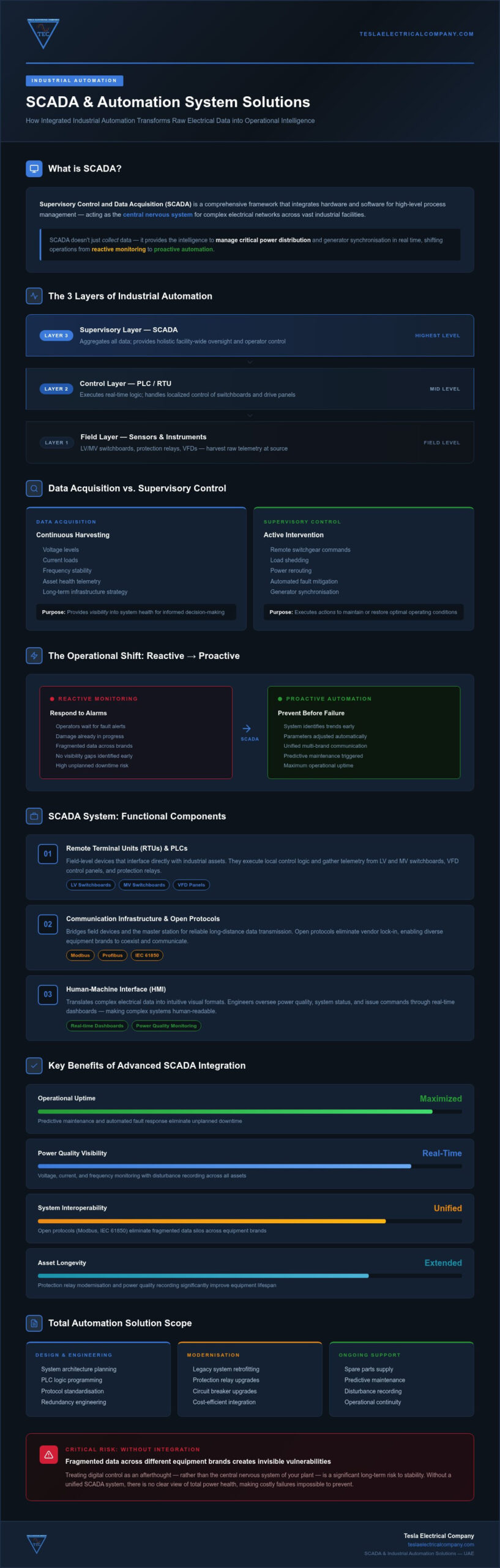
SCADA, or Supervisory Control and Data Acquisition, is a comprehensive framework designed to integrate hardware and software for high-level process management. In the industrial environments of the United Arab Emirates, where operational uptime is a critical metric, SCADA and automation system solutions act as the central nervous system for complex electrical networks. This architecture doesn’t just collect data; it provides the intelligence required to manage critical power distribution and generator synchronisation across vast facilities. For a foundational understanding of how this technology works, our detailed resource on what is a SCADA system and its core industrial automation principles provides an essential technical reference.
It’s vital to distinguish between the various layers of automation to understand their specific roles. While a PLC control system handles specific, localized logic and an HMI provides a visual interface for operators, SCADA serves as the overarching supervisory layer. It aggregates information from multiple PLCs and RTUs to provide a holistic view of the entire infrastructure. Modern industry is rapidly moving from reactive monitoring, where operators respond to alarms, to proactive automation, where the system identifies trends and adjusts parameters before a fault occurs. As these systems become more interconnected, understanding the implications of SCADA security for critical industrial infrastructure becomes an essential consideration for any facility expanding its automation footprint.
The Functional Components of a SCADA System
A robust SCADA architecture relies on several integrated layers to function effectively. These components must work in unison to maintain system stability:
- Remote Terminal Units (RTUs) and PLCs: These field-level devices interface directly with industrial assets like LV and MV switchboards, executing local logic and gathering telemetry.
- Communication Infrastructure: This layer bridges the gap between field devices and the master station using industrial protocols to ensure reliable data transmission over long distances.
- Human-Machine Interface (HMI): HMIs translate complex electrical data into intuitive visual formats, allowing engineers to oversee power quality and system status in real time.
Data Acquisition vs. Supervisory Control
Data acquisition involves the continuous harvesting of telemetry, such as voltage levels, current loads, and frequency stability. This steady stream of information informs long-term infrastructure strategy and allows for detailed asset health assessments. Supervisory control, conversely, is the mechanism that allows operators or automated algorithms to issue commands to remote switchgear or VFD control panels. This capability ensures that the system doesn’t just observe problems but actively mitigates them by rerouting power or shedding loads.
Monitoring provides the necessary visibility into system health, while control executes the specific actions required to maintain or restore optimal operating conditions.
The Architecture of Integrated Automation: From Field Devices to Logic
The architecture of a truly integrated industrial environment requires more than just high-level software; it demands a methodical alignment of physical hardware and digital logic. Professional SCADA and automation system solutions bridge three distinct layers: the field layer, the control layer, and the supervisory layer. At the field layer, instruments and sensors harvest raw data from LV and MV switchboards. This data flows into the control layer, where PLCs execute real-time logic, before finally reaching the supervisory layer for operator oversight.
Interoperability is the cornerstone of this architecture. Without the use of open protocols such as Modbus, Profibus, or IEC 61850, facilities often find themselves trapped by proprietary systems that can’t communicate with newer equipment. Standardising these protocols ensures that your VFD control panels and protection relays function as a single, unified entity. This integration is particularly vital in the UAE’s industrial sector, where diverse equipment brands must often coexist within the same power network to maintain operational continuity. However, this increased connectivity also expands the attack surface of your control environment, making a robust approach to protecting industrial control systems against modern cyber threats an integral part of any interoperability strategy.
Redundancy: Ensuring Zero-Fail Operation
In high-stakes environments like hospitals or data centres, a single point of failure in the control system is unacceptable. Achieving zero-fail operation requires a redundant system architecture that eliminates downtime during hardware malfunctions. Hot-standby configurations provide the highest level of security, where a secondary PLC or server remains synchronised with the primary unit, ready to take over in milliseconds. Cold-standby options offer a more cost-effective alternative for less critical processes. Implementing redundancy at both the PLC and server levels ensures that supervisory control remains intact even if a specific network node fails.
PLC Control Systems and Process Logic
The precision of industrial processes depends heavily on the sophistication of the underlying PLC logic. Proportional-Integral-Derivative (PID) control loops are essential for maintaining stability in variables like pressure, temperature, or frequency. When customising PLC logic for a Generator Synchronizing Control Panel, the system must manage complex load-sharing algorithms and automated load shedding across MV/LV switchboards. This logic ensures that as power demands fluctuate, the automation system makes instantaneous decisions to protect the network’s integrity and prevent total blackouts.
Legacy Modernisation: Retrofitting SCADA into Existing Electrical Systems
Many industrial facilities in the United Arab Emirates operate with robust but aging electrical assets that lack native digital connectivity. Replacing entire switchboard lineups simply to gain visibility is often financially unjustifiable and operationally disruptive. Retrofitting offers a strategic alternative, allowing for the integration of modern SCADA and automation system solutions without the capital expenditure of a full infrastructure replacement. By targeting specific communication-capable components, engineers can bridge the gap between legacy hardware and modern supervisory software.
The primary challenge in hybrid environments is managing the handshake between old physical hardware and new digital logic. This requires a deep understanding of both legacy protection schemes and modern industrial protocols. Successful modernisation doesn’t just add a layer of software; it revitalises the physical assets by providing the real-time data needed to manage them effectively. This approach extends the lifecycle of existing switchgear while providing the same level of oversight found in brand-new installations. Understanding what is a SCADA system at its architectural level is particularly valuable when planning how to layer modern supervisory intelligence over legacy infrastructure.
Protection Relay and Circuit Breaker Retrofits
The protection relay is the primary interface between the physical power flow and the digital control network. Upgrading obsolete electromagnetic or basic electronic relays to high-performance digital equivalents provides an immediate SCADA entry point for the entire panel. These modern relays don’t just protect; they communicate critical telemetry like harmonic distortion and fault records directly to the master station. Similarly, professional retrofitting of circuit breakers ensures these mechanical assets can be monitored and controlled remotely. This process involves:
- Replacing obsolete relays with digital units that support IEC 61850 or Modbus protocols.
- Installing auxiliary contacts and motor operators on legacy breakers for remote status feedback.
- Enhancing breaker longevity by replacing worn internal components during the digital upgrade.
A protection relay upgrade acts as the essential gateway that translates physical electrical events into digital data packets for SCADA processing.
Phased Implementation Strategies
System upgrades shouldn’t necessitate prolonged facility shutdowns. A phased approach allows for the systematic integration of SCADA nodes, prioritising critical feeders and generator synchronising panels first. This method ensures that the most vital parts of the infrastructure gain visibility immediately while lower-priority assets are integrated during scheduled maintenance windows. Managing a hybrid system requires a robust inventory of spare parts to support older hardware while the transition occurs. This methodical strategy minimises downtime and allows for the validation of each automation layer before proceeding to the next stage of the project.
Key Benefits of Advanced SCADA and Automation Solutions
Implementing robust SCADA and automation system solutions provides more than just a digital overview of your facility; it establishes a framework for continuous operational improvement. In many UAE industrial plants, electrical blind spots lead to unexpected outages that could’ve been avoided with better telemetry. Advanced automation eliminates these gaps by aggregating data from every node, from the main MV switchboard to individual motor starters. This visibility allows engineers to transition from reactive troubleshooting to a predictive maintenance model, where subtle changes in equipment behavior are flagged before they escalate into catastrophic failures.
Investing in sophisticated SCADA and automation system solutions is no longer a luxury but a necessity for maintaining a competitive edge in the regional market. These systems serve as the foundation for high-stakes decision-making, ensuring that every kilowatt of power is accounted for and every asset is performing within its optimal parameters. By unifying disparate components into a single management interface, you gain the ability to oversee complex processes with the precision that modern industrial standards demand.
Power Quality and Disturbance Recording
The integration of a Power Quality and Disturbance Recording System within the SCADA interface is a critical advantage for modern infrastructure. By tracking voltage dips, transients, and harmonic distortion in real time, operators can identify the root causes of equipment stress. High-stakes environments depend on this data to ensure that sensitive electronics and heavy machinery aren’t being degraded by poor power characteristics. This granular level of analysis directly correlates with equipment longevity, as it allows for the proactive adjustment of capacitor banks to maintain an optimal power factor. Reliable disturbance recording ensures that every event is captured for forensic analysis, preventing the repetition of costly electrical faults.
Operational Efficiency and ROI
Automation significantly enhances the return on investment by streamlining complex procedures that previously required manual intervention. For instance, an automated Generator Synchronizing Control Panel ensures that multiple power sources are aligned perfectly without human error, protecting the system from synchronization faults. Beyond protection, the use of a VFD Control Panel within the automation loop allows for precise motor speed control, which directly reduces energy consumption and mechanical wear. Centralised reporting further aids in regulatory compliance and internal energy audits, providing the documented proof required for local utility requirements in the UAE. These systems collectively reduce long-term O&M costs by minimising the need for on-site inspections and manual data logging.
To see how these technologies can be tailored to your specific infrastructure, explore our full range of SCADA & Automation Systems designed for the UAE market.
Tesla Electrical Company: Engineering Your Total Automation Solution
Tesla Electrical Company stands as a definitive partner for industries requiring robust SCADA and automation system solutions that are integrated directly into their electrical DNA. Our methodology moves beyond the simple installation of software, focusing instead on a total solution model. This encompasses everything from the initial design and manufacturing of LV and MV switchboards to the supply of critical spare parts and final system commissioning. By controlling the entire lifecycle of the project, we ensure that the communication protocols and physical hardware are perfectly aligned for maximum uptime. This end-to-end oversight eliminates the compatibility risks often associated with multi-vendor installations.
Our expertise in the UAE market allows us to navigate the specific technical and regulatory requirements unique to the region. We specialise in high-stakes environments where power reliability isn’t negotiable. From designing a Redundant System for critical data centres to implementing PLC control systems for complex process logic, our team delivers the technical depth required to manage sophisticated power networks. We don’t just provide components; we engineer the cohesive infrastructure that allows your facility to operate as an intelligent, self-monitoring entity.
Bespoke Control Panel Design
We take pride in the engineering of custom VFD control panels and generator synchronising control panels that meet the rigorous demands of the UAE industrial sector. Each build is designed to incorporate a Power Quality and Disturbance Recording System as a standard feature, providing the forensic data necessary for maintaining network stability. Our designs strictly adhere to national industrial standards, ensuring seamless integration with local utility grids and existing facility requirements. Key aspects of our design process include:
- Precision integration of PID control for stable industrial processes.
- Customised synchronising logic for multi-generator configurations.
- Factory acceptance testing to validate all SCADA and automation system solutions before site delivery.
Partnering for Long-Term System Reliability
Choosing Tesla Electrical Company means securing a long-term commitment to your facility’s reliability. Our human-centric engineering expertise allows us to design redundant system architectures that are both scalable and future-proof. Whether you’re retrofitting a legacy circuit breaker or commissioning a new automation layer, our team provides the steady hand required to manage high-stakes power requirements. We understand that industrial needs evolve; therefore, we architect our solutions with the flexibility to expand as your operational demands grow. Request a technical consultation with our engineering team to discuss your specific SCADA requirements and discover how our integrated approach can enhance your facility’s industrial intelligence.
Securing the Future of Industrial Power Infrastructure
The transition toward a fully integrated industrial environment is a strategic necessity for maintaining operational stability in the United Arab Emirates. We’ve explored how SCADA and automation system solutions serve as the essential link between field-level switchgear and high-level supervisory intelligence. By architecting systems that prioritise interoperability and real-time power quality monitoring, facilities can eliminate data fragmentation and significantly extend the lifecycle of their assets. Whether through the implementation of redundant systems for zero-fail operation or the methodical retrofitting of legacy protection relays, the goal remains the same: transforming raw telemetry into actionable industrial intelligence.
Tesla Electrical Company provides the seasoned expertise required to manage these complex transitions. As comprehensive LV and MV switchboard manufacturers and specialists in Generator Synchronising Control Panels, we deliver total solutions that encompass design, supply, and commissioning. Our commitment to high standards of excellence ensures that your infrastructure is not only robust today but also scalable for the demands of tomorrow. We stand ready to guide your facility through every stage of its digital evolution.
Consult our engineers for your custom SCADA and automation system solutions to begin modernising your facility with a partner you can trust. We look forward to helping you achieve a new standard of industrial reliability.
Frequently Asked Questions
What is the primary difference between SCADA and a PLC?
A PLC is the physical hardware that executes local logic and control at the machine level, while SCADA is the overarching supervisory system that aggregates data from multiple PLCs. While the PLC makes instantaneous decisions for a specific asset, SCADA provides the high-level interface for monitoring the entire facility. This hierarchy ensures that while the PLC manages immediate machine safety, the SCADA system manages the overall efficiency of the industrial process.
Can a SCADA system be integrated into an existing old electrical panel?
Yes, legacy electrical panels can be integrated into modern SCADA and automation system solutions through a methodical retrofitting process. By replacing older electromagnetic relays with digital protection units and adding communication-capable meters, you can harvest telemetry from aging assets. This approach allows for centralised oversight without the prohibitive cost of replacing entire switchboard lineups. It effectively extends the lifecycle of your existing physical infrastructure while providing the same visibility as a new installation.
How does SCADA improve power quality in industrial plants?
SCADA improves power quality by providing real-time visibility into electrical parameters such as harmonic distortion, voltage dips, and transients. By integrating a Power Quality and Disturbance Recording System, operators can identify the root causes of equipment stress immediately. This data allows for the automated adjustment of capacitor banks to maintain an optimal power factor. It prevents equipment degradation and ensures compliance with UAE utility standards, ultimately reducing the risk of unexpected component failure.
What are the benefits of using a redundant control system in automation?
A redundant control system eliminates single points of failure by providing a hot-standby secondary controller that takes over instantly if the primary unit fails. This architecture is essential for critical infrastructure like hospitals and data centres where even a millisecond of downtime is unacceptable. It ensures that supervisory control remains intact during hardware malfunctions or network interruptions. This setup provides a vital layer of operational security for high-stakes environments that can’t afford power loss.
Is SCADA only suitable for large-scale industrial facilities?
SCADA isn’t exclusive to large-scale plants; it’s a scalable solution that benefits any facility requiring precise control and data visibility. Small to medium-sized enterprises use automation to reduce manual logging and protect expensive machinery from electrical faults. The modular nature of these systems means you can start with a basic monitoring setup and expand your control capabilities as your operational requirements grow. It’s an investment in long-term reliability regardless of the facility’s current size.
How does retrofitting protection relays help with SCADA implementation?
Retrofitting protection relays serves as the primary digital gateway for SCADA implementation in legacy systems. Modern digital relays are equipped with built-in communication protocols that translate physical electrical events into data packets for the master station. By replacing obsolete relays, you gain the ability to monitor fault records and load profiles remotely. This upgrade provides the essential telemetry required for the SCADA master station to perform its supervisory functions and execute automated load shedding strategies.
What communication protocols are most common in SCADA and automation solutions?
The most common protocols for SCADA and automation system solutions include Modbus, Profibus, and IEC 61850. Modbus remains a standard for basic device communication, while IEC 61850 is the modern benchmark for substation automation and high-speed protection. Using these open protocols ensures interoperability between different equipment brands. It allows a unified management interface to control VFDs, PLCs, and switchboards across the entire industrial power network, preventing the limitations of proprietary, closed-loop systems.
What role do VFD control panels play in an automated system?
VFD control panels act as the execution layer for motor speed control within an automated loop. They allow the SCADA system to adjust motor outputs based on real-time process demands, which significantly reduces energy consumption and mechanical wear. Beyond control, VFDs serve as critical data points that report motor health and frequency stability back to the central interface. This integration enables more accurate predictive maintenance strategies and allows for finer tuning of complex industrial processes.
Disclaimer
Some content, images, text, or other materials on this website may have been created or assisted by artificial intelligence (AI).
While we review AI-generated content for accuracy and quality, we do not guarantee that all information is free from errors or omissions.
Content generated using AI is provided for informational purposes only and should not be solely relied upon without independent verification.
18 Responses