
Industrial resilience isn’t an off-the-shelf commodity; it’s a meticulously engineered outcome of custom electrical switchboards that bridge the gap between heavy power distribution and intelligent automation. You understand that unexpected system downtime caused by non-standard components or the friction of integrating legacy hardware with modern SCADA systems can paralyze an entire facility. It’s a high-stakes environment where compliance with evolving international safety standards, including the 2026 NEC updates on arc-flash labeling, remains a critical priority for any seasoned engineer. Maintaining stability requires more than just hardware; it demands a systematic approach to power quality and distribution.
This article provides the technical clarity you need to specify high-performance systems that secure your infrastructure against modern vulnerabilities. We’ll examine the rigorous engineering standards, generator synchronizing strategies, and professional retrofitting techniques required to achieve a seamless, future-proof distribution network. By exploring the integration of redundant architectures and specialized VFD controls, you’ll discover how to extend equipment life and ensure total operational reliability. We’ll guide you through the complexities of modernizing your LV and MV infrastructure with precision and comprehensive oversight.
Key Takeaways
- Distinguish between standard distribution boards and custom electrical switchboards that are specifically engineered to accommodate the unique load profiles and environmental demands of heavy industry.
- Explore how the integration of SCADA and automation systems provides the necessary intelligence for real-time monitoring and advanced process control within your power network.
- Discover how specialized retrofitting of circuit breakers and protection relays can effectively extend the lifecycle of your existing infrastructure while minimizing capital expenditure.
- Identify the critical engineering specifications required for Low Voltage (LV) and Medium Voltage (MV) architectures to support redundant systems and generator synchronizing.
- Understand the importance of a structured design lifecycle, from initial single-line diagrams to 3D modeling, to ensure every component is optimized for seamless site integration.
The Strategic Importance of Custom Electrical Switchboards in Industrial Infrastructure
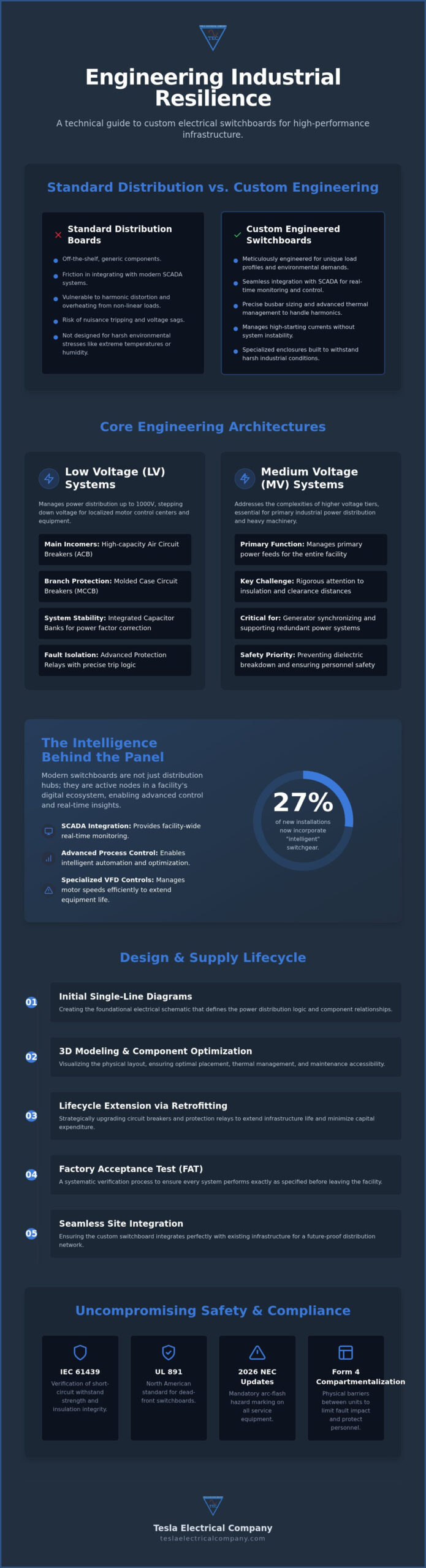
Custom electrical switchboards represent a fundamental departure from standardized distribution equipment. They function as engineered assets, meticulously designed to align with the specific operational profile of a complex facility. While a basic electrical switchboard overview describes the general routing of power, a custom-engineered solution for heavy industry accounts for precise load characteristics and environmental stresses. In the UAE’s high-stakes industrial sector, these systems are critical for maintaining power quality and preventing the catastrophic financial impact of system downtime. The 2026 market shift shows that nearly 27% of new installations now incorporate “intelligent” switchgear, moving beyond simple distribution to become active nodes in a facility’s digital ecosystem.
Meeting Complex Load Requirements
Industrial environments present non-linear loads that generate significant harmonic distortion, which can lead to overheating in standard components. Custom electrical switchboards address this by utilizing precise busbar sizing and advanced thermal management strategies tailored to the facility’s heat dissipation needs. We prioritize the analysis of high-starting currents from large motors. This ensures that the switchgear handles transient surges without triggering nuisance tripping or causing voltage sags that affect sensitive electronics. Reliability in the UAE requires specialized enclosures. These must withstand extreme ambient temperatures and high humidity, ensuring that the internal components remain within their optimal operating parameters despite harsh external conditions.
Compliance and Safety Standards
Rigorous adherence to international benchmarks such as IEC 61439 and UL 891 is essential for ensuring the longevity of industrial assemblies. These standards provide a framework for verifying that custom builds withstand short-circuit stresses and maintain insulation integrity. A vital component of our quality assurance is the Factory Acceptance Test (FAT). This systematic verification process ensures that every system performs exactly as specified in the original engineering design before it leaves the facility. Safety features are integrated at the architectural level. By implementing internal arc fault protection and compartmentalization up to Form 4, we provide physical barriers between functional units. This systematic separation limits the impact of internal faults, protecting personnel and minimizing the scope of potential repairs. Furthermore, the 2026 NEC updates now require arc-flash marking on all non-dwelling service equipment, a standard we integrate into every custom build to ensure full regulatory compliance.
Core Engineering Specifications: LV and MV Switchboard Architectures
Engineering custom electrical switchboards requires a deep understanding of the distinctions between Low Voltage (LV) and Medium Voltage (MV) architectures. LV systems typically manage distribution up to 1000V, whereas MV engineering addresses the complexities of higher voltage tiers required for primary industrial distribution. The integration of low voltage distribution boards within heavy infrastructure ensures that power is stepped down and routed safely to localized motor control centers. To maintain operational integrity, these boards utilize high-capacity Air Circuit Breakers (ACB) for main incomers and Molded Case Circuit Breakers (MCCB) for branch circuit protection. Advanced protection relays monitor these components, providing the necessary trip logic to isolate faults. We also incorporate capacitor banks directly into the switchboard design to manage power factor correction, which optimizes energy efficiency and stabilizes the network.
Medium Voltage (MV) Engineering Challenges
MV switchgear demands rigorous attention to insulation and clearance distances to prevent dielectric breakdown. When evaluating medium voltage switchgear suppliers, it’s vital to assess their capability in both Gas-Insulated (GIS) and Air-Insulated (AIS) configurations. GIS offers a compact footprint and protection against environmental contaminants. AIS remains a standard for facilities where space isn’t the primary constraint. Adhering to OSHA safety requirements regarding workspace access and the guarding of live parts is a mandatory part of our engineering workflow. Lead times for medium-voltage switchgear currently span 40 to 80 weeks as of May 2026, which emphasizes the need for early procurement and technical specification.
Redundancy and Critical Power Architecture
Resilience is built upon redundant power paths. Implementing dual-incomer systems with Automatic Transfer Switching (ATS) allows a facility to transition between utility power and backup generators seamlessly. Bus-couplers play a critical role here. They enable maintenance on one section of the board while keeping the other half energized, preventing total plant shutdowns. For mission-critical processes, we design for N+1 or 2N redundancy, ensuring that a single component failure doesn’t result in an operational halt. Given that lead times for large low-voltage custom electrical switchboards currently range from 35 to 62 weeks as of May 2026, early planning for these redundant architectures is essential. If your facility requires a specialized architecture, you can explore our approach to engineering low voltage distribution boards for heavy industry.
Integration and Automation: The Intelligence Behind the Panel
Modern industrial resilience depends on the data intelligence embedded within the power distribution network. A switchboard is only as effective as its ability to communicate and react to dynamic load conditions. Integrating SCADA and automation system solutions transforms custom electrical switchboards from passive hardware into proactive management tools. These systems provide real-time oversight, allowing engineers to identify inefficiencies or faults before they escalate into costly outages. This integration ensures that every component is monitored for performance, creating a transparent and reliable power distribution environment that supports long-term stability.
Within these custom enclosures, we often house sophisticated VFD control panels. These require specialized thermal management systems to dissipate the significant heat generated by high-frequency switching. Our designs prioritize cooling efficiency to prevent derating of the drives and ensure long-term equipment health. To ensure complete transparency, we integrate power quality and disturbance recording systems. These tools capture transient events and harmonic profiles, providing the data necessary to maintain adherence to the IEEE C37.20.2 standard for metal-clad switchgear. We also provide PLC control systems for process control PID, ensuring that your automation logic is as robust as the physical busbars.
Generator Synchronizing Control Panels
Managing a facility’s power requires precise coordination between utility feeds and onsite generation. We engineer the logic for complex generator synchronizing control panels that handle multiple units and seamless load sharing. By integrating industry-leading Woodward and ComAp controllers, we ensure that power transitions occur without disruption. These panels manage active and reactive power sharing while implementing automated load shedding protocols. This systematic approach protects critical industrial assets by prioritizing essential loads during a supply shortfall. It provides a sense of security for operators managing high-stakes technical requirements in the national UAE industrial sector.
PLC and SCADA Communication Protocols
The flow of information between the plant floor and the control room is the backbone of modern automation. Our custom electrical switchboards utilize robust communication protocols such as Modbus, Profibus, and Ethernet/IP to facilitate this data exchange. This connectivity allows for the remote monitoring of breaker status, energy consumption, and the thermal health of critical junctions. We also utilize digital twins during the design phase to simulate performance and streamline troubleshooting. This methodical oversight ensures that the physical assembly aligns perfectly with the digital control logic before onsite deployment, reinforcing a narrative of end-to-end expertise and holistic service delivery.
Retrofitting vs. New Fabrication: Maximizing System Longevity
Industrial facility managers often face a difficult choice when aging infrastructure begins to falter. Replacing an entire lineup of custom electrical switchboards involves significant capital expenditure and prolonged operational downtime. Retrofitting circuit breakers and protection relays offers a strategic alternative. This approach modernizes the system’s core while retaining the structural enclosure and the existing busbar network. By applying established industrial switchboard design principles, engineers can enhance reliability without the logistical burden of a total teardown. Modernization typically provides a superior return on investment by extending the asset’s service life at a fraction of the cost of new fabrication.
The Process of Circuit Breaker Retrofitting
Retrofitting begins with a rigorous assessment of obsolete Air Circuit Breakers (ACBs). These are replaced with modern, high-performance units that offer improved breaking capacities and digital connectivity. We prioritize mechanical alignment to ensure that new components interface perfectly with the legacy busbar architecture. Upgrading protection relays is equally vital. Modern relays improve fault detection sensitivity and enable the communication protocols described in previous sections. This systematic approach ensures that modernized internals function reliably within the existing framework, providing a sense of security for high-stakes industrial operations. For a structured framework on evaluating your legacy assets against current NEC 2026 requirements, our comprehensive guide on upgrading old electrical switchgear provides the technical checklist your maintenance team needs.
When to Choose Full Modernization
Specific indicators suggest that retrofitting might no longer be a viable path. End-of-life signals such as extreme thermal stress on the main busbars or a total scarcity of specialized spare parts often necessitate the installation of new custom electrical switchboards. If your facility requires a transition to a redundant system architecture to support mission-critical growth, full modernization is the logical path forward. We’ve seen targeted retrofits extend the life of industrial plants by 15 years or more. However, the decision must always be led by engineering rigor and data. If your infrastructure is nearing its operational limit, request a professional retrofit feasibility study to determine the most resilient path for your facility.
Partnering for Excellence: The Design and Supply Lifecycle
The lifecycle of high-performance custom electrical switchboards extends far beyond the assembly line. It requires a consultative partnership that prioritizes engineering rigor from the conceptual phase through to on-site commissioning. Tesla Electrical Company operates as a “Total Solution” provider, managing the intricate transition from initial single-line diagrams (SLD) to detailed 3D modeling. This methodical progression ensures that every spatial constraint and electrical requirement is addressed before fabrication begins. Our focus on national UAE industrial infrastructure allows us to provide localized expertise that global OEMs often lack, ensuring your power distribution system is optimized for regional conditions and specific load profiles.
The Engineering Consultation Phase
We initiate every project with collaborative site surveys to understand the unique operational constraints of your facility. This data informs the development of custom PLC control systems for process control PID, allowing for precise regulation of industrial variables. Our engineering team works as a mentor-figure, guiding you through the complexities of integrating modern controls with the existing hardware discussed in previous sections. Factory Acceptance Testing (FAT) serves as the ultimate proof of custom build quality, verifying that the assembly meets all performance and safety specifications before deployment. This level of oversight minimizes site integration risks and ensures immediate operational readiness for your infrastructure.
Long-term Support and Spare Parts
Bespoke systems require a strategic approach to maintenance and component availability. Because custom electrical switchboards utilize specific configurations of circuit breakers and protection relays, maintaining a dedicated spare parts inventory is essential for minimizing potential downtime. We provide specialized support to ensure that critical components for your redundant systems or generator synchronizing panels are always accessible. Professional maintenance prevents catastrophic switchgear failure by identifying thermal stress and mechanical wear before they lead to a system trip. Our commitment to your facility’s resilience includes providing the technical oversight necessary to manage your power infrastructure throughout its entire operational life.
Consult with Tesla Electrical Company for your next custom switchboard project to secure an engineered solution backed by national technical support and industry-leading expertise.
Securing the Future of Industrial Power Distribution
Engineering for resilience requires a transition from passive distribution to active, intelligent power management. We’ve explored how the integration of advanced SCADA systems and redundant architectures transforms custom electrical switchboards into the backbone of a reliable facility. Whether you’re evaluating the complexities of medium-voltage specifications or calculating the lifecycle benefits of professional circuit breaker retrofitting, the priority remains the same: minimizing risk through technical rigor. A systematic approach to power quality and synchronization doesn’t just protect hardware; it secures your operational continuity in an increasingly demanding market.
Achieving this level of stability requires a partner who understands the nuances of the UAE industrial sector and the precision required for high-stakes infrastructure. With expertise in Woodward and ComAp integration alongside specialized retrofit services for systems from ABB and Schneider Electric, we provide the comprehensive oversight your project demands. Partner with Tesla Electrical Company for authoritative industrial switchboard engineering and ensure your distribution network is prepared for the challenges of tomorrow. It’s time to build a foundation of engineering excellence that supports your facility’s long-term success.
Frequently Asked Questions
What is the typical lead time for custom industrial switchboards in 2026?
Lead times for custom electrical switchboards are currently extended due to high demand and raw material constraints. As of May 2026, large low-voltage systems (1,200A+) typically require 35 to 62 weeks for delivery. Medium-voltage switchgear experiences even longer wait times, ranging from 40 to 80 weeks. We recommend early procurement and collaborative planning to ensure that these critical path items don’t delay your construction or modernization timelines in the UAE.
Can custom switchboards be integrated with existing SCADA systems?
Modern custom electrical switchboards are designed for seamless integration with legacy and contemporary SCADA systems. We utilize open communication protocols such as Modbus, Profibus, or Ethernet/IP to facilitate real-time data exchange between the panel and your central control room. This connectivity allows for comprehensive monitoring of breaker status, energy consumption, and thermal health. It ensures that your power distribution network remains an active, intelligent component of your industrial automation architecture.
What are the main differences between LV and MV custom switchboards?
The primary distinction lies in voltage ratings and engineering complexity. Low Voltage (LV) boards typically operate up to 1000V and focus on localized distribution and motor control. Medium Voltage (MV) systems handle higher tiers required for primary distribution. MV engineering demands more rigorous insulation, specialized clearance requirements, and often utilizes gas-insulated (GIS) or air-insulated (AIS) configurations. Both systems require precise busbar sizing and thermal management to handle the non-linear loads common in heavy industry.
Is it possible to retrofit modern circuit breakers into an older custom switchboard?
It’s entirely possible and often strategically advantageous to retrofit modern circuit breakers into existing enclosures. Our professional retrofitting services replace obsolete Air Circuit Breakers (ACBs) with high-performance units from manufacturers like ABB or Schneider Electric. We ensure mechanical alignment and busbar compatibility to modernize your system without the high cost of a total replacement. This approach extends equipment life by 15 or more years while enhancing fault detection through upgraded protection relays.
What standards should custom electrical switchboards follow for industrial use?
Custom assemblies must adhere to recognized international benchmarks to ensure safety and reliability. Key standards include:
- IEC 61439 for low-voltage switchgear and controlgear assemblies.
- UL 891 for switchboards.
- IEEE C37.20.2 for metal-clad medium-voltage switchgear.
- NEC 2026 for updated arc-flash labeling and GFCI requirements.
Compliance is verified through Factory Acceptance Testing (FAT) to confirm that every build meets specific performance criteria before deployment.
How does a generator synchronizing panel integrate with a main switchboard?
A generator synchronizing control panel integrates with the main switchboard through a sophisticated logic controller, such as Woodward or ComAp. This system manages the frequency, voltage, and phase angle of multiple power sources to ensure seamless transitions and load sharing. It coordinates with the main incomers and bus-couplers to maintain stability during utility failure. This systematic integration allows for automated load shedding and prioritizing critical industrial assets to maintain operational continuity during outages.
What are the benefits of using VFD control panels within a custom switchboard?
Housing a VFD control panel within a custom enclosure provides centralized management of motor speeds and torque. This integration improves energy efficiency by matching motor output to actual process demand, reducing mechanical stress and extending equipment life. Custom switchboards designed for VFDs include specialized thermal management systems to dissipate the heat generated by high-frequency switching. This ensures that sensitive electronics remain within optimal operating parameters even in the harsh environmental conditions of the UAE.
How do capacitor banks improve the efficiency of industrial switchboards?
Capacitor banks improve efficiency by providing power factor correction directly at the distribution point. They offset the reactive power consumed by inductive loads, such as large motors and transformers, which reduces the total current drawn from the utility. This results in lower energy costs and reduced thermal stress on the switchboard’s internal busbars and cables. By stabilizing the voltage profile, capacitor banks ensure that your power distribution infrastructure operates at peak performance with minimal losses.
Disclaimer
Some content, images, text, or other materials on this website may have been created or assisted by artificial intelligence (AI).
While we review AI-generated content for accuracy and quality, we do not guarantee that all information is free from errors or omissions.
Content generated using AI is provided for informational purposes only and should not be solely relied upon without independent verification.