
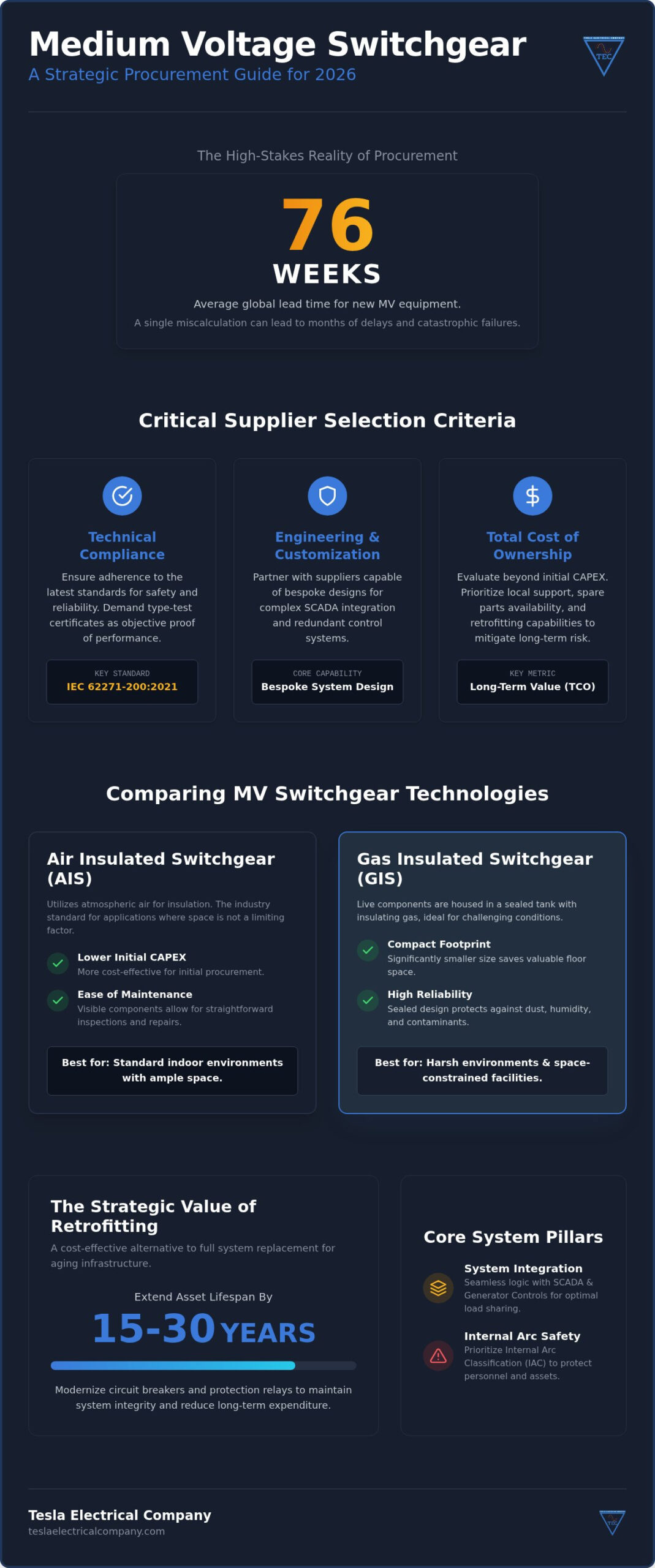
With average lead times for new equipment currently reaching 76 weeks, the process of evaluating medium voltage switchgear suppliers has become a high-stakes strategic challenge. You likely recognize that a single miscalculation in technical compatibility or supplier reliability can lead to catastrophic equipment failure or months of integration delays. It’s a reality where the difference between a functional system and a costly liability often rests on the vendor’s ability to synchronize new hardware with legacy SCADA and generator control systems.
This 2026 guide provides the rigorous framework you need to master both the technical and commercial criteria for a successful procurement. We promise to clarify how to achieve a compliant, reliable MV system that reduces your total cost of ownership while maintaining the highest safety standards. Our analysis previews the essential evaluation metrics for the current year; this includes the shift toward SF6-free alternatives, the impact of the latest IEC 62271-200:2021 standards, and the strategic role of circuit breaker retrofitting in modernizing aging infrastructure.
Key Takeaways
- Audit medium voltage switchgear suppliers based on their engineering capacity to meet the rigorous IEC 62271-200:2021 standards and national UAE regulatory requirements.
- Compare the operational benefits of AIS, GIS, and SIS technologies to select the insulation medium that best suits your facility’s spatial limits and environmental conditions.
- Mitigate operational risks by prioritizing Internal Arc Classification (IAC) and rapid-extinguishing safety systems to protect both personnel and critical assets.
- Analyze the strategic value of retrofitting circuit breakers and protection relays as a cost-effective alternative to full system replacement in aging infrastructure.
- Master the logic behind integrating MV switchgear with generator synchronizing control panels and SCADA systems for optimal load sharing and power reliability.
Critical Selection Criteria for Medium Voltage Switchgear Suppliers
Selecting the right Switchgear is a decision that dictates the safety and operational continuity of your facility for decades. In 2026, the landscape for medium voltage switchgear suppliers is defined by a clear divide between hardware vendors and true integration partners. A reliable supplier doesn’t just deliver a cabinet; they provide a verified system capable of withstanding the rigorous demands of industrial power distribution while adhering to national UAE standards.
Technical Compliance and Certification
Reliability begins with uncompromising adherence to current international benchmarks. You must verify that any prospective supplier complies with IEC 62271-200:2021+AMD1:2024 (Edition 3.1), which is the active standard for AC metal-enclosed switchgear. It’s essential to demand type-test certificates for all primary components, including vacuum circuit breakers and protection relays. These documents provide the only objective proof that the equipment can handle rated short-circuit currents and internal arcing faults. Furthermore, ensuring the equipment meets national grid codes is vital for seamless utility interconnection and regulatory approval.
Engineering Depth and Customisation
Standardized solutions often fail to address the complexities of modern industrial plants. A supplier’s engineering capacity is best measured by their ability to execute bespoke industrial switchboard design tailored to specific environmental and spatial constraints. This expertise is particularly critical when your project requires redundant control system architectures or sophisticated SCADA integration. You should look for partners who provide comprehensive documentation, including detailed wiring diagrams and communication protocol maps, to ensure the switchgear functions as a cohesive part of your automation ecosystem.
Total Cost of Ownership and Support
While the initial capital expenditure is a significant factor, the Total Cost of Ownership (TCO) reveals the true value of a contract. With current global lead times for new units averaging 76 weeks, a supplier’s ability to provide local technical support and a robust inventory of spare parts is a critical risk mitigation factor. A superior supplier offers a structured maintenance roadmap and has the specialized skills to perform retrofits on aging infrastructure. This capability allows you to extend the life of existing assets by 15 to 30 years, significantly reducing long-term expenditure while maintaining system integrity. Prioritizing suppliers with a national UAE presence ensures that technical assistance is available when high-stakes troubleshooting is required.
Comparing MV Switchgear Technologies: AIS vs. GIS vs. SIS
Choosing the appropriate insulation technology is a foundational decision that influences both immediate capital expenditure and long-term operational costs. Professional medium voltage switchgear suppliers categorize these systems based on their insulation medium, each offering distinct advantages for specific industrial applications. Whether you’re managing a space-constrained urban substation or a sprawling industrial complex, the choice between AIS, GIS, and SIS determines your facility’s physical footprint and future maintenance requirements.
Air Insulated Switchgear (AIS) Applications
Air Insulated Switchgear utilizes atmospheric air as the primary insulation medium and typically operates across the 3.3kV to 40.5kV voltage range. This technology remains the industry standard for facilities where floor space is not a restrictive factor. It’s favored for its lower initial capital expenditure and the ease with which technicians can perform visual inspections of the busbars and connections. Because the components are separated by air, the enclosures are naturally larger; this facilitates straightforward maintenance and component replacement without the need for specialized gas-handling equipment. It’s a reliable, transparent solution for standard indoor environments where accessibility is a priority.
Gas Insulated Switchgear (GIS) for Harsh Environments
Gas Insulated Switchgear provides a robust solution for environments plagued by high humidity, dust, or chemical contaminants. By housing all live components in a hermetically sealed tank filled with insulating gas, GIS offers maximum protection against environmental degradation and oxidation. One of its most compelling advantages is a significant footprint reduction, often requiring up to 70% less space than traditional AIS counterparts. This compactness makes it the preferred choice for urban centers or offshore platforms where every square meter is at a premium. While the initial investment is higher, the reduced maintenance needs and enhanced reliability in harsh conditions often result in a lower lifecycle cost.
Solid Insulated Switchgear (SIS) and Hybrid Options
Solid Insulated Switchgear is gaining traction for specific industrial loads where a maintenance-free approach is paramount. By encapsulating high-voltage components in solid materials like epoxy resin, SIS eliminates the risk of gas leaks and provides excellent dielectric strength. This technology is particularly effective for underground installations or locations with extreme temperature fluctuations. For projects that require a balance between compactness and accessibility, hybrid solutions combine elements of both air and gas insulation. These systems allow for future expansions without the extensive footprint of a full AIS lineup. When evaluating these options, consulting with an expert in MV and LV switchboards ensures that your technology choice aligns with your specific operational goals.
Safety and Reliability: Internal Arc Protection and Monitoring
Safety in medium voltage environments is not a secondary feature; it’s a fundamental engineering requirement. Leading medium voltage switchgear suppliers prioritize Internal Arc Classification (IAC) to ensure that, in the event of a fault, the explosive energy is directed away from personnel. This involves the use of reinforced enclosures and strategically placed pressure relief flaps that vent hazardous gases safely. Beyond physical containment, modern systems utilize rapid-extinguishing technology. These systems detect the specific light and pressure signatures of an arc flash, triggering a high-speed earthing switch to quench the arc in milliseconds. This process prevents catastrophic damage to the switchboard and ensures the safety of nearby operators.
Advanced Fault Protection and Relay Logic
Effective fault isolation relies on sophisticated relay logic and selective coordination. By utilizing high-speed protection relays, we minimize equipment damage and prevent widespread outages. Selective coordination ensures that only the protective device nearest to the fault operates, maintaining power to the rest of the network. This involves configuring specific protection curves for overcurrent and earth fault detection. Tesla Electrical Company implements redundant relay logic for critical industrial loads, ensuring that a single component failure doesn’t compromise the entire protection scheme. When vetting medium voltage switchgear suppliers, the presence of these high-speed isolation systems should be a non-negotiable requirement.
Power Quality and Condition Monitoring
Reliability is maintained through continuous oversight rather than periodic inspection. Modern switchgear integrates Power Quality and Disturbance Recording Systems to capture high-resolution data during transient events. This post-event analysis is crucial for identifying root causes and preventing recurrence. We also employ continuous thermal monitoring of busbars and cable terminations, using non-contact infrared sensors to detect hotspots before they lead to failure. By architecting SCADA and automation system solutions for modern industrial infrastructure, we enable predictive maintenance strategies. This integration allows operators to monitor the health of their MV assets in real-time, shifting from reactive repairs to a proactive, data-driven management model that significantly reduces the risk of unplanned downtime.
Modernisation vs. Replacement: The Strategic Value of Retrofitting
Facing the 76-week lead times currently affecting the procurement of new equipment in 2026, the “repair vs. replace” dilemma has become a central strategic decision for industrial facility managers. While full replacement offers a clean slate, it often involves prohibitive costs and extensive civil works that can paralyze production for weeks. Targeted retrofitting provides a sophisticated alternative. By upgrading critical components, you can achieve modern performance levels at 40% to 70% of the cost of a new installation. This approach extends the operational life of your switchgear by 15 to 30 years while ensuring compliance with current IEEE C37.59 standards for modified equipment.
Circuit Breaker Retrofit Services
Many legacy systems still rely on obsolete oil or air circuit breakers that present significant maintenance and safety risks. Leading medium voltage switchgear suppliers offer specialized services to replace these units with modern vacuum or SF6 circuit breakers. This upgrade improves short-circuit ratings and enhances the reliability of the entire distribution network. A precision-engineered retrofit kit maintains the original enclosure integrity while upgrading performance to modern standards. This method minimizes plant downtime, as the mechanical and electrical interfaces are designed to fit perfectly within the existing cubicle, eliminating the need for major busbar modifications.
Protection Relay Modernisation
Reliability is often compromised by aging electromagnetic relays that lack the precision and logic required for complex 2026 power systems. Modernizing these components involves transitioning to numerical protection relays that support the IEC 61850 communication protocol. This shift enables seamless SCADA integration, providing operators with real-time data logging and remote monitoring capabilities. These numerical units offer superior fault recording and self-diagnostic features, which are essential for predictive maintenance strategies. If you’re struggling with component obsolescence or lack of spare parts for legacy systems, consider our Retrofit of Circuit Breakers and Protection Relays to restore system integrity without the burden of a full site overhaul.
Integrating MV Switchgear with Synchronisation and Automation
Many medium voltage switchgear suppliers treat their equipment as isolated hardware components. However, in complex industrial environments, the switchboard acts as the central execution point for a much larger automated ecosystem. Achieving true power stability requires a seamless synergy between the MV switchgear and the facility’s control logic. This integration ensures that the distribution system responds dynamically to load changes, grid fluctuations, and emergency power transitions. By adopting a “total system” approach, you move beyond mere procurement and toward a resilient infrastructure designed for end-to-end performance.
Generator Synchronisation and Load Management
Captive power plants and facilities with redundant backup requirements rely on precise synchronisation to avoid catastrophic busbar faults. The MV switchgear must facilitate seamless transitions between the utility grid and local generation. We achieve this through the implementation of advanced Woodward or ComAp controls within our Generator Synchronizing Control Panel. These systems manage the complex logic of load sharing and shedding; this ensures that critical processes remain powered while non-essential loads are dropped during a supply shortage. Additionally, the integration of capacitor banks at the MV level provides essential power factor correction, which reduces energy waste and improves overall system capacity.
The Role of SCADA in MV Infrastructure
In 2026, a switchboard without digital visibility is a significant blind spot in your operations. Centralised SCADA & Automation Systems provide real-time visualisation of energy flows, breaker statuses, and protection relay health across national-scale facilities. This level of oversight allows for rapid disturbance recording and analysis, which is vital for maintaining the safety standards we established in earlier chapters. Integration with a VFD Control Panel further enhances efficiency by managing the high inrush currents of large motors during startup. Tesla Electrical Company’s methodology prioritizes this holistic view, distinguishing us from typical medium voltage switchgear suppliers by taking total responsibility from the initial design phase through to final commissioning. This ensures that every component, from the PLC control systems to the physical switchgear, functions as a unified and reliable unit. A complete understanding of your facility’s power hierarchy — including how low voltage distribution boards interface with MV systems — is essential for achieving this end-to-end integration.
Securing Your Industrial Infrastructure for 2026 and Beyond
Evaluating the requirements of medium voltage switchgear suppliers requires a shift from simple hardware procurement to a strategic partnership. You’ve seen how the choice between AIS and GIS technologies, combined with rigorous internal arc protection, forms the bedrock of a safe facility. Stability is paramount. In an era of 76-week lead times, the ability to modernize existing infrastructure through targeted retrofitting is no longer just an option; it’s a competitive necessity for maintaining operational continuity.
Reliability is achieved when your switchgear operates in perfect synchrony with your automation and generator controls. This holistic approach ensures that your power distribution system remains resilient against disturbances while providing clear data for predictive maintenance. By prioritizing technical compliance and engineering depth, you protect both your personnel and your long-term capital investment.
Consult with Tesla Electrical Company for Bespoke MV Switchgear and Retrofit Solutions. As specialists in Generator Synchronizing Control Panels and comprehensive circuit breaker retrofit services, we provide national engineering support for industrial infrastructure across the UAE. We look forward to engineering a stable and secure future for your operations.
Frequently Asked Questions
What is the typical lifespan of medium voltage switchgear?
Typically, the operational lifespan of medium voltage switchgear is between 25 and 30 years. Regular maintenance and professional retrofitting can extend this period by another 15 to 30 years. When evaluating medium voltage switchgear suppliers, it’s essential to consider the availability of spare parts for this duration. Industrial environments with high humidity might see shorter lifespans if the equipment isn’t properly protected, making routine thermal imaging and insulation testing vital.
How do I choose between AIS and GIS for an industrial plant?
The choice depends on your environmental risk and available space. Air Insulated Switchgear (AIS) is suitable for standard indoor settings where maintenance accessibility is a priority. Gas Insulated Switchgear (GIS) is necessary for sites exposed to high humidity or salt air, as the sealed environment prevents internal corrosion. While GIS offers a more compact design, AIS remains popular for its lower upfront cost and simpler inspection requirements during routine service intervals.
Is it better to retrofit an old circuit breaker or buy a new switchgear unit?
Retrofitting is the superior option when you need to upgrade performance without disturbing existing cabling and foundations. This process replaces aging circuit breakers with modern vacuum units while keeping the original enclosure intact. It is particularly effective for addressing component obsolescence when spare parts are no longer available. By choosing a retrofit, you avoid the lengthy lead times for new units from medium voltage switchgear suppliers and significantly reduce the total duration of your site outage.
What are the essential safety standards for MV switchgear in the UAE?
Safety in the UAE is governed by strict adherence to the IEC 62271-200 standard and national utility grid codes. Every switchboard must undergo Internal Arc Classification (IAC) testing to ensure operator protection during a fault. It’s vital to confirm that your equipment is approved by the relevant national authorities. This involves verifying type-test certificates for short-circuit endurance and dielectric strength, which ensures the system can handle the specific demands of the local network.
Can MV switchgear be integrated with existing SCADA systems?
Yes, integration is achieved through digital protection relays and gateways using the IEC 61850 or Modbus protocols. This allows your existing SCADA system to pull real-time data on voltage, current, and switch status. Modern switchgear acts as an intelligent node within your network, providing the high-resolution disturbance data needed for post-event analysis. Proper integration ensures that your automation logic can respond instantly to faults, protecting your downstream industrial loads from damage.
How often should industrial medium voltage switchgear be maintained?
Industrial MV switchgear requires a comprehensive inspection every 12 to 24 months to ensure long-term reliability. Tasks include checking the integrity of insulation, testing the timing of circuit breakers, and verifying relay settings. In harsh environments or high-switching applications, more frequent intervals are recommended. Proactive maintenance helps identify issues like partial discharge or loose connections before they lead to catastrophic failure, thereby extending the equipment’s life and reducing the total cost of ownership.
What are the advantages of using vacuum circuit breakers in MV applications?
Vacuum circuit breakers (VCBs) are preferred for medium voltage applications because they offer exceptional arc-quenching capabilities within a sealed chamber. This design prevents contact oxidation and eliminates the need for insulating gas or oil, making them virtually maintenance-free. VCBs are capable of thousands of operations without degradation, which is essential for high-cycle industrial processes. Their high dielectric strength and rapid recovery rate ensure that faults are cleared quickly, protecting the integrity of your power distribution system.
How does a generator synchronizing panel interact with MV switchgear?
The synchronizing panel monitors the electrical parameters of both the generator and the live busbar. It sends precise close or trip signals to the MV switchgear’s circuit breakers only when the two sources are perfectly matched in frequency and phase. This coordination prevents massive mechanical stress on the generator. Once connected, the panel continues to communicate with the switchgear to manage active and reactive power sharing across the facility’s distribution network.
Disclaimer
Some content, images, text, or other materials on this website may have been created or assisted by artificial intelligence (AI).
While we review AI-generated content for accuracy and quality, we do not guarantee that all information is free from errors or omissions.
Content generated using AI is provided for informational purposes only and should not be solely relied upon without independent verification.
One Response