
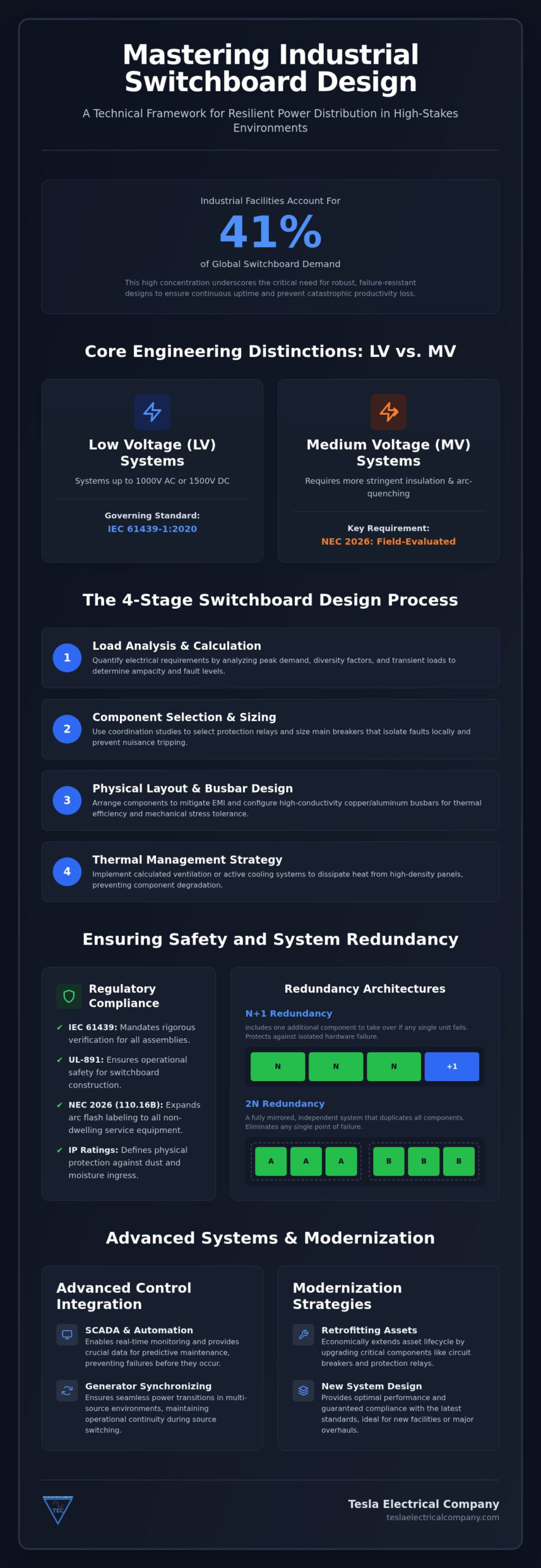
Industrial facilities account for 41% of global switchboard demand, yet a single engineering oversight can lead to catastrophic system failure and millions in lost productivity. You likely recognize that maintaining operational continuity depends on more than just high-quality components; it requires a sophisticated approach to industrial switchboard design that anticipates every potential point of failure. Navigating the transition to the IEC 61439-1:2020 standard and the expanded arc flash labeling requirements of NEC 2026 adds layers of complexity to an already high-stakes environment.
This comprehensive reference provides the technical framework you need to master core engineering principles and safety standards for resilient power distribution. We’ll examine the critical integration of SCADA and automation systems for real-time monitoring; you’ll also learn how to implement redundant system architectures that protect against unforeseen downtime. By the end of this guide, you’ll have a clear roadmap for designing LV and MV switchboards that offer both immediate performance and long-term reliability for the most demanding industrial applications.
Key Takeaways
- Identify the critical engineering distinctions between Low Voltage and Medium Voltage systems to establish a secure foundation for power management.
- Execute a methodical industrial switchboard design by conducting precise load analyses and selecting busbar configurations that optimize thermal efficiency.
- Master the integration of generator synchronizing control panels and SCADA logic to ensure seamless transitions in multi-source power environments.
- Implement N+1 or 2N redundant system architectures to eliminate single points of failure and protect critical infrastructure from downtime.
- Evaluate the technical and economic viability of retrofitting circuit breakers and protection relays to extend the lifecycle of existing assets.
Understanding Industrial Switchboard Design Fundamentals
An electric switchboard serves as the primary distribution point for power within a facility. It’s the central hub where protection, management, and distribution converge. In industrial switchboard design, the focus shifts from simple power routing to ensuring that complex machinery and process lines remain energized under varying load conditions. Reliability is the absolute priority in these high-stakes environments.
Engineering requirements change significantly based on voltage levels. Low Voltage (LV) design typically covers systems up to 1000V AC or 1500V DC, following the IEC 61439-1:2020 standard. Medium Voltage (MV) engineering requires more stringent insulation and arc-quenching capabilities. Under NEC 2026 standards, MV equipment is now required to be listed or field-evaluated. This distinction dictates component selection, busbar sizing, and clearance distances to ensure system integrity. When procuring MV equipment, carefully evaluating medium voltage switchgear suppliers against current IEC 62271-200:2021 compliance and lead time commitments is essential to avoiding costly integration delays.
Industrial facilities represent approximately 41% of global switchboard demand. This high concentration is due to the necessity of continuous uptime. A well-engineered switchboard prevents cascading failures. It acts as a shield for downstream assets like Motor Control Centers and sensitive PLC control systems. Without a robust industrial switchboard design, the risk of unplanned downtime increases, which directly impacts a facility’s bottom line.
The Functional Purpose of Industrial Switchgear
A switchboard performs several critical roles beyond basic power routing. It facilitates the safe isolation of electrical circuits, allowing technicians to perform maintenance on specific sections without a total plant shutdown. It also ensures the efficient distribution of power to various industrial loads. By integrating power quality and disturbance recording systems, the switchboard provides the data needed for predictive maintenance. This proactive strategy helps identify potential issues before they escalate into catastrophic failures.
Regulatory Compliance and Safety Standards
Compliance with international standards like IEC 61439 and UL-891 is mandatory for operational safety. The industry has eliminated the distinction between Type-Tested Assemblies and Partially Type-Tested Assemblies. Now, all assemblies must meet rigorous verification requirements to handle high-fault-current environments. Safety also involves physical protection through IP ratings, which define resistance to dust and moisture. Additionally, NEC 2026 has expanded arc flash labeling requirements. Section 110.16(B) now mandates arc flash marking on all non-dwelling service equipment, regardless of amperage, to protect personnel during live-line work.
The Engineering Process: From Load Analysis to Architecture
Effective industrial switchboard design begins with a rigorous quantification of the facility’s electrical requirements. It’s not enough to simply aggregate nameplate ratings; engineers must account for diversity factors and peak demand profiles to ensure the architecture handles transient loads without compromising stability. This process determines the necessary ampacity and fault levels that define the board’s structural and electrical limits. A failure to calculate short-circuit withstand ratings accurately can result in catastrophic mechanical failure during a fault event.
Load Calculation and Component Selection
Calculating peak demand requires a granular understanding of industrial machinery cycles. Engineers utilize coordination studies to select protection relays that isolate faults locally, preventing widespread outages. Sizing main breakers and feeder sections incorrectly leads to nuisance tripping, which halts production. Adherence to OSHA electrical standards ensures these selections prioritize personnel safety and equipment longevity. This technical rigor allows for the precise selection of components that match the specific operational profile of the plant. We prioritize the integration of advanced protection logic to ensure that every breaker operates within its safe thermal and magnetic limits.
Physical Layout and Thermal Management
The internal arrangement of a switchboard must address both electromagnetic interference (EMI) and heat dissipation. High-density control panels generate significant thermal energy that requires calculated ventilation or active cooling to prevent component degradation. Busbar materials, typically high-conductivity copper or aluminum, are configured to maximize thermal efficiency and withstand the mechanical stresses of a short-circuit event. Proper spacing and insulation are critical to prevent phase-to-phase arcing in compact enclosures.
Designing for scalability is a core requirement for modern facilities. A modular architecture allows for future plant expansions without requiring a total system overhaul. Integrating a VFD Control Panel into the broader distribution framework requires careful consideration of harmonic distortion and cable routing to maintain power quality. Ergonomic access must also be maintained; safe operator interfaces and clear labeling reduce the risk of human error during critical switching operations. A disciplined approach to industrial switchboard design ensures that the finished assembly is not just a collection of parts, but a cohesive, resilient system built for decades of service. If you’re planning a new facility, consulting with experts in custom switchboard engineering can prevent costly design revisions later in the project lifecycle.
Integrating Advanced Control and Synchronizing Systems
Sophisticated industrial switchboard design must account for the increasing complexity of multi-source power environments. Modern facilities don’t just consume grid power; they manage a delicate balance between utility supply and onsite generation. This requires a Generator Synchronizing Control Panel that acts as the intelligent brain of the distribution network. These panels govern the transition between sources, ensuring that the facility remains energized even during utility instability.
Generator Synchronization Logic
Precision is mandatory when paralleling multiple power sources. The control system must perfectly match frequency, voltage, and phase angles before closing the circuit breaker to prevent massive mechanical stress or electrical failure. We utilize industry-leading Woodward and ComAp controllers to achieve this synchronization with micro-second accuracy. These systems also facilitate black-start capabilities, ensuring that critical industrial plants can recover from a total power loss without external assistance. By automating this process, we eliminate the risks associated with manual synchronization and human error.
Beyond simple switching, Automatic Mains Failure (AMF) logic monitors the grid’s health and initiates generator startup the moment parameters drift outside acceptable limits. Once online, load sharing systems optimize fuel efficiency and engine life by distributing the electrical demand proportionally across available units. This prevents “wet stacking” in diesel engines and ensures that every generator operates within its peak efficiency curve, significantly reducing long-term maintenance costs.
SCADA and PLC Integration
A resilient switchboard is no longer an isolated asset; it’s a data-rich node in the plant’s digital ecosystem. By architecting SCADA and automation system solutions, we provide real-time oversight of every electrical parameter. This involves mapping hundreds of I/O points to a central interface, allowing operators to monitor busbar temperatures, breaker statuses, and harmonic levels from a remote control room. This transparency is vital for identifying emerging faults before they cause a shutdown.
Implementing PLC control systems allows for complex process PID loops that can automatically shed non-essential loads or adjust power factor correction in real-time. Data integrity is maintained through robust communication protocols like Modbus and Profibus, ensuring that the control logic receives accurate, uncorrupted information from every corner of the facility. This level of integration represents the pinnacle of modern industrial switchboard design, transforming a passive enclosure into an active, self-optimizing power manager that supports the facility’s broader operational goals.
Safety Standards and System Redundancy
In critical industrial infrastructure, the cost of a single point of failure is often measured in millions of dollars and compromised safety. A robust industrial switchboard design must prioritize redundancy as a foundational engineering requirement rather than an optional upgrade. Implementing N+1 or 2N redundancy in control circuits and power paths ensures that if one component fails, the backup immediately sustains the load. This architecture is essential for facilities where a total power loss is unacceptable.
Architecting for Fault Tolerance
Designing for fault tolerance requires a methodical approach to system layout. We implement redundant power supplies for control and protection circuits to ensure the brains of the switchgear remain active during localized faults. Key strategies for enhancing system resilience include:
- Dual-Bus Configurations: This architecture allows for seamless maintenance on one bus while the other maintains plant operations, ensuring high availability.
- Protection Relay Coordination: Relays are programmed to isolate specific faults with surgical precision, preventing a minor issue from triggering a total system shutdown.
- High-Reliability Components: Standardizing on parts with high Mean Time Between Failures minimizes the risk of spontaneous component failure.
Arc flash mitigation is another critical layer of modern industrial switchboard design. We incorporate passive barriers and active arc-quenching technologies to protect personnel and minimize equipment damage. These safety measures are designed to exceed minimum regulatory requirements, providing a superior level of protection for both operators and assets.
Monitoring Power Quality and Disturbances
System reliability isn’t just about surviving failures. It’s about understanding the health of the electrical environment in real-time. Integrating a Power Quality and Disturbance Recording System allows for post-event forensic analysis, helping engineers identify the root cause of transients or voltage dips. High-density industrial environments with heavy VFD loads often suffer from harmonics that degrade equipment over time. We utilize Capacitor Banks for power factor correction and voltage stability, ensuring the grid remains clean and efficient. Continuous monitoring of these parameters provides early warning signs of component wear, allowing for intervention before a failure occurs. If your facility requires a high-availability Redundant System to protect against downtime, our engineering team can design a solution tailored to your specific fault tolerance requirements.
Modernization Strategies: Retrofitting vs. New Design
Deciding between a complete system replacement and a targeted retrofit is a fundamental strategic challenge for facility managers. While a new industrial switchboard design offers the latest in integrated technology, retrofitting often provides a more efficient path to modernization without the extensive civil works or prolonged shutdowns associated with a full overhaul. We evaluate the lifecycle of your existing gear to determine if the structural integrity of the enclosures and busbars justifies a second life through component upgrades. This assessment identifies whether the equipment can still meet the fault-level requirements of a modern grid or if the underlying architecture has reached its technical limit. For facilities sourcing new MV equipment as part of this process, our 2026 guide to evaluating medium voltage switchgear suppliers outlines the critical technical and commercial criteria to ensure procurement decisions support long-term reliability.
The Retrofit Engineering Process
The engineering focus during a retrofit centers on the seamless integration of modern components into legacy environments. This involves custom-engineering adapter kits that allow new, high-performance circuit breakers to interface with existing busbar connections. We prioritize the Retrofit of Circuit Breakers and Protection Relays to transition from aging electromechanical systems to advanced digital protection. Digital relays offer superior accuracy and communication capabilities, allowing for better integration with plant-wide monitoring systems. This process includes verifying dielectric integrity and assessing the physical condition of the busbars to ensure the modernized assembly meets current safety benchmarks. Phased execution allows for these upgrades to occur during scheduled maintenance windows; this effectively minimizes operational downtime while steadily improving system reliability.
Future-Proofing Industrial Switchboards
A forward-looking industrial switchboard design incorporates features that simplify future maintenance and expansion. Modularity is key; it ensures that future component generations can be integrated without requiring structural modifications. We often incorporate IoT-enabled sensors for real-time thermal and health monitoring, providing an early warning system for loose connections or overloaded circuits. This proactive data collection supports a transition from reactive to predictive maintenance schedules. Comprehensive documentation, including updated schematics and digital twin models, remains a cornerstone of long-term facility management. Finally, ensuring a reliable supply of Spare parts is essential for maintaining system readiness over the next twenty years. This methodical approach to modernization extends the functional life of critical infrastructure while significantly enhancing its protective capabilities.
Advancing Industrial Power Reliability Through Engineering Excellence
Mastering the complexities of industrial switchboard design requires a disciplined integration of power distribution, automated synchronization, and stringent safety standards. We’ve explored how a methodical engineering process, from initial load analysis to the implementation of redundant system architectures, ensures your facility remains resilient against unforeseen failures. Whether you’re developing a new Medium Voltage distribution hub or modernizing legacy infrastructure through circuit breaker retrofits, the goal remains the same: absolute stability and operational continuity.
A high-performance switchboard is more than an enclosure; it’s an intelligent manager of your plant’s energy ecosystem. By prioritizing precision in generator synchronization and real-time SCADA oversight, you protect your critical assets from the risks of downtime and electrical disturbances. This holistic approach to engineering provides the security required for high-stakes industrial operations.
Consult with Tesla Electrical Company for Your Custom Switchboard Engineering Needs. As established experts in redundant system architecture and specialists in Generator Synchronizing Control Panels, we provide comprehensive LV and MV engineering capabilities. Our team is ready to help you navigate your next technical milestone with confidence and precision.
Frequently Asked Questions
What is the primary difference between a switchboard and switchgear?
A switchboard is a large single panel or assembly used to route power to smaller downstream circuits, typically operating at low to medium voltages. Switchgear is a more comprehensive term that includes the combination of switches, fuses, and circuit breakers used to control and isolate electrical equipment. In industrial switchboard design, the board acts as the distribution hub, while switchgear provides the high-level protection and interrupting capacity for the system.
Why is generator synchronization critical in industrial switchboard design?
Synchronization is essential to prevent catastrophic mechanical and electrical failure when paralleling multiple power sources. The control system must precisely match the frequency, voltage, and phase angles of the generator to the live busbar before closing the breaker. An out-of-phase connection can destroy alternators and cause immediate plant-wide outages. Advanced control panels automate this logic, ensuring seamless transitions between grid and onsite power without risking equipment integrity.
How does a redundant control system prevent industrial downtime?
A redundant system architecture eliminates single points of failure by providing backup power paths and control logic. If a primary controller or power supply fails, the secondary system assumes command without interrupting the industrial process. This is non-negotiable for critical infrastructure where even a few seconds of downtime results in significant financial loss. It provides a necessary safety net that ensures continuous operations during component failures or routine maintenance cycles.
What are the benefits of retrofitting circuit breakers instead of full replacement?
Retrofitting allows for the modernization of protection systems without the prohibitive cost and downtime of a full replacement. By installing new circuit breakers and digital protection relays into existing enclosures, facilities gain improved accuracy and communication capabilities. This approach extends the lifecycle of structural assets while enhancing safety. It also ensures the system can meet modern fault-level requirements while maintaining the existing physical footprint of the industrial plant.
Which standards govern industrial switchboard design nationally?
Design is governed by international and national codes such as IEC 61439 and the 2026 National Electrical Code (NEC/NFPA 70). These standards dictate busbar clearances, thermal management, and arc flash labeling requirements. Specifically, IEC 61439-1:2020 provides general rules for assemblies, while NEC 2026 introduces expanded mandates for GFCI protection and arc flash markings. Adherence to these standards is mandatory to ensure personnel safety and legal compliance in industrial environments.
How do VFD control panels impact the overall design of a switchboard?
Variable Frequency Drives (VFDs) introduce harmonic distortion and significant thermal loads that must be managed within the switchboard architecture. Design considerations include specialized shielding to minimize electromagnetic interference and enhanced ventilation systems to dissipate heat generated by the drives. Additionally, busbars and cabling must be rated to handle non-linear loads. This prevents premature insulation breakdown and ensures that the industrial switchboard design remains resilient under high-demand motor control conditions.
What role does SCADA play in modern industrial power distribution?
SCADA systems provide the real-time visualization and control layer for modern power distribution networks. They allow operators to monitor busbar temperatures, energy consumption, and breaker statuses from a centralized interface. By integrating SCADA, a facility can implement predictive maintenance strategies based on actual performance data. This connectivity transforms a passive switchboard into an active node that automatically responds to grid disturbances or complex load-shedding requirements across the facility.
How often should industrial switchboards undergo maintenance and testing?
Industrial switchboards should undergo a comprehensive inspection and testing cycle at least once every 12 to 36 months, depending on the environment. Harsh settings with high dust or moisture levels require more frequent intervals. Regular maintenance includes thermal imaging to detect hot spots, torque verification of busbar connections, and secondary injection testing of protection relays. Consistent testing ensures that protection logic remains calibrated to isolate faults effectively and prevent widespread system damage.
Disclaimer
Some content, images, text, or other materials on this website may have been created or assisted by artificial intelligence (AI).
While we review AI-generated content for accuracy and quality, we do not guarantee that all information is free from errors or omissions.
Content generated using AI is provided for informational purposes only and should not be solely relied upon without independent verification.
11 Responses