
A single unexplained circuit breaker trip or a prematurely failed motor isn’t just an isolated incident; it’s often the first symptom of a systemic electrical “infection” that erodes your plant’s profitability. You likely understand that while modern non-linear loads like VFDs and robotics drive efficiency, they also introduce significant distortion into your power system. Managing this complexity while maintaining compliance with current IEEE 519-2022 standards is a constant, high-stakes challenge for facility engineers. If left unaddressed, these harmonics lead to excessive heat, nuisance tripping, and inflated energy costs through poor power factor.
This guide provides a systematic engineering approach to harmonic mitigation for industrial plants, detailing how to identify, measure, and neutralize these disturbances to protect your critical assets. We’ll examine the technical methodologies for reducing Total Harmonic Distortion (THD) and the role of advanced power quality and disturbance recording systems in establishing a stable electrical infrastructure. By moving from reactive maintenance to a holistic mitigation strategy, you ensure the longevity of your LV and MV switchboards and maintain the integrity of your entire process control system.
Key Takeaways
- Identify the specific non-linear loads and point of common coupling (PCC) using advanced power quality and disturbance recording systems to establish an accurate baseline.
- Select the optimal strategy for harmonic mitigation for industrial plants by comparing the frequency-specific correction of passive filters with the real-time compensation of active harmonic filters.
- Mitigate the unique operational risks harmonics pose to generator synchronising control panels, including rotor heating and voltage regulator instability during island mode.
- Integrate comprehensive power quality data into your existing SCADA and automation systems to enable proactive monitoring and rapid response to THD threshold breaches.
- Ensure long-term infrastructure stability and compliance with IEEE 519-2022 standards through a systematic engineering workflow rather than isolated hardware additions.
Understanding the Impact of Harmonics on Industrial Power Quality
Implementing robust harmonic mitigation for industrial plants requires a deep understanding of how these distortions manifest within an electrical distribution system. Total Harmonic Distortion (THD) serves as the primary metric for this assessment, representing the mathematical ratio between the root mean square (RMS) of the harmonic components and the RMS value of the fundamental frequency. When THD levels escalate, the integrity of the electrical sine wave is compromised, leading to systemic inefficiencies that threaten the reliability of LV and MV switchboards.
The primary sources of these disturbances are non-linear loads, which have become ubiquitous in modern manufacturing environments. Variable Frequency Drives (VFDs), rectifiers, and arc furnaces are the most frequent contributors to harmonic pollution. These devices generate significant distortion through their switching actions, which can lead to the “skin effect” in conductors. This phenomenon occurs as higher-frequency harmonic currents migrate toward the outer surface of a cable, effectively reducing the cross-sectional area available for current flow. This increased resistance generates excessive heat, causing cables and transformer windings to overheat even when operating well below their rated current capacity.
Beyond thermal stress, harmonics frequently cause nuisance tripping in protection relays and circuit breakers. Many electronic trip units respond to peak current or utilize zero-crossing detection, both of which are distorted by harmonic content. This results in unexplained downtime that disrupts production cycles and complicates fault diagnostics.
Linear vs. Non-Linear Loads: The Root Cause
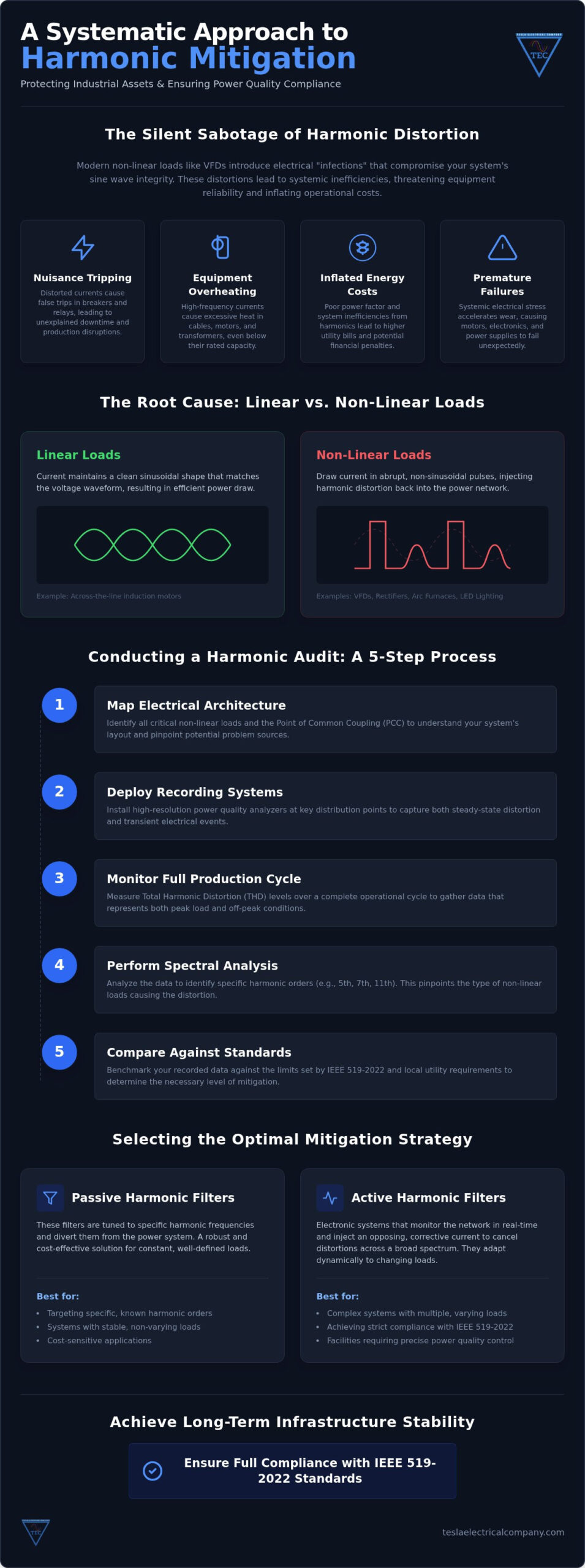
In a standard linear load, such as an across-the-line induction motor, the current maintains a sinusoidal shape that matches the voltage waveform. However, modern VFD-driven systems operate differently by converting AC to DC and back to AC using high-speed switching transistors. This process draws current in abrupt, non-sinusoidal pulses rather than a continuous wave. A non-linear load is an electrical component that draws current in discontinuous pulses, resulting in a mismatched impedance between the applied voltage and the resulting current flow. This pulse-based consumption is the fundamental driver of harmonic current injection back into the facility’s power network.
The Hidden Costs of Harmonic Distortion
The financial impact of poor power quality extends far beyond immediate equipment failure. Excessive THD levels necessitate transformer de-rating, meaning a transformer cannot safely deliver its full nameplate KVA without risking premature insulation failure. High-frequency noise also migrates into SCADA and automation systems, where it causes data packet loss and communication errors that can paralyze process control logic. Furthermore, many utility providers now impose strict financial penalties for high THD or poor power factor, making harmonic mitigation for industrial plants a critical component of operational cost control.
How to Conduct a Harmonic Audit for Your Plant
A structured harmonic audit is the foundational phase of any effective strategy for harmonic mitigation for industrial plants. It transforms anecdotal evidence of equipment failure into actionable engineering data. Without a methodical measurement process, facility managers risk investing in hardware that may not address the specific frequencies present in their system. The goal is to move beyond guesswork and establish a clear baseline of power quality.
- Step 1: Map the facility’s electrical architecture to identify critical non-linear loads and the Point of Common Coupling (PCC).
- Step 2: Deploy high-resolution recording systems at key distribution points to capture transient events and steady-state distortion.
- Step 3: Monitor THD levels throughout a complete production cycle, ensuring data represents both peak load conditions and off-peak periods.
- Step 4: Perform a spectral analysis to identify specific harmonic orders, such as the 5th, 7th, 11th, or 13th, which indicate the type of non-linear loads responsible.
- Step 5: Compare the recorded data against IEEE 519-2022 standards or local utility grid codes to determine the required mitigation performance.
Tools Required for Accurate Measurement
Achieving a complete profile of your plant’s electrical health requires sophisticated instrumentation. While handheld meters provide quick snapshot readings, they often miss intermittent disturbances that occur during specific process transitions. Professional-grade Power Quality Analyzers and Disturbance Recorders are necessary for long-term logging, typically over a seven-day period. It’s vital to measure both Voltage Total Harmonic Distortion (THDv) and Current Total Harmonic Distortion (THDi). While THDi reveals the distortion produced by your equipment, THDv indicates how that current interacts with the system’s impedance, directly impacting the longevity of sensitive electronics.
Identifying the Point of Common Coupling (PCC)
The PCC is the interface between the industrial facility and the utility’s distribution network. Monitoring at this location is essential for compliance, as utilities use this point to assess whether a plant’s harmonic injection exceeds allowable limits. However, a comprehensive audit also requires measurement at the main LV switchboard and individual industrial VFD control panel design locations. This localized data helps isolate internal sources of interference before they propagate through the system. If your initial audit indicates significant THD levels, implementing a permanent Power Quality and Disturbance Recording System ensures you maintain continuous visibility over your infrastructure’s health.
Selecting the Right Harmonic Mitigation Strategy
Selecting an effective strategy for harmonic mitigation for industrial plants requires a precise alignment between the detected distortion profile and the facility’s operational dynamics. Once the audit phase has identified specific harmonic orders, engineers must determine whether the environment demands a fixed, frequency-specific solution or a dynamic, real-time response. This decision impacts not only the immediate reduction of Total Harmonic Distortion (THD) but also the long-term stability of the plant’s electrical distribution network.
Passive harmonic filters utilize tuned LC circuits, consisting of inductors and capacitors, to provide a low-impedance path for specific harmonic frequencies, typically the 5th or 7th orders. These systems remain a reliable choice for facilities with constant, predictable loads where cost-efficiency is a primary driver. However, passive solutions lack the flexibility to adapt to changing load conditions and carry a risk of resonance with the utility grid if not engineered with precision.
In contrast, Active Harmonic Filters (AHF) represent the pinnacle of modern mitigation technology. These systems monitor the load current in real time and inject a compensating current that is exactly 180 degrees out of phase with the detected harmonics. This active cancellation effectively “cleans” the waveform before it propagates back into the main LV switchboard. Because AHFs are not frequency-dependent, they can target multiple harmonic orders simultaneously while adapting to the rapid load fluctuations common in automated manufacturing.
Passive vs. Active Filtering: Performance Comparison
Evaluating these two technologies involves assessing both performance and secondary benefits. Passive filters are best suited for fixed-speed motors or stable process environments. While they are effective at their tuned frequency, their performance degrades if the system frequency shifts or if the load drops significantly. Active filters provide a much higher degree of versatility. Beyond their primary role in harmonic cancellation, AHFs provide instantaneous power factor correction. This dual capability eliminates the need for separate capacitor banks and prevents the over-correction issues often associated with passive components in dynamic industrial environments.
VFD-Specific Mitigation Techniques
Variable Frequency Drives are the most common source of distortion, but they also offer localized opportunities for mitigation. Basic protection starts with AC line reactors or DC link chokes, which provide a cost-effective way to impede the flow of harmonic currents. For more demanding environments, integrating these filters directly into custom electrical switchboards ensures that mitigation is handled as close to the source as possible. Multi-pulse configurations, such as 12-pulse or 18-pulse rectifiers, offer a robust alternative to external filtering. An 18-pulse drive configuration represents a superior solution for high-power applications, as it inherently cancels the most significant low-order harmonics at the source through phase-shifting transformers, significantly reducing the burden on the rest of the facility’s infrastructure. For facilities evaluating advanced drive technology with built-in harmonic mitigation capabilities, reviewing Danfoss VFD solutions provides a detailed engineering comparison of modern drives designed to minimize distortion at the source.
Mitigation in Generator Synchronising Environments
When an industrial facility transitions to island mode, the generator becomes the sole source of power. Unlike the utility grid, which possesses low impedance and high fault levels, a generator has higher internal impedance. This characteristic makes the system significantly more susceptible to voltage distortion from non-linear loads. Effective harmonic mitigation for industrial plants is therefore most critical during these periods to prevent the failure of the synchronisation process and avoid catastrophic mechanical damage.
Synchronising relays depend on identifying the exact zero-crossing of the voltage waveform to match frequency and phase between sources. High harmonic content creates multiple zero-crossings or “notches,” which can lead to the relay failing to synchronise or, worse, closing the breaker out of phase. Such an event causes massive mechanical stress on the generator shaft and potential electrical damage to the windings. Additionally, harmonic currents cause significant rotor heating due to induced currents in the pole faces, while the Automatic Voltage Regulator (AVR) may struggle with hunting or systemic instability.
It’s vital that redundant control systems are hardened against these interferences. In a mission-critical environment, a failure in the synchronising logic during a power transition can lead to a total plant blackout. Ensuring your infrastructure is resilient requires a methodical approach to both hardware selection and control logic programming.
Protecting Generator Synchronizing Control Panels
Our Generator Synchronizing Control Panels are engineered with specialized filtering on all voltage and current sensing circuits. This ensures the control logic receives a clean representation of the fundamental frequency, even in high-distortion environments. We prioritize a redundant system architecture to ensure that if one control path is compromised by electrical noise, the backup continues to manage the load safely. Tesla Electrical Company designs these panels with resilient synchronising logic that accounts for non-sinusoidal waveforms, ensuring reliable closure every time. If you require a robust solution for your facility, you can explore our expertise in Generator Synchronizing Control Panel engineering.
Managing Load Sharing in Distorted Networks
In a multi-generator setup, harmonics interfere with the calculation of real and reactive power. Traditional meters might under-report or over-report kW and kVAR when harmonics are present, leading to uneven load sharing and eventual tripping. Modernizing your infrastructure is a strategic step to ensure your protection devices utilize True RMS sensing. This allows the system to accurately interpret non-sinusoidal waveforms and maintain stable operation. Adjusting protection relay settings to account for these distortions is essential, particularly when integrating new VFDs into an older system. A comprehensive retrofit of circuit breakers and protection relays ensures that your load-sharing systems remain accurate and your assets remain protected under all operational cycles.
Implementing a Long-Term Power Quality Management Plan
A successful approach to harmonic mitigation for industrial plants doesn’t end with the installation of a single filter; it requires a sustained commitment to system monitoring and lifecycle management. Establishing a robust power quality management plan ensures that the initial improvements in Total Harmonic Distortion (THD) are maintained as the facility evolves. As new non-linear loads are added or process requirements change, your electrical infrastructure must remain resilient and compliant with IEEE 519-2022 standards. This proactive stance prevents the gradual “creep” of distortion that often leads to unexplained equipment failure years after a system is commissioned.
This long-term strategy begins with the integration of power quality data into SCADA and automation systems. By centralizing this information, plant operators can establish a clear performance baseline and configure automated alarms for THD threshold breaches. These early warning systems allow technical teams to address rising distortion levels before they lead to nuisance tripping or equipment degradation. Regular maintenance cycles must also include the detailed inspection of capacitor banks and active filter components, as these devices are often subjected to significant thermal stress in high-harmonic environments.
SCADA-Based Power Quality Monitoring
Modern SCADA platforms provide the visualization tools necessary to track harmonic trends across multiple distribution points in real-time. This visibility is essential for identifying the specific operational cycles where distortion peaks, allowing for better load management and scheduling. Automated report generation simplifies the process of utility compliance audits, providing a documented history of power quality performance. Additionally, utilizing high-performance PLC control systems allows for the intelligent management of dynamic filter banks, ensuring that mitigation resources are deployed only when and where they are most needed to maintain system equilibrium.
Modernisation and Retrofit Strategies
Legacy electrical systems often lack the high-speed sensing required to manage modern harmonic profiles. A critical component of a long-term plan involves the strategic modernization of existing infrastructure, which remains the most effective path toward permanent harmonic mitigation for industrial plants. This includes upgrading legacy switchgear with integrated power quality recording equipment and replacing aging, standard-duty capacitors with harmonic-rated capacitor banks designed for higher thermal tolerances. Periodic retrofit of circuit breakers and protection relays ensures that your protective devices remain accurate and responsive to non-sinusoidal waveforms. These upgrades significantly extend the service life of your assets while reinforcing the stability of your power distribution network. If you’re ready to secure your facility’s future, consult Tesla Electrical Company for professional power quality audits and mitigation solutions.
Securing Your Infrastructure Against Electrical Distortion
Effective harmonic mitigation for industrial plants isn’t a simple equipment purchase; it’s a rigorous engineering commitment to system integrity. By transitioning from reactive troubleshooting to a systematic audit and monitoring process, you protect your critical LV and MV switchboards from the destructive effects of thermal stress and nuisance tripping. Integrating these mitigation strategies with modern SCADA and automation systems ensures your facility remains compliant with current IEEE 519-2022 standards while maintaining peak operational efficiency across all production cycles.
Tesla Electrical Company provides the technical depth required to manage these complex environments. We’re specialists in Generator Synchronizing Control Panels and offer sophisticated power quality and disturbance recording systems that provide the high-resolution data needed for precise intervention. Our team ensures that your mitigation hardware is perfectly aligned with your process control logic to deliver a comprehensive, end-to-end solution for your infrastructure.
Secure your plant’s power quality with Tesla Electrical Company’s expert engineering solutions.
Establishing a stable electrical environment is the most direct path to safeguarding your industrial assets and ensuring the long-term reliability of your operations.
Frequently Asked Questions
What are the standard limits for THD in industrial plants?
IEEE 519-2022 provides the primary framework for these limits, specifying that Voltage Total Harmonic Distortion (THDv) should typically remain below 5% at the Point of Common Coupling (PCC). Current distortion limits are more complex, as they depend on the ratio of the facility’s short-circuit current to its maximum demand load current. Adhering to these standards is essential to avoid utility penalties and ensure the safe operation of your LV and MV switchboards.
Can harmonics cause my circuit breakers to trip without an overload?
Harmonics frequently cause nuisance tripping because many modern circuit breakers and protection relays use peak-sensing or zero-crossing detection logic. Distorted waveforms create “notches” or multiple zero-crossings that confuse the relay’s internal processors, triggering a trip even when the RMS current is below the overload threshold. High-frequency harmonic currents also increase heat within the thermal elements of the breaker, causing it to operate as if an actual overload is occurring.
What is the difference between a line reactor and a harmonic filter?
A line reactor is a basic inductor placed in series with a load to provide a modest reduction in current distortion and protect against voltage transients. In contrast, a harmonic filter is a more sophisticated solution designed specifically for harmonic mitigation for industrial plants. Passive filters use tuned LC circuits to trap specific frequencies, while active harmonic filters utilize power electronics to provide real-time, wide-spectrum cancellation that far exceeds the capabilities of a simple reactor.
How do harmonics affect the lifespan of my industrial motors?
Harmonics significantly reduce motor longevity by inducing eddy currents and hysteresis losses in the motor core, which generate excessive internal heat. This thermal stress accelerates the degradation of winding insulation, often cutting the motor’s expected service life by half if THD levels are high. Negative sequence harmonics also create counter-torque that opposes the motor’s rotation, leading to mechanical vibrations and premature bearing failure that increase your long-term maintenance costs.
Is an active harmonic filter worth the investment compared to passive options?
Active harmonic filters generally offer a superior return on investment for dynamic industrial environments where load levels fluctuate. While passive filters are less expensive initially, they’re tuned to a single frequency and can’t adapt to changing conditions. AHFs provide comprehensive cancellation across all harmonic orders and include instantaneous power factor correction. This flexibility prevents resonance issues and typically results in a payback period of one to three years through reduced downtime and improved efficiency.
Can high harmonics damage my generator’s voltage regulator?
High harmonic distortion can severely destabilize a generator’s Automatic Voltage Regulator (AVR) by distorting the feedback signal it uses to maintain voltage levels. This often results in “voltage hunting” or systemic instability, especially when the generator is operating in island mode. To prevent this, we integrate specialized filtering into our Generator Synchronizing Control Panels, ensuring that the AVR and synchronising relays receive clean signals, protecting the generator from rotor heating and excitation failure.
Do I need to install mitigation at every VFD or just at the main switchboard?
The optimal location for harmonic mitigation for industrial plants depends on the concentration of non-linear loads. If a few large VFDs dominate the system, installing mitigation at each drive is most effective to prevent distortion from spreading. However, if there are many small drives, a centralized active harmonic filter at the main LV switchboard often provides a more cost-effective solution. A thorough audit using a Power Quality and Disturbance Recording System will determine the most efficient placement.
How often should I conduct a harmonic audit in a manufacturing facility?
You should conduct a comprehensive harmonic audit at least once every two years or whenever you perform a major facility expansion or switchgear retrofit. Significant changes to your load profile, such as adding new Danfoss VFD solutions or robotics, can shift your harmonic signature and compromise existing mitigation strategies. Regular audits ensure that your protective settings remain accurate and that your facility stays in compliance with utility grid codes and IEEE standards.
Disclaimer
Some content, images, text, or other materials on this website may have been created or assisted by artificial intelligence (AI).
While we review AI-generated content for accuracy and quality, we do not guarantee that all information is free from errors or omissions.
Content generated using AI is provided for informational purposes only and should not be solely relied upon without independent verification.
One Response