
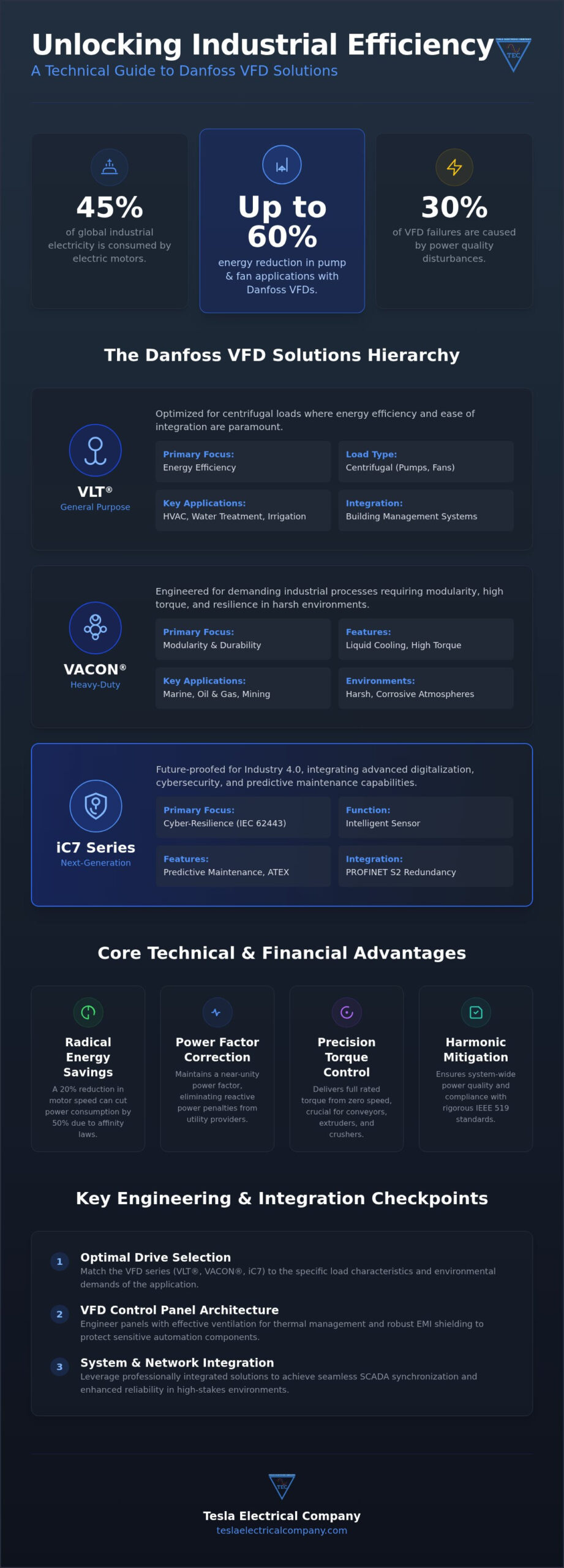
Electric motors account for approximately 45% of the world’s industrial electricity consumption, yet many facilities continue to operate with inefficient control systems that bleed capital through wasted energy. Implementing advanced Danfoss VFD solutions isn’t merely a hardware upgrade; it’s a strategic move that can reduce motor energy consumption by up to 60% in pump and fan applications. For UAE industrial operators, the challenge lies in selecting the right drive and integrating it into complex automation networks without compromising power quality.
You likely understand that achieving high-performance motor control requires more than just an off-the-shelf component. This guide delivers an engineering-grade comparison of the latest 2026 Danfoss releases, including the iC7-Aqua and iC7-HVACR series, to ensure you maximize energy efficiency and reliability. We will examine how to mitigate harmonic distortion to meet IEEE 519 standards and ensure your system remains resilient against the power disturbances responsible for 30% of VFD failures.
Key Takeaways
- Identify the optimal drive for your specific application by navigating the 2026 hierarchy of Danfoss hardware, from the iC7-Automation series to specialized water and HVACR models.
- Master the technical requirements for harmonic mitigation and power factor correction to ensure your facility meets IEEE 519 standards while reducing operational costs.
- Compare the engineering philosophies of Danfoss and Mitsubishi to determine which platform offers the superior software suite and hardware durability for your control network.
- Gain insights into the architectural requirements of VFD control panels, focusing on effective ventilation and EMI shielding to protect sensitive automation components.
- Understand how to leverage professionally integrated Danfoss VFD solutions to achieve seamless SCADA synchronization and enhanced system reliability in high-stakes industrial environments.
Understanding the Hierarchy of Danfoss VFD Solutions
A Variable-frequency drive (VFD) serves as the critical execution layer in modern industrial automation. It functions by converting fixed-frequency grid power into a variable-frequency output, allowing for precise control over motor speed and torque. Since Danfoss pioneered the first mass-produced VLT drive in 1968, the technology has transitioned from basic analog speed control to the sophisticated, data-driven Danfoss VFD solutions we deploy in 2026. These systems utilize advanced Pulse Width Modulation (PWM) to regulate the voltage and frequency delivered to the motor. This ensures the system maintains optimal magnetic flux, which maximizes torque across the entire speed range while significantly reducing thermal stress on the motor windings.
The current Danfoss portfolio is built upon three strategic pillars designed to address specific industrial requirements. The VLT® series remains the standard for general-purpose applications, while the VACON® line is reserved for heavy-duty industrial environments. The newly expanded iC7 series represents the future-proofed tier, integrating advanced digitalization and cybersecurity features that were unavailable in previous generations. Each series is engineered with a specific power density and cooling logic to ensure long-term reliability in high-stakes environments.
VLT® vs. VACON®: Selecting the Right Architecture
Choosing between these two established architectures requires a thorough analysis of the application’s load characteristics. The VLT® series is meticulously optimized for centrifugal loads common in HVAC, irrigation, and water treatment sectors. These units excel in high-volume environments where energy efficiency and ease of integration into building management systems are the primary objectives.
The VACON® series is engineered for more demanding industrial processes such as marine propulsion, oil and gas extraction, and heavy mining. Unlike the more compact VLT® units, VACON® drives emphasize modularity. This allows for custom configurations, including liquid-cooled options that are essential for high-power requirements where air cooling is physically impractical or where ambient temperatures in the UAE exceed standard operating limits. We often specify VACON® hardware when the system requires high-torque performance at low speeds or when the drive must operate in harsh, corrosive atmospheres.
The iC7 Series: Next-Generation Cyber-Resilient Drives
The iC7 series, including the iC7-Automation line updated in July 2026, is designed to meet the rigorous demands of Industry 4.0. These drives feature integrated PROFINET S2 redundancy and ATEX safety options, making them ideal for high-uptime environments and hazardous locations. A defining characteristic of the iC7 architecture is its inherent cyber-resilience. As of April 2026, these units are certified to comply with Security Level 1 (SL1) of the IEC 62443 standard, providing a hardware-based defense against unauthorized access to the control network.
Beyond security, the iC7 series functions as an intelligent sensor. It utilizes condition-based monitoring to track motor health in real-time. By analyzing current signatures and vibration patterns, the drive can predict potential stator insulation failures or bearing wear before they result in unplanned downtime. This capability allows engineers to move from reactive maintenance to a truly predictive model, ensuring the seamless operation of complex redundant systems.
Key Technical Advantages: Efficiency and Harmonic Mitigation
The primary driver for adopting Danfoss VFD solutions in heavy industry is the immediate impact on operational expenditures. While generic marketing often cites an 80% energy saving claim, real-world ROI in industrial pump and fan applications typically ranges between 20% and 60% depending on the duty cycle. These savings stem from the affinity laws of centrifugal loads, where a 20% reduction in motor speed can result in a 50% reduction in power consumption. By decoupling the motor from the supply grid, the drive maintains a near-unity power factor. This eliminates the need for external capacitor banks and protects the facility from reactive power penalties imposed by utility providers.
Precision torque control represents another critical advantage for heavy machinery. Unlike traditional across-the-line starters, Danfoss drives provide full rated torque from zero speed, which is essential for conveyors, extruders, and crushers. Achieving this level of control requires professional integration with industrial VFD control panel design. A centralized management approach ensures that the drive’s logic is perfectly synchronized with the broader automation network, allowing for millisecond-level adjustments to load fluctuations.
Addressing Harmonic Distortion in Industrial Plants
Industrial plants often face challenges with non-linear loads that introduce harmonic interference into the electrical distribution system. This distortion can lead to overheating in transformers and nuisance tripping of sensitive electronic equipment. Danfoss addresses this through advanced active and passive filter solutions, such as the Danfoss Advanced Active Filter AAF 007. The latest iC7-Aqua ultra-low harmonic (ULH) models are specifically designed to meet the IEEE 519 grid standard, achieving a Total Harmonic Distortion (THDi) below 3%. For a deeper technical analysis of these phenomena, refer to our guide on harmonic mitigation for industrial plants.
Motor Protection and Longevity
Mechanical longevity is directly linked to the controlled acceleration and deceleration profiles provided by VFDs. Soft starting eliminates the massive inrush currents and mechanical shocks associated with direct-on-line starting, which significantly extends the lifespan of belts, gears, and couplings. Tesla Electrical Company integrates these drives with advanced thermal protection and overload monitoring to safeguard the motor windings from premature failure.
To further protect critical infrastructure, we utilize dU/dt filters and sine-wave filters to prevent voltage spikes and bearing currents. These components are vital when long motor cables are required, as they mitigate the reflective wave phenomenon that can puncture stator insulation. By addressing these electrical stressors at the source, our VFD Control Panel solutions ensure that your motors operate within their designed thermal and electrical limits for their entire service life.
Danfoss vs. Mitsubishi: Comparative Analysis for Industrial Applications
Selecting the appropriate drive architecture requires a balanced evaluation of engineering philosophies. European engineering, represented by Danfoss, emphasizes modular versatility and application-specific software optimization. In contrast, Japanese manufacturers like Mitsubishi focus on high-density precision and extreme hardware standardization. While Mitsubishi’s FR-F800 series is respected for its performance in pumping and fan applications, Danfoss VFD solutions often provide a more flexible integration path for complex industrial control systems. This flexibility is most evident when analyzing the MyDrive® Suite, which offers a more intuitive commissioning environment than the Mitsubishi FR Configurator, particularly for multi-axis configurations.
Network compatibility remains a decisive factor for modern facilities. Both manufacturers support standard protocols like Profinet, EtherCAT, and Modbus. However, the 2026 Danfoss iC7 series introduces native PROFINET S2 redundancy, providing a higher level of communication reliability for mission-critical processes. When conducting a Total Cost of Ownership (TCO) analysis over a 15-year industrial lifecycle, Danfoss frequently demonstrates superior value. This isn’t solely due to initial hardware costs but results from reduced integration labor and lower maintenance requirements over the drive’s operational life.
Performance at High Ambient Temperatures
The UAE climate presents unique thermal challenges that can lead to significant equipment derating. Standard industrial drives often begin to lose capacity once ambient temperatures exceed 40°C. Danfoss drives are specifically engineered to handle these high-heat environments, with many models maintaining full rated performance up to 50°C before derating factors apply. While Mitsubishi units are robust, their derating curves are often steeper in extreme heat. For high-power installations where air cooling is insufficient, Danfoss offers sophisticated liquid-cooled modules. These systems effectively manage thermal loads in confined spaces, ensuring that the internal power electronics remain within safe operating limits even during peak summer conditions.
Ease of Integration and Commissioning
Rapid deployment is essential for emergency retrofits and plant expansions. Danfoss prioritizes a plug-and-play approach with pre-configured application wizards that significantly reduce commissioning time. Their global support network ensures that spare parts and expert technical assistance are readily available, which is critical for minimizing downtime in the UAE industrial sector. These drives are designed for seamless pairing with SCADA and automation system solutions. This integration allows for real-time data streaming and remote diagnostics, enabling maintenance teams to identify and resolve issues before they escalate into system failures. By utilizing standardized communication blocks, engineers can integrate these drives into existing PLC networks with minimal custom coding.
Engineering Custom VFD Control Panels and Retrofit Strategies
Integrating Danfoss VFD solutions into a facility requires more than just mounting a module. It demands a rigorous approach to the internal architecture of the VFD Control Panel. Proper ventilation is paramount, especially when housing multiple high-power drives that generate significant heat. We design specialized airflow paths and utilize precision-engineered cooling fans to maintain stable internal temperatures. Advanced cable management and EMI shielding are implemented to prevent electromagnetic interference from disrupting sensitive control signals. This engineering discipline is rooted in the fundamental principles of industrial switchboard design, ensuring that the enclosure provides a stable environment for the electronics while maintaining accessibility for future maintenance.
For critical process control applications where downtime is not an option, we design comprehensive Redundant Systems. These configurations prevent a single point of failure from halting production. This often involves dual-drive setups or automated bypass arrangements that allow the motor to continue operating via a soft starter or direct-on-line connection while a primary drive is serviced. Our engineering team ensures that these transitions are seamless and don’t cause mechanical stress to the connected load. This human-centric expertise in commissioning complex systems ensures that your infrastructure remains resilient under all operating conditions.
Retrofitting Legacy Control Panels
Many facilities still rely on aging fixed-speed starters that lack the efficiency of modern drives. Our team specializes in the professional Retrofit of Circuit Breakers and Protection Relays alongside the installation of new VFDs. We manage the spatial constraints of existing LV and MV switchboards by using compact Danfoss hardware, such as the VLT Midi Drive FC 280, which is specifically designed to replace legacy units with identical mounting dimensions. This methodical approach minimizes downtime, allowing for a structured transition from fixed-speed to variable-speed control without requiring a total system overhaul.
SCADA Integration and Remote Monitoring
Modern industrial infrastructure depends on real-time oversight. We map critical VFD parameters, including torque, current, and thermal levels, directly to SCADA dashboards. This transparency allows operators to utilize condition-based monitoring for predictive maintenance alerts. By securing the VFD communication layer with encrypted protocols and hardware-based security chips, we ensure that the control network remains resilient against external threats. This level of integration transforms a standalone drive into a smart node within the broader automation ecosystem. Ensuring that the control logic governing these nodes is properly structured requires a thorough understanding of industrial PLC programming for automation, where even a minor oversight in scan cycle execution can lead to costly operational disruptions. If you’re ready to modernize your motor control infrastructure, our engineers can design a custom VFD Control Panel tailored to your specific operational requirements.
Implementing Turnkey VFD Solutions with Tesla Electrical Company
Establishing a reliable motor control network requires a partner capable of managing the entire lifecycle of the project, from initial load analysis to final commissioning. At Tesla Electrical Company, we provide a comprehensive design-to-commissioning approach that ensures Danfoss VFD solutions are perfectly calibrated for your specific industrial environment. We don’t simply supply hardware; we engineer a total solution that incorporates custom-built VFD Control Panel architectures designed to withstand the unique environmental challenges of the UAE. High ambient temperatures, airborne particulates, and humidity require specialized enclosure cooling and filtration systems that standard off-the-shelf units often lack.
The value of a “Total Solution” partner becomes evident during the synchronization of complex systems. Our human-centric expertise allows us to bridge the gap between hardware capabilities and operational requirements. We ensure that your SCADA & Automation Systems communicate flawlessly with the drives, providing the granular data needed for predictive maintenance. This holistic oversight is critical for high-stakes electrical infrastructure, where a single integration error can lead to costly downtime or equipment damage. By managing every stage of the process, we provide the security and stability that seasoned industry leaders expect.
Why Choose Tesla Electrical Company for Danfoss Integration?
Our technical capabilities extend beyond simple drive installation. We possess deep expertise in the design of the Generator Synchronizing Control Panel, allowing us to manage complex load sharing and transition scenarios where VFDs must operate alongside backup power sources. Because we manufacture LV and MV Switchboards in-house, we can guarantee that the internal housing for your drives meets the highest standards for EMI shielding and thermal management. Our proven track record in deploying the Power Quality and Disturbance Recording System allows us to verify that your new VFD installation won’t negatively impact the rest of your facility’s electrical health.
Next Steps for Your Industrial Upgrade
Modernizing your facility begins with a methodical assessment of your current motor control assets. Our engineering team provides detailed consultations for VFD sizing and harmonic study requirements to ensure your system complies with national grid standards. We offer a structured path forward, starting with a technical proposal for a custom VFD Control Panel design that addresses your specific torque and efficiency targets. Contact our engineering team today to schedule a national-level infrastructure assessment and discover how a professionally integrated Danfoss solution can extend your motor lifespan and reduce operational overhead.
Optimizing Industrial Motor Control for the Future
The transition to high-efficiency motor control is no longer a luxury but a necessity for industrial resilience. By selecting the appropriate architecture from the 2026 hierarchy of Danfoss VFD solutions, you ensure that your facility benefits from maximum energy savings and superior torque control. We’ve explored how specialized integration mitigates harmonic distortion and how custom-engineered enclosures protect sensitive electronics from the thermal demands of the UAE climate. Success in these complex deployments requires a partner who understands the intersection of European engineering and local operational requirements.
Tesla Electrical Company provides the steady hand needed to manage your infrastructure upgrades from initial design to final commissioning. Our commitment to ISO-certified manufacturing standards and specialized VFD Control Panel design ensures that your systems operate with unmatched reliability. With national UAE engineering support, we’re ready to help you architect a more efficient, future-proof control network. We look forward to supporting your next major industrial milestone.
Consult with Our Engineers on Your Custom Danfoss VFD Solution
Frequently Asked Questions
What are the primary differences between Danfoss VLT and VACON drives?
The primary difference lies in their application focus: VLT drives are optimized for centrifugal loads in HVAC and water treatment, while VACON drives are engineered for heavy-duty industrial processes like marine and mining. VACON architecture offers superior modularity and liquid-cooling options for high-power requirements. Conversely, VLT units prioritize high-volume efficiency and compact design for building automation. Selecting between them depends on whether your load requires precision torque or high-efficiency flow control.
How does a Danfoss VFD improve energy efficiency in industrial pump systems?
Danfoss VFD solutions improve energy efficiency by utilizing the affinity laws of centrifugal pumps, where power consumption is proportional to the cube of the shaft speed. Reducing motor speed by just 20% can lead to a 50% decrease in energy usage. In typical industrial pump applications, this results in documented savings of 20% to 60%. These drives also maintain a near-unity power factor, which eliminates reactive power charges from utility providers.
Can Danfoss VFD solutions be retrofitted into existing electrical switchboards?
Yes, Danfoss drives are specifically engineered for modernization projects with a focus on footprint compatibility. For instance, the VLT Midi Drive FC 280 features identical mounting dimensions to the legacy VLT 2800 series, allowing for seamless integration into existing LV and MV switchboards. Our engineers manage the spatial constraints and electrical requirements to ensure the transition from fixed-speed starters to variable control is completed with minimal operational downtime.
What is the role of harmonic filters in a Danfoss VFD installation?
Harmonic filters are essential for maintaining power quality by mitigating the non-linear loads created by the drive’s rectifiers. Without mitigation, these harmonics cause overheating in transformers and interference in sensitive electronics. Utilizing the Danfoss Advanced Active Filter AAF 007 or the ultra-low harmonic iC7-Aqua drive ensures compliance with the IEEE 519 standard. This results in a Total Harmonic Distortion (THDi) below 3%, protecting your facility’s entire electrical distribution network.
How does the iC7 series address industrial cybersecurity concerns?
The iC7 series addresses cybersecurity through hardware-based protection that complies with Security Level 1 (SL1) of the IEC 62443 standard. These drives incorporate integrated crypto chips and support PROFINET S2 redundancy to ensure secure communication within industrial networks. By achieving these certifications as of April 2026, Danfoss provides a robust defense against unauthorized access, which is critical as industrial control systems become increasingly integrated with cloud-based digitalization platforms.
What maintenance is required for a custom VFD control panel?
Maintenance for a custom VFD control panel involves periodic inspections of the cooling system and electrical connections to prevent failure. Technicians must clean or replace ventilation filters and verify that cooling fans are operating at their designed RPM. It’s also vital to check the torque on power terminals, as thermal cycling can loosen connections over time. Utilizing the built-in condition-based monitoring features of the drive can automate many of these predictive maintenance tasks.
Does Tesla Electrical Company provide on-site commissioning for Danfoss drives?
Tesla Electrical Company provides comprehensive on-site commissioning for all Danfoss VFD solutions we design and manufacture. Our engineering team manages the entire process, including parameter configuration, SCADA synchronization, and initial load testing. This turnkey approach ensures that the drive is perfectly calibrated for the specific environmental and mechanical stresses of your facility. We provide national-level support across the UAE to ensure your high-stakes electrical infrastructure operates with maximum reliability.
How do Danfoss VFDs handle the high ambient temperatures in the UAE?
Danfoss VFDs are engineered to handle the thermal demands of the UAE climate, with many models rated for full performance at ambient temperatures up to 50°C. When temperatures exceed this threshold, the drives utilize sophisticated derating curves to maintain operation without tripping. For high-power installations where air cooling is insufficient, we implement liquid-cooled modules. These systems effectively dissipate heat in confined spaces, protecting the internal power electronics from the premature failure caused by extreme heat.
Disclaimer
Some content, images, text, or other materials on this website may have been created or assisted by artificial intelligence (AI).
While we review AI-generated content for accuracy and quality, we do not guarantee that all information is free from errors or omissions.
Content generated using AI is provided for informational purposes only and should not be solely relied upon without independent verification.