
What if the difference between a resilient power grid and a catastrophic system failure isn’t found in the copper wiring, but in the invisible execution of a single scan cycle? For engineers managing high-stakes infrastructure in the United Arab Emirates, the pressure to maintain zero downtime is a constant reality. You likely recognize the difficulty of bridging the gap between legacy hardware and modern logic, especially when integrating complex generator synchronizing control panels with SCADA systems. It’s a technical hurdle where even a minor oversight in industrial PLC programming for automation can lead to costly operational disruptions.
This comprehensive reference serves as a professional guide to mastering the core principles of control logic and redundant system architecture. You’ll gain a deep understanding of how to implement fail-safe protocols that protect critical assets and ensure seamless communication between VFD control panels and central automation hubs. We’ll analyze the nuances of PLC scan cycles, compare programming languages for specific industrial tasks, and explore the methodical approach required for robust SCADA integration. By the end of this guide, you’ll possess the technical insights necessary to transform rigid hardware into a responsive, data-driven ecosystem.
Key Takeaways
- Understand the deterministic nature of PLC scan cycles to ensure precise and reliable process control across complex industrial environments.
- Learn how to architect high-availability redundant systems that mitigate the risk of downtime in critical power and infrastructure operations.
- Master industrial PLC programming for automation by utilizing standardized IEC 61131-3 languages to ensure code consistency and global interoperability.
- Discover the methodology for seamless integration between PLC logic, SCADA systems, and VFD control panels for comprehensive data visualization.
- Explore the strategic advantages of phased retrofitting to modernize legacy hardware and extend the lifespan of existing industrial infrastructure.
The Logic of Industrial PLC Programming for Automation
A Programmable Logic Controller (PLC) isn’t merely a standard computer housed in a metal box; it’s a ruggedized, deterministic system engineered to operate with absolute predictability in harsh environments. For engineers overseeing critical power systems and infrastructure in the United Arab Emirates, this predictability is the foundation of operational safety. The evolution of industrial PLC programming for automation marked a fundamental shift from rigid, hard-wired relay logic to flexible, software-driven control. This transition allows for complex logic adjustments without the need for physical rewiring, which drastically reduces both commissioning time and long-term maintenance costs.
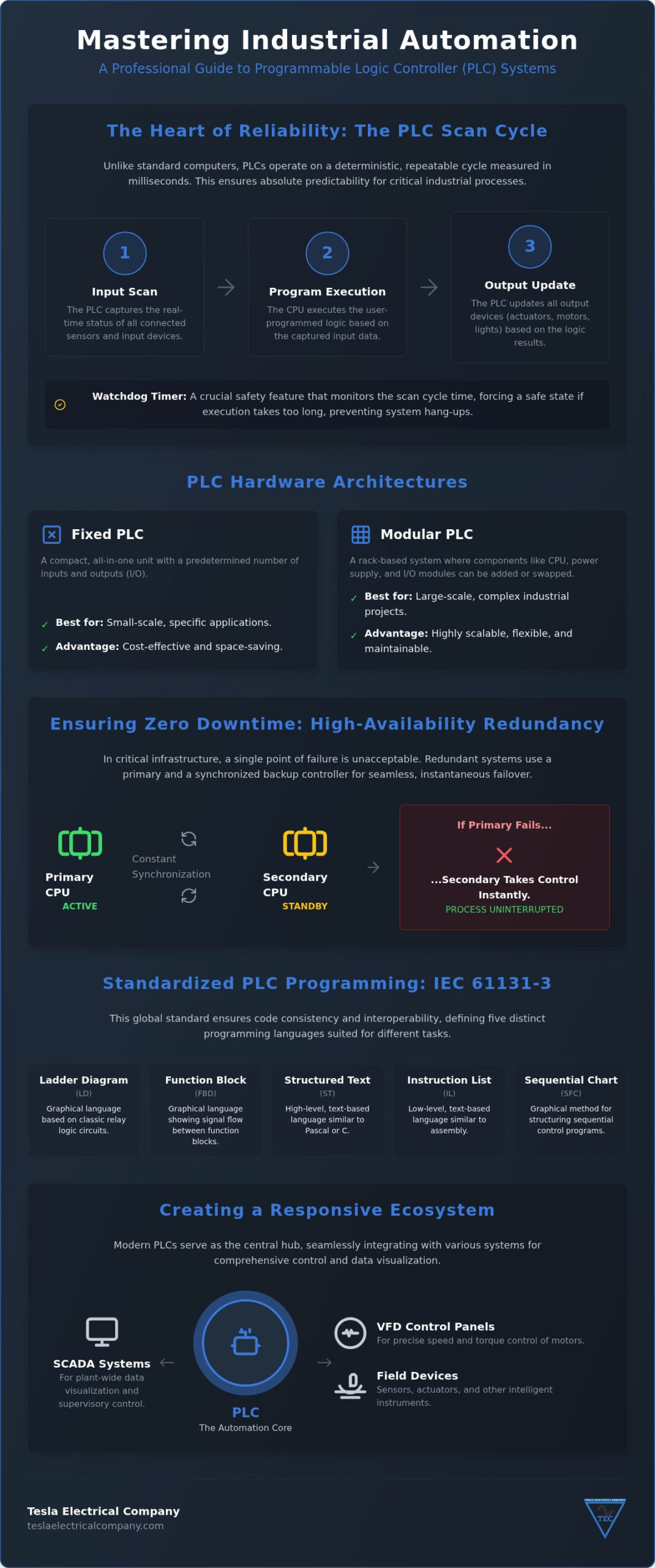
The core of this reliability lies in the deterministic execution of the PLC scan cycle. Unlike standard operating systems that may prioritize background tasks, a PLC follows a strict, repeatable sequence: the Input Image, Program Execution, and the Output Image. During the Input Image phase, the controller captures the current state of all field sensors. It then solves the user-defined logic during the Program Execution phase before finally updating the actuators in the Output Image phase. This cycle ensures that process timing remains consistent, which is vital for maintaining the synchronization required in high-stakes industrial applications.
Core Components of an Industrial PLC System
A professional-grade PLC architecture relies on specialized hardware modules designed for high-availability environments:
- The CPU: Often described as the brain of the system, the CPU manages processing speed and memory allocation. It’s responsible for executing the industrial PLC programming for automation while simultaneously performing self-diagnostics.
- I/O Modules: These modules serve as the interface between the digital logic and the physical world. They translate signals from digital sensors, analog transducers, and actuators into data the CPU can process.
- Communication Ports: To ensure seamless integration, modern PLCs utilize ports supporting protocols such as Modbus, Profinet, and Ethernet/IP. These enable the controller to communicate with SCADA systems and other intelligent field devices.
Real-Time Processing vs. Standard Computing
Standard computing models often utilize interrupt-driven operating systems, which can introduce jitter or unpredictable delays. In contrast, PLCs utilize a cyclic execution model where “real-time” is defined by scan times measured in milliseconds. This ensures that a safety interlock or a high-speed PID loop responds within a guaranteed timeframe. To maintain this rigor, PLCs employ watchdog timers. These timers monitor the scan cycle; if the logic execution exceeds a specific duration, the watchdog timer forces the system into a safe state. This mechanism prevents logic hang-ups and ensures that the automation system remains under control even during unexpected processing loads.
Hardware Architectures and the Logic of Redundancy
Selecting the correct hardware architecture is as critical as the industrial PLC programming for automation that runs upon it. For small-scale applications, fixed PLCs offer a compact, cost-effective solution with a predetermined number of inputs and outputs. However, large-scale industrial projects in the UAE require modular architectures. These rack-based systems provide the scalability needed to expand I/O capacity as operational requirements grow; they allow engineers to swap modules without replacing the entire controller. The flexibility of modular hardware supports the long-term evolution of industrial PLC programming for automation by allowing for seamless logic updates and hardware expansions.
In critical power environments, such as data centers or utility plants, a single controller failure can be catastrophic. High-Availability (HA) architectures address this risk by implementing redundant control systems. These configurations typically feature two identical CPUs working in tandem to ensure that if the primary unit fails, the secondary unit takes control instantly. This hardware-level synchronization is the backbone of resilient infrastructure, ensuring that the process remains uninterrupted even during a hardware fault.
Redundant PLC Configurations for Critical Infrastructure
Effective redundancy requires constant synchronization between the primary and secondary CPUs. This process ensures the secondary controller’s memory is a mirror image of the primary’s state, allowing for a seamless failover without losing process data or timing. Redundant I/O networking further strengthens the system by providing multiple communication paths for sensor data, which prevents a single cable break from halting operations. Hot-standby redundancy is the gold standard for zero-downtime automation in 2026.
Distributed I/O and Remote Racks
Centralized control often leads to excessive cabling costs and potential signal degradation over long distances. By utilizing distributed I/O, engineers can place modules closer to field devices, significantly reducing the amount of copper wiring required. In electrically noisy environments, fiber optic backbones are used to connect these remote racks to the central CPU, ensuring superior data integrity and immunity to interference. These remote I/O solutions are often integrated directly into a sophisticated industrial switchboard design to centralize power and control distribution. If you’re planning a system upgrade, exploring our redundant system solutions can help secure your facility’s operational future.
Standardized PLC Programming Languages: IEC 61131-3
The IEC 61131-3 standard provides a unified framework that ensures global consistency across diverse hardware platforms. This standardization is vital for engineers in the UAE who manage multi-vendor environments, as it allows for the seamless porting of logic between different controllers. Within this framework, industrial PLC programming for automation utilizes five distinct languages, each suited to specific operational demands. Ladder Logic (LD) remains the most prevalent choice for discrete control. It mimics traditional electrical relay schematics, which makes it highly intuitive for maintenance teams accustomed to reading hard-wired circuit diagrams. While LD excels at simple interlocking, modern systems often require more sophisticated approaches to handle data-heavy tasks.
Structured Text (ST) offers a high-level, syntax-based environment similar to Pascal or C. It’s the preferred tool for complex mathematical modeling, scaling algorithms, and managing large data arrays that would be cumbersome to implement in a visual language. Conversely, Function Block Diagram (FBD) provides a graphical representation of signal flow. It’s particularly effective for process control applications where engineers need to visualize the relationship between input sensors and output actuators. By selecting the appropriate language within the IEC standard, developers create code that is both robust and easily maintainable over the long term.
Choosing the Right Language for the Task
Efficiency in industrial PLC programming for automation depends on matching the language to the functional requirement. Ladder Logic is the logical choice for motor starting and basic safety interlocks due to its straightforward execution. However, when your system requires complex data manipulation or repetitive calculations, Structured Text provides superior scalability. For multi-step industrial processes that follow a strict chronological order, Sequential Function Charts (SFC) are indispensable. SFC allows engineers to break down a complex operation into manageable steps and transitions, ensuring that the system only advances when specific conditions are met.
Advanced Logic: PID Control for Process Automation
Proportional-Integral-Derivative (PID) control is the primary mechanism for managing continuous process variables such as pressure, temperature, and flow. Within the PLC environment, a PID loop continuously calculates an error value as the difference between a desired setpoint and a measured process variable. The controller then applies a correction based on proportional, integral, and derivative terms to minimize this error. This level of precision is essential for maintaining stability in an industrial VFD control panel design, where the PLC must modulate motor speeds in real-time to respond to changing load conditions. Proper PID tuning ensures that the automation system remains responsive without overshooting or oscillating, which protects sensitive hardware from mechanical stress.
Integrating PLCs with SCADA, VFDs, and Control Centers
The true power of industrial PLC programming for automation is realized when the controller moves beyond isolated logic and begins to orchestrate the entire facility. Integrating these controllers with SCADA and automation system solutions allows for centralized oversight and high-level data acquisition. This synergy depends on precise data mapping, where PLC register values are translated into intuitive HMI visualizations. Whether it’s a boolean flag for a pump status or a floating-point number for a flow rate, the PLC acts as the primary data source, ensuring that operators in the control center receive real-time, deterministic information from the field.
Beyond simple monitoring, the PLC serves as the intelligent bridge between software commands and physical hardware. In UAE industrial environments, where power quality and efficiency are paramount, the PLC manages variable loads by communicating directly with motor control centers. This integration allows for sophisticated load-sharing protocols and automated responses to utility fluctuations. By centralizing this control, facilities can achieve a level of operational harmony that manual systems simply can’t match.
PLC Communication with Variable Frequency Drives (VFDs)
Engineers must choose between hard-wired and networked VFD control based on the required data density. While hard-wired connections offer simplicity for basic start/stop functions, networked protocols like Modbus TCP or Profinet provide deep insights into motor health, torque, and energy consumption. This data-rich environment is essential for managing harmonic mitigation for industrial plants via PLC-driven VFD scheduling. By analyzing real-time analytics, the PLC can adjust switching frequencies or stagger motor starts to minimize electrical noise and protect sensitive LV and MV switchboards.
Generator Synchronization and Load Sharing
In complex power systems, the PLC is the primary intelligence behind the Generator Synchronizing Control Panel. It continuously monitors the phase, frequency, and voltage of multiple power sources to ensure they match perfectly before closing the breaker. This logic extends to automatic load shedding protocols, where the PLC identifies non-essential loads to disconnect during peak demand or utility failure. PLC-based synchronizing panels ensure grid stability during industrial transitions. To enhance your facility’s resilience, consider our comprehensive SCADA and automation system solutions for end-to-end integration.
Retrofitting Legacy Systems and Future-Proofing Automation
The economic reality for many industrial facilities in the United Arab Emirates involves managing aging infrastructure while demanding modern performance. Retrofitting legacy PLCs offers a cost-effective alternative to full system replacements; it allows organizations to preserve their investment in field wiring and physical enclosures while upgrading the central intelligence of the operation. Successful industrial PLC programming for automation in this context focuses on phased migration strategies. These strategies involve upgrading controllers in stages, ensuring that existing I/O modules continue to function while the logic is migrated to high-speed, Ethernet-based architectures. This methodical approach bridges the gap between legacy protocols like Data Highway Plus (DH+) or Serial and modern industrial networks, ensuring system longevity through the use of standardized, non-proprietary logic that prevents vendor lock-in.
Future-proofing isn’t just about hardware; it’s about building a logic architecture that can adapt to evolving data requirements. By utilizing open standards, engineers ensure that their code remains portable and readable for decades. This commitment to transparency is vital for long-term maintenance and makes it easier for future teams to troubleshoot or expand the system without starting from scratch. It’s a steady-handed approach that prioritizes stability over short-term fixes.
The Systematic Approach to PLC Retrofitting
A rigorous retrofit begins with a comprehensive audit and documentation process. It’s essential to recover and verify the logic from obsolete controllers, as original code documentation is often missing or outdated in legacy environments. Once the logic is secured, engineers perform hardware mapping to align old physical terminations with modern modular PLC racks. This systematic preparation culminates in Factory Acceptance Testing (FAT). By simulating the process in a controlled environment before on-site installation, we minimize commissioning time and prevent unexpected downtime during the final switchover at the facility.
Industrial IoT (IIoT) and the Future of PLCs
Modern PLCs are rapidly evolving into edge computing devices. They no longer just execute simple logic; they process and filter complex data sets before transmitting them to the cloud for high-level analytics. This transition requires a renewed focus on cybersecurity at the controller level to protect sensitive logic from unauthorized access. As we look toward 2026, the integration of AI-driven predictive maintenance within industrial PLC programming for automation will become the industry standard. Controllers will analyze their own I/O patterns to predict motor failures or valve stiction before they occur. This proactive stance ensures that your automation ecosystem remains resilient against both mechanical wear and emerging digital threats.
Securing the Future of Industrial Automation
Precise control logic is the defining factor in the reliability of modern power systems. It’s not enough to simply install hardware; engineers must ensure that every scan cycle reinforces the stability of the entire network. Through robust industrial PLC programming for automation, facilities can achieve the seamless integration of SCADA systems and VFD control panels required for high-stakes infrastructure. This methodical approach to logic design prevents single points of failure and prepares your operation for the data-driven demands of 2026.
Tesla Electrical Company provides comprehensive expertise in redundant control architecture and generator synchronizing control panels throughout the United Arab Emirates. Our role as a total solution provider ensures that your project benefits from the highest standards of engineering rigor and reliability. We prioritize long-term partnerships and deliver the technical oversight necessary for complex industrial transitions. Our national coverage ensures that your electrical infrastructure remains resilient, efficient, and fully optimized for future growth.
Contact Tesla Electrical Company for Advanced SCADA and PLC Automation Solutions to discuss your specific infrastructure requirements. Your facility’s resilience is our primary commitment, and we look forward to supporting your next automation milestone.
Frequently Asked Questions
What is the difference between a PLC and a PAC in industrial automation?
A PAC (Programmable Automation Controller) offers multi-domain functionality on a single platform, integrating discrete, process, and motion control with a flexible memory architecture. While PLCs are traditionally optimized for high-speed discrete control and relay-style logic, PACs handle complex, data-heavy tasks and advanced programming more efficiently. In the UAE market, PACs are often selected for large-scale infrastructure projects that require extensive C++ integration alongside standard industrial logic.
Can PLC programming be used for safety-critical applications?
Yes, specialized safety PLCs are utilized for emergency shutdown systems and high-risk environments. These controllers are engineered with internal hardware redundancy and extensive self-diagnostics to meet SIL 2 or SIL 3 safety integrity standards. The logic is designed to be fail-safe, which ensures that any detected fault or communication error immediately forces the industrial process into a known safe state to protect personnel and equipment.
How do I choose between different PLC communication protocols like Modbus and Profinet?
Profinet is the superior choice for modern, high-speed Ethernet communication that requires deterministic performance and deep diagnostic capabilities. Modbus remains a reliable and cost-effective option for integrating legacy hardware or simple devices like power meters. Your choice should depend on the required data refresh rates and the existing network architecture used in your industrial PLC programming for automation to ensure seamless interoperability across the plant.
What is the typical lifespan of an industrial PLC system before a retrofit is needed?
An industrial PLC system typically maintains a reliable operational lifespan of 15 to 20 years. Beyond this window, the risk of hardware failure increases and the availability of spare parts often diminishes. While the controller might still execute logic, the inability to interface with modern SCADA systems or the lack of vendor support usually necessitates a strategic retrofit to maintain facility uptime and security.
How does PLC programming integrate with a SCADA system for plant-wide monitoring?
The PLC acts as the primary data acquisition layer, capturing field signals and storing them in specific memory registers. The SCADA system communicates with these registers via protocols like OPC-UA or Modbus TCP to visualize real-time data on an HMI. This integration allows operators to monitor process variables, acknowledge alarms, and send high-level control setpoints directly to the PLC logic from a centralized control room.
What are the benefits of using redundant PLC systems in power generation?
Redundant PLC systems provide high availability by utilizing a hot-standby configuration where two CPUs execute the same logic simultaneously. If the primary controller experiences a fault, the secondary unit assumes control in milliseconds without interrupting the process. This architecture is vital for generator synchronizing and power distribution, as it eliminates single points of failure that could otherwise lead to costly grid instability or blackouts.
Is it possible to upgrade PLC logic without replacing the physical wiring?
It’s entirely possible to modernize your industrial PLC programming for automation while retaining existing field wiring through a phased migration. Engineers use specialized conversion kits or communication gateways to bridge new, high-performance CPUs with legacy I/O racks. This approach significantly reduces the labor costs and downtime associated with physical rewiring, allowing for a faster and more secure transition to a modern automation platform.
What is the role of a PLC in industrial motor control centers (MCCs)?
The PLC serves as the intelligent coordinator within the MCC, managing the precise sequencing and interlocking of various motor starters and VFDs. It monitors critical feedback such as motor current, temperature, and fault status to prevent mechanical damage. By centralizing this control logic, the PLC optimizes energy consumption and ensures that all motor-driven loads operate in strict accordance with the broader plant safety and process requirements.
Disclaimer
Some content, images, text, or other materials on this website may have been created or assisted by artificial intelligence (AI).
While we review AI-generated content for accuracy and quality, we do not guarantee that all information is free from errors or omissions.
Content generated using AI is provided for informational purposes only and should not be solely relied upon without independent verification.