
In high-stakes industrial environments, the cost of a single controller failure is rarely measured in mere minutes of downtime, but rather in the staggering financial impact of lost production and the grave risk to asset integrity. You recognize that maintaining absolute uptime is not simply an operational preference; it’s a fundamental requirement for both safety and long-term profitability. This article explores how a robust redundant control system architecture eliminates single points of failure to ensure continuous industrial operation and uncompromising safety standards.
Through a methodical engineering lens, we will examine the various levels of redundancy available to modern facilities. You’ll gain a clear understanding of the technical criteria used to choose between hot and cold standby configurations, as well as the complexities involved in processor synchronization. Finally, we provide a comprehensive framework for risk-based architecture design. This guide serves to empower your team to build a system that stands resilient against unforeseen technical disruptions while adhering to the highest standards of industrial excellence.
Key Takeaways
- Understand how the duplication of critical automation components effectively eliminates single points of failure to maintain continuous industrial production.
- Identify the specific technical criteria required to select between hot, warm, and cold standby configurations based on your facility’s permissible downtime.
- Learn to implement a robust redundant control system architecture by utilizing FMEA and FTA methodologies to preemptively address potential failure modes.
- Explore the necessity of network and I/O redundancy, including the strategic selection of ring or star topologies to ensure total communication continuity.
- Discover the advantages of integrating redundant PLC systems with advanced VFD control panels for a comprehensive, mission-critical motor control solution.
Defining Redundant Control System Architecture
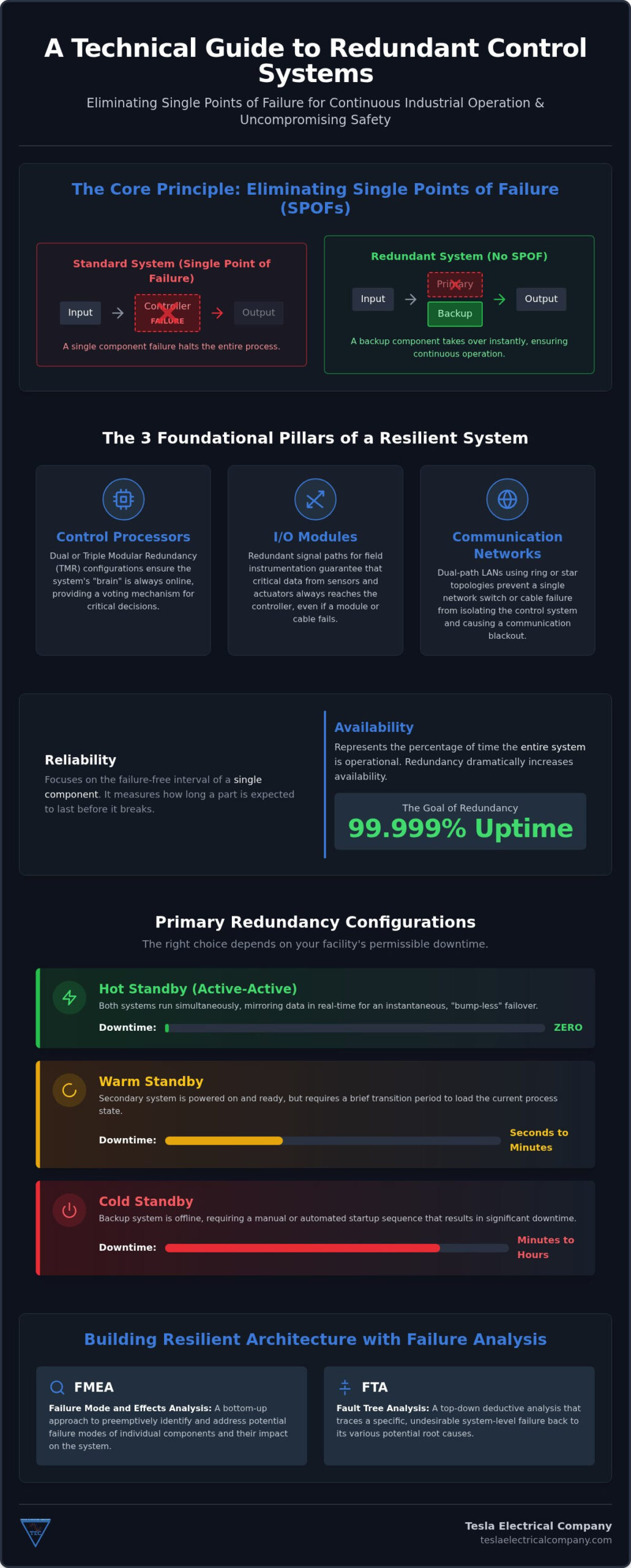
Redundant control system architecture refers to the intentional duplication of critical components within an industrial automation framework. This practice ensures that if one part fails, another is prepared to take over immediately. The primary objective is the total elimination of single points of failure (SPOFs). In high-stakes environments like power generation or chemical processing, a single failure can lead to catastrophic financial losses or safety incidents. Redundancy is a strategic safety layer designed into the system’s DNA, rather than a mere hardware backup added as an afterthought. This engineering philosophy relies on the broader principles of Redundancy (engineering), which provides the foundation for building resilient, mission-critical systems.
The Core Components of a Redundant System
A robust redundant control system architecture is built upon three foundational pillars. First, control processors act as the central intelligence. In redundant setups, these processors operate in dual or triple configurations; often referred to as Triple Modular Redundancy (TMR); to provide a voting mechanism for decision-making. Second, I/O modules must offer redundant signal paths. This ensures that field instrumentation data reaches the controller even if a single module or cable is damaged. Finally, communication networks utilize dual-path LANs. These separate paths for control, I/O, and supervisory data prevent a network switch failure from isolating the entire system.
Availability vs. Reliability: Understanding the Difference
Engineers must distinguish between reliability and availability to design effective systems. Reliability focuses on the failure-free interval of a single component. It’s a measure of how long a part will last before it breaks. Availability, however, represents the percentage of total time the entire system remains operational. Redundancy increases availability even when individual component reliability remains constant. By placing two components in parallel, the system only fails if both fail simultaneously. This mathematical reality allows industrial facilities to achieve 99.999% uptime, even when using standard industrial-grade hardware. It’s the difference between a single robust part and a system designed to survive the failure of its parts.
Primary Redundancy Configurations: Hot, Warm, and Cold Standby
The selection of a specific redundant control system architecture depends heavily on the “permissible downtime” your facility can tolerate during a system switchover. Engineering teams must evaluate the operational impact of a control failure against the technical complexity and cost of the standby solution. In modern industrial settings, this choice isn’t merely about hardware availability; it’s about the speed and reliability of recovery. Choosing the wrong configuration can lead to synchronization errors or, worse, a complete system stall during a critical transition.
- Hot Standby (Active-Active): Both systems run simultaneously, mirroring data in real-time to allow for instantaneous, “bump-less” failover.
- Warm Standby: The secondary system is powered and ready but requires a brief transition period to load the current process state and assume control.
- Cold Standby: The backup remains offline, requiring a manual or automated startup sequence that may result in minutes or hours of operational downtime.
Hot Standby and Bump-less Transfer
In high-speed industrial processes, even a momentary loss of control can lead to mechanical stress or severe equipment damage. Hot standby configurations utilize real-time memory synchronization between the primary and secondary Programmable Logic Controllers (PLCs). This mechanism ensures that the secondary unit possesses an identical data image of the process at every scan cycle. A dedicated redundancy module manages “heartbeat” signals to monitor processor health. If the primary unit falters, the secondary takes over without any perceived gap in logic execution. This high-level coordination is supported by the Evolutionary Dynamics of Redundant Control, which highlights how complex systems balance implementation costs with the necessity of immediate failover. For processes involving volatile chemicals or high-speed turbines, anything less than a hot standby configuration poses an unacceptable risk to both personnel and assets.
Parallel vs. Series Redundancy
Beyond standby modes, engineers must choose between parallel and series arrangements. Parallel redundancy involves multiple components performing the same task simultaneously to share the load. If one component fails, the remaining units continue operation, usually at a higher utilization rate. Conversely, series redundancy arranges components to provide a clear failover path; the backup only engages when the primary path is severed. By 2026 industrial standards, the cost-to-benefit ratio increasingly favors parallel configurations for critical infrastructure due to the reduced stress on individual components and the elimination of switchover delays. While series redundancy remains a cost-effective choice for non-critical auxiliary systems, the total solution approach demanded by modern industry often mandates parallel paths for both power and logic. If you’re currently evaluating your facility’s resilience, consult with an expert to specify a redundant system tailored to your specific process requirements.
Failure Analysis: FMEA and FTA in Architecture Design
A resilient redundant control system architecture isn’t achieved by simply doubling hardware; it requires a methodical analysis of potential vulnerabilities before the first panel is wired. Engineers rely on two primary analytical frameworks to validate their designs. Failure Mode and Effects Analysis (FMEA) takes a bottom-up approach, examining individual components to determine how their failure impacts the broader system. Conversely, Fault Tree Analysis (FTA) works from a top-down perspective, beginning with an undesirable system-level event and tracing backward to identify all possible root causes. By conducting these rigorous assessments, engineers identify common-mode failures where a single environmental or technical event; such as a surge or temperature spike; might simultaneously disable both the primary and secondary systems.
Identifying Single Points of Failure (SPOFs)
Designing for redundancy often reveals hidden single points of failure that are easily overlooked in standard configurations. Shared backplanes, single network switches, and unified power supplies frequently act as critical bottlenecks. If two redundant processors share a single power source, that source becomes a SPOF that negates the benefit of the dual controllers. Implementing redundant power feeds from electrically isolated sources significantly enhances control reliability. This integration requires a sophisticated approach to industrial switchboard design, ensuring the power infrastructure supports the logic redundancy. Robust designs often utilize separate circuit breakers and isolated busbars to prevent a localized electrical fault from compromising the entire control suite. A systematic engineering approach to critical power redundant systems is essential to ensure that hidden vulnerabilities in your power architecture do not undermine the resilience of your control logic.
Determining the Required Redundancy Level
The decision to implement specific redundancy levels is driven by a risk-based assessment that balances the potential cost of failure against the necessary investment in hardware. Regulatory and safety standards, particularly Safety Integrity Level (SIL) ratings, dictate the architecture choice for hazardous operations. In safety-critical applications, engineers must decide between different voting logics. A 1-out-of-2 (1oo2) configuration provides high availability by allowing either controller to maintain operation. However, a 2-out-of-3 (2oo3) voting system offers superior reliability by requiring at least two processors to agree on a command, effectively filtering out nuisance trips caused by a single faulty unit. These principles are vital in sectors where precision is paramount, as detailed in research regarding Redundant Control in Petrochemical Processes. By selecting the appropriate voting logic, organizations achieve a total solution that aligns technical capability with their specific financial and safety objectives.
Network and I/O Redundancy: Ensuring Total Continuity
A sophisticated redundant control system architecture is essentially paralyzed if the communication path to field devices is compromised. While dual processors provide the necessary logic resilience, the physical and logical network must support this continuity to prevent “islanding,” where a healthy controller cannot reach its sensors or actuators. True industrial resilience requires a holistic approach that extends redundancy from the CPU rack down to the terminal blocks of field instrumentation. If the link to the field is severed, even the most advanced processor becomes a blind observer.
Choosing the correct network topology is fundamental to this continuity. Ring topology is often preferred for automation networks because it provides a redundant data path; if a cable is severed, the network automatically re-routes traffic in the opposite direction. In contrast, a standard star topology relies on a central switch, which represents a single point of failure. Beyond logical routing, physical separation is a critical design requirement often overlooked by generalist providers. Housing redundant processors in separate control rooms or fire-rated cabinets ensures that a localized event, such as a cabinet fire or physical impact, doesn’t disable both halves of the system simultaneously.
SCADA and Automation Integration
Effective visualization is vital for maintaining a redundant system. Human-Machine Interfaces (HMIs) must clearly indicate the current “Master” status of the controllers, allowing operators to understand which unit is actively driving the process. A significant risk in redundant environments is the “latent failure,” where the standby system fails while the primary is still running. Without robust alarm management, this failure remains undetected until the primary unit falters and the backup is unable to take over. You can explore advanced monitoring strategies through our SCADA and automation system solutions, which provide the transparency needed to manage these complex configurations.
Industrial Communication Protocols
Modern industrial networks utilize specialized protocols to manage redundant media connections without the delays associated with standard IT protocols like Spanning Tree. Parallel Redundancy Protocol (PRP) and High-availability Seamless Redundancy (HSR) are designed for zero-millisecond recovery times, sending identical data packets over two independent paths simultaneously. Ethernet/IP and PROFINET also offer native media redundancy support, provided they are implemented with managed switches. These switches are essential for preventing broadcast storms during failover events, ensuring that the network remains stable when the architecture switches its primary data path. To ensure your facility’s network meets these rigorous standards, you should consult with an automation specialist to design a resilient communication backbone.
Implementing Redundant Systems with Tesla Electrical Company
Tesla Electrical Company provides a steady hand in the engineering of mission-critical industrial infrastructure. We deliver authoritative design and supply for complex redundant control system architecture, ensuring that every panel we manufacture meets the rigorous demands of national-level industrial operations. Our engineering team manages the entire lifecycle of a project, from initial conceptual design through to final site commissioning. By prioritizing a total solution approach, we ensure that redundancy is not just an added feature but a foundational element of your facility’s operational resilience.
A core capability of our team involves the seamless integration of redundant PLC systems with industrial VFD control panel design. In many process-heavy industries, the failure of a single motor controller can halt an entire production line, leading to significant financial loss. By implementing redundant control paths for motor operation, we provide clients with a fail-safe mechanism that maintains throughput even during hardware malfunctions. This synergy between logic redundancy and high-performance motor control is essential for modern facilities aiming for maximum availability and equipment protection.
Synergy with Generator Synchronizing Panels
In environments where power continuity is non-negotiable, our generator synchronizing control panels serve as the facility’s backbone. Tesla integrates industry-leading controls, such as those from Woodward and ComAp, into fully redundant architectures to manage critical power loads and ensure precise load sharing. This sophisticated approach prevents a single controller failure from causing a total blackout. For facilities requiring a deeper understanding of how to architect and implement high-availability critical power redundant systems that meet NEC 2026 standards, our engineering team provides the technical foresight needed for seamless power transitions during utility outages. We also incorporate redundant disturbance recording and power quality monitoring systems. These tools maintain the integrity of the electrical supply and provide a comprehensive oversight of the system’s performance, allowing for proactive maintenance before failures occur.
Retrofitting and Modernization Services
Many industrial facilities currently operate on legacy single-processor systems that no longer meet modern safety or reliability standards. Tesla Electrical Company specializes in upgrading these aging systems to a modern redundant control system architecture without requiring a total plant overhaul. Our team performs professional retrofitting of protection relays and circuit breakers, extending the functional lifespan of existing switchgear while enhancing overall system longevity. This commitment to modernization reflects our role as a grounded, dependable partner. We remain dedicated to the long-term success of our industrial collaborators through high standards of excellence and methodical execution.
Securing the Future of Industrial Automation
Building a robust redundant control system architecture is a strategic investment in your facility’s long-term stability and safety. You’ve seen how integrating physical separation with logical synchronization creates a foundation for continuous operation, even during unforeseen component failures. By choosing the correct standby configuration and addressing hidden vulnerabilities through rigorous failure analysis, your organization moves from reactive maintenance to proactive resilience.
Tesla Electrical Company provides the authoritative B2B industrial automation expertise required to execute these complex designs. Our team offers comprehensive end-to-end design and supply capabilities, including specialized engineering for Generator Synchronizing Panels. We’re dedicated to ensuring your high-stakes technical requirements are met with precision and deep-seated confidence. Secure your critical infrastructure with Tesla’s redundant system solutions and establish a partnership built on established reliability. It’s time to engineer a system that stands as a steady hand against industrial disruption.
Frequently Asked Questions
What is the main advantage of a redundant control system architecture?
The primary advantage of a redundant control system architecture is the elimination of single points of failure to ensure uninterrupted industrial operation. By duplicating critical components like processors and power supplies, you prevent a localized hardware fault from escalating into a total system shutdown. This architectural approach significantly enhances safety and protects your assets from the damage often associated with unscheduled downtime. It provides the security required for high-stakes technical environments.
How does hot standby redundancy differ from parallel redundancy?
Hot standby redundancy involves a primary controller performing all tasks while a secondary unit mirrors data in real-time for immediate failover. In contrast, parallel redundancy utilizes multiple components that share the operational load simultaneously. While hot standby focuses on a seamless transition during a fault, parallel configurations often aim to reduce individual component stress. Both strategies are essential for building a total solution that prioritizes long-term system availability and reliability.
Is redundancy only necessary for large-scale industrial plants?
Redundancy isn’t exclusive to large-scale industrial plants; it’s necessary for any process where the cost of failure exceeds the investment in resilient hardware. Even smaller facilities with mission-critical equipment, such as a single high-speed production line or a critical generator set, require these architectures. The decision depends on your specific risk profile and the potential impact of downtime on your national-level infrastructure or safety protocols. Engineering resilience is a requirement for all high-stakes operations.
Can I retrofit redundancy into an existing automation system?
You can absolutely retrofit redundancy into an existing automation system through professional engineering and modernization services. Tesla Electrical Company specializes in upgrading legacy single-processor setups to modern redundant configurations. This process often involves retrofitting protection relays and circuit breakers to enhance system longevity. A well-executed retrofit allows you to achieve contemporary reliability standards without the massive capital expenditure required for a completely new plant-wide installation, ensuring your facility remains competitive and secure.
What are the common-mode failures in redundant systems?
Common-mode failures occur when a single event or condition simultaneously disables both the primary and redundant components of a system. Examples include a shared power surge, localized fire, or a software bug present in both controllers. To mitigate these risks, engineers implement physical separation and utilize isolated power feeds. Identifying these vulnerabilities through rigorous analysis ensures that your redundant control system architecture remains resilient against environmental or systemic threats that might otherwise bypass hardware duplication.
How much does implementing a redundant control system cost?
The cost of implementing a redundant control system varies based on the level of complexity and the number of I/O points involved. While the initial investment for redundant hardware and engineering is higher than for non-redundant systems, it’s essential to weigh this against the financial impact of unscheduled downtime. Most industrial professionals report that the protection against equipment damage and production loss provides a clear return on investment within high-stakes environments where reliability is paramount.
What role does SCADA play in a redundant control architecture?
SCADA systems provide the essential visualization and monitoring layer for a redundant control architecture. They allow operators to identify which controller is currently the master and monitor the health of the standby unit. Effective SCADA integration ensures that latent failures in the backup system are detected and alarmed before they are needed. This transparency is vital for maintaining the high standards of excellence required for complex industrial automation and long-term system health.
Which industries benefit most from redundant control systems?
Industries that manage safety-critical or high-value processes benefit most from these systems. This includes power generation, where generator synchronizing control panels require absolute uptime, and the petrochemical sector, where failures pose severe safety risks. Additionally, water treatment facilities and high-speed manufacturing plants rely on redundancy to maintain national infrastructure stability. Any sector where unscheduled downtime results in significant financial consequences should prioritize these resilient engineering solutions to ensure continuous, safe operation.
Disclaimer
Some content, images, text, or other materials on this website may have been created or assisted by artificial intelligence (AI).
While we review AI-generated content for accuracy and quality, we do not guarantee that all information is free from errors or omissions.
Content generated using AI is provided for informational purposes only and should not be solely relied upon without independent verification.
7 Responses