
The assumption that aging switchgear requires a total, multi-million dollar replacement is one of the most costly misconceptions in modern industrial engineering. While legacy electromechanical relays are increasingly prone to nuisance trips and lack the response speeds required by current standards, the structural integrity of your primary equipment often remains sound. You’re likely facing the growing risk of catastrophic failure and the frustration of hunting for obsolete spare parts that no longer exist in the supply chain. It’s a high-stakes environment where a single slow relay response can jeopardize your entire operation.
This authoritative guide provides a roadmap for a strategic protection relay upgrade, a process that modernizes your electrical infrastructure at a fraction of the cost of full replacement. You’ll discover how to leverage 2026 technological advancements, including the IEC 63522-3 standards for relay coil reliability and the latest Siemens SIPROTEC 5 V11.00 features, to enhance system reliability and extend asset lifespan. We’ll examine the technical requirements for seamless SCADA integration and provide a methodical overview of how industrial retrofitting transforms legacy systems into resilient, data-driven power networks.
Key Takeaways
- Identify the critical operational risks associated with legacy electromechanical devices and the strategic necessity of transitioning to microprocessor-based logic.
- Evaluate the commercial advantages of a protection relay upgrade over full equipment replacement, focusing on reduced downtime and lower total cost of ownership.
- Explore the technical advantages of modern digital platforms, including enhanced fault diagnostics and seamless integration with SCADA systems via IEC 61850 protocols.
- Learn the methodical engineering steps required for a successful retrofit, including site surveys and the precise mapping of legacy wiring to modern configurations.
- Understand the role of professional end-to-end solutions in managing complex LV and MV modernization projects from initial design through final commissioning.
The Strategic Necessity of a Protection Relay Upgrade
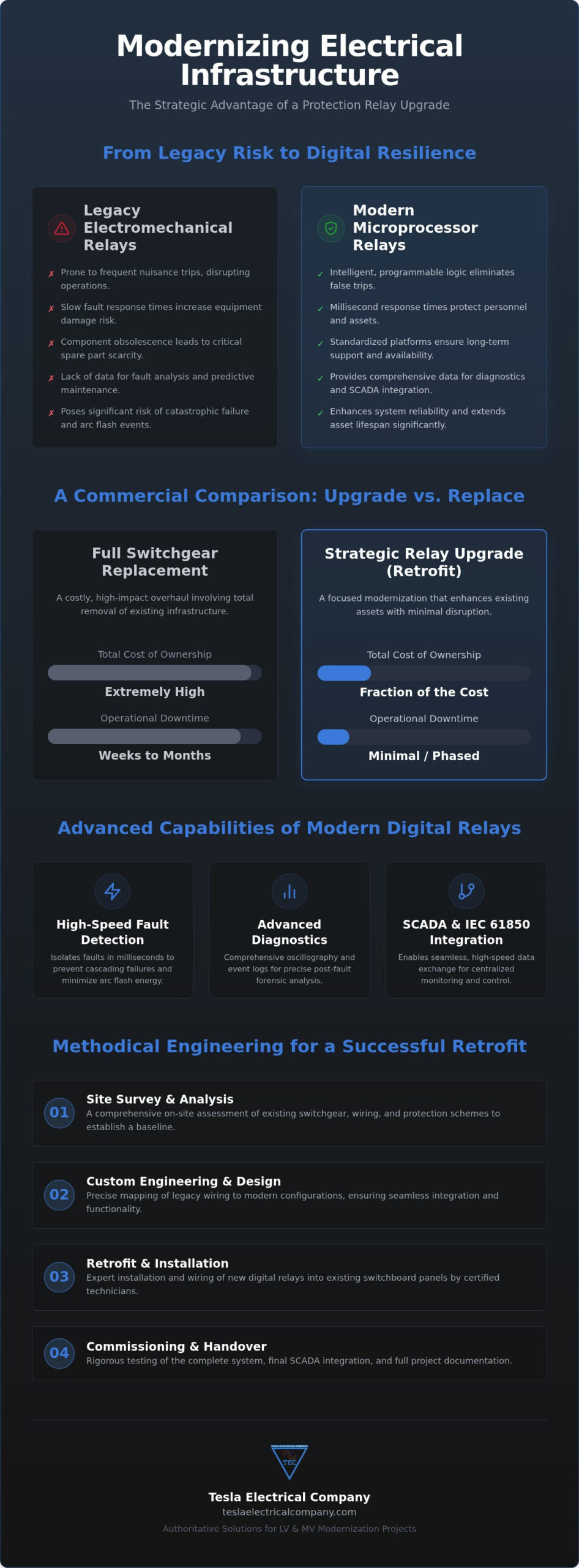
A protection relay upgrade represents a fundamental shift from reactive hardware to intelligent, programmable logic. It isn’t merely a maintenance task; it’s a strategic modernization of the sensing and tripping mechanisms that safeguard critical industrial assets. In the current industrial landscape, the Protective relay has evolved from simple induction disc models to high-speed numerical processors capable of millisecond response times. Continuing to rely on legacy systems creates a vulnerability gap that modern infrastructure cannot afford to ignore.
System reliability depends on the speed and accuracy of fault detection. Modernizing these components directly impacts system resilience by reducing the energy released during an arc flash event. This protects personnel and minimizes physical damage to switchboards and connected machinery. From a compliance perspective, keeping pace with NEC 2026 updates is often a prerequisite for maintaining insurance coverage and meeting stringent industrial safety certifications. A methodical upgrade ensures your facility remains compliant while significantly lowering the risk of catastrophic equipment failure.
Addressing Component Obsolescence and Spare Part Scarcity
The lifecycle of industrial electronics has shortened, leaving many 20-year-old relay models without manufacturer support. Sourcing components from the secondary market introduces unacceptable risks, as these parts often lack verified calibration or known service histories. Relying on unverified spare parts is a high-risk strategy that can lead to unexpected system behavior during a fault. By standardizing on a modern digital platform, organizations simplify their maintenance inventories and ensure long-term availability of technical support. This proactive approach eliminates the frantic search for “new old stock” during an unplanned outage.
Enhancing Fault Detection and System Sensitivity
Legacy protection often relies on crude, fixed-time overcurrent settings that lack the nuance required for sensitive equipment. A protection relay upgrade introduces sophisticated curve modeling that aligns with the specific thermal limits of transformers and motors. High-speed digital processing allows the system to detect and isolate faults in milliseconds, preventing the cascading failures that lead to total system blackouts. This precision is vital for protecting high-value assets from the cumulative stress of minor electrical disturbances. Modern relays utilize advanced logic and programmable curves to distinguish between transient surges and genuine faults, effectively eliminating the frequent nuisance tripping that plagues aging electromechanical systems.
Evaluating Digital Protection Relay Features and Capabilities
The transition from electromechanical units to microprocessor-based logic marks a significant advancement in power system management. A protection relay upgrade enables the implementation of high-speed processing and advanced communication protocols that legacy systems simply cannot support. Central to this modernization is the adoption of the IEC 61850 standard. This protocol facilitates seamless interoperability and high-speed data exchange across the industrial network. Unlike legacy units, modern digital relays include internal self-diagnostics and watchdog timers. These features continuously monitor the relay’s own hardware and software integrity, ensuring the device remains functional and ready to trip when a fault occurs.
These devices serve as the critical data nodes within broader SCADA and automation system solutions, providing real-time visibility into electrical parameters. This connectivity allows operators to monitor system health from a centralized interface, enhancing situational awareness across the entire facility.
Comprehensive Disturbance Recording and Diagnostics
Modern digital relays provide comprehensive oscillography and event logging capabilities. This data allows for precise post-fault forensic analysis, identifying the exact nature and location of a disturbance. Engineers utilize these insights to support predictive maintenance programs by monitoring trends in load and fault history over time. By providing clear fault location data, these units significantly reduce the Mean Time to Repair (MTTR). Maintenance teams can bypass tedious manual troubleshooting and restore service with confidence, knowing exactly where the fault originated.
Programmable Logic and Multi-Function Protection
The ability to consolidate multiple discrete relays into a single multi-function unit is a major engineering advantage. Digital platforms allow for customized logic specifically designed for complex generator synchronizing control panels. This integration ensures that protection settings remain coordinated even during intricate load-sharing operations. Adaptive protection settings further enhance this by automatically adjusting relay sensitivity based on varying load conditions or system configurations. This flexibility is essential for maintaining stability in facilities with fluctuating power demands.
In high-availability environments, upgrading to digital relays strengthens the redundant system architecture. By utilizing dual-redundant communication paths and mirrored protection logic, facilities achieve a level of resilience that legacy electromechanical systems cannot replicate. For organizations seeking to fortify their power infrastructure, Tesla Electrical Company provides authoritative retrofit of circuit breakers and protection relays that align with these modern standards.
Retrofit vs. Full Switchboard Replacement: A Commercial Comparison
Deciding between a comprehensive switchboard replacement and a targeted protection relay upgrade is a pivotal commercial decision for any industrial facility. While new equipment offers a psychological sense of security, the Total Cost of Ownership (TCO) often favors the retrofit approach. A full replacement involves far more than the sticker price of the hardware. It requires significant civil works, the rerouting of high-voltage cabling, and the complex disposal of existing structures. By focusing on the protection logic, facilities can achieve modern performance standards without the logistical burden of a complete system overhaul.
Extending the life of existing steel and copper components is also an environmentally responsible choice. Industrial assets are resource-intensive. Modernizing the control and protection elements allows these materials to remain in service for another 15 to 20 years. This significantly reduces the carbon footprint associated with manufacturing and transporting new switchgear while preserving the capital already invested in the physical infrastructure.
Cost-Benefit Analysis of Modernization
From a financial perspective, a protection relay upgrade typically falls under a manageable Capital Expenditure (CAPEX) budget while delivering immediate reductions in Operational Expenditure (OPEX). The Return on Investment (ROI) is realized through improved power quality and the elimination of nuisance trips that halt production lines. Advanced power system protection relays protect high-value assets by providing precise fault isolation that prevents minor disturbances from causing permanent damage to expensive motors and transformers.
Minimizing Operational Downtime through Phased Retrofitting
For continuous processes, downtime is the single most significant cost factor. Phased retrofitting allows engineers to upgrade relays during scheduled maintenance windows, often one bay at a time. This approach maintains partial facility operation and mitigates the risk of a total plant shutdown. Modern retrofit kits utilize “Plug-and-Play” designs that match the physical footprint of legacy devices, reducing the time required for mechanical modifications. Benefits of this methodical transition include:
- Reduced installation time: Prefabricated mounting plates and wiring harnesses accelerate the physical transition.
- Incremental testing: Each bay can be commissioned and verified independently before moving to the next section.
- Minimal cable disturbance: Reusing existing power cables avoids the high cost and risk of pulling new runs through aging conduits.
Risk mitigation is central to this process. By upgrading in stages, technical teams can ensure the stability of the remaining system while integrating new digital logic. This level of control is impossible during a full replacement, where the entire system must be de-energized for an extended period.
Engineering a Successful Protection Relay Upgrade Methodology
A successful protection relay upgrade requires a systematic engineering approach that extends far beyond simple component replacement. It begins with a comprehensive audit of the existing infrastructure to ensure new digital logic aligns perfectly with legacy primary equipment. This process demands a deep understanding of how modern microprocessor-based devices interact with older switchgear. Tesla Electrical Company manages this entire lifecycle, providing the specialized expertise needed to transition complex LV and MV systems without compromising operational integrity.
Mapping legacy point-to-point wiring to modern digital terminal configurations is a meticulous task. It requires translating 20-year-old schematics into contemporary digital input/output assignments. This ensures that every signal, from trip commands to status indications, is correctly interpreted by the new system. Without this rigorous attention to detail, the advantages of modern protection logic can be undermined by installation errors or signal mismatches.
Protection coordination studies are a critical component of this methodology. These studies ensure that the new relay settings are synchronized with upstream and downstream devices, preventing wide-scale outages during localized faults. Secondary injection testing serves as the final validation, simulating actual fault currents to verify the relay’s response time and tripping logic under real-world conditions. This comprehensive testing protocol ensures that the system will perform exactly as designed when a genuine fault occurs.
Site Survey and Documentation Review
Engineers must verify the current transformer (CT) and potential transformer (PT) ratios, ensuring the burden requirements of the new digital relay are compatible with existing sensors. Physical mounting constraints often pose challenges in legacy switchgear. Consequently, custom mounting plates or adapter kits are frequently designed during this phase to maintain the professional appearance and structural integrity of the switchboard. Reviewing historical fault data allows for the optimization of new settings, ensuring the protection curves are tailored to the actual operating environment rather than generic factory defaults.
Configuration, Testing, and Commissioning
Developing logic files and setting groups is a precise task that requires deep familiarity with specific industrial applications. Before on-site installation, Factory Acceptance Testing (FAT) verifies the relay logic in a controlled environment. Once installed, Site Acceptance Testing (SAT) confirms the relay communicates correctly with the circuit breaker and secondary circuits. This phase also includes training personnel on the new digital interface and software tools, empowering your team to utilize advanced diagnostics. For professional assistance with your infrastructure, consult with the experts at Tesla Electrical Company to begin your comprehensive site audit.
Tesla Electrical Company: Authoritative Retrofit and Modernization Solutions
Tesla Electrical Company operates as a premier specialist in the design and execution of industrial power modernization. Our team brings deep-seated technical proficiency to every protection relay upgrade, addressing the unique requirements of both low voltage (LV) and medium voltage (MV) environments. Unlike providers who offer generic replacement kits, we prioritize a holistic engineering approach that respects the existing investment in your infrastructure while introducing the precision of modern digital logic. This commitment to excellence ensures that your facility maintains the highest standards of reliability and safety.
Our engineering philosophy is rooted in human-centric expertise. We recognize that every industrial site has a specific history and operational rhythm. By providing customized solutions rather than off-the-shelf products, we empower our clients to navigate the complexities of aging infrastructure with confidence. This authoritative guidance is essential for facilities that require engineering critical power redundant systems to maintain continuous operations without interruption.
Custom Retrofit Engineering for Diverse Industrial Environments
We specialize in bridging the gap between legacy hardware and modern digital standards. Our technical team designs bespoke mounting plates and wiring harnesses that allow for the seamless installation of new relays into legacy switchgear cubicles. This capability is particularly vital when integrating multi-vendor equipment into a unified protection strategy. We don’t just replace a component; we engineer a cohesive system. To support this, we maintain a dedicated inventory of spare parts, ensuring that retrofitted assets remain serviceable for their extended lifespans.
Total Solution Provider: From Design to Execution
Tesla Electrical Company manages the entire modernization lifecycle with a steady and methodical hand. Our role as a total solution provider means we take full responsibility for the project, from initial site documentation to final commissioning. This includes ensuring that new relays are perfectly integrated with existing PLC and SCADA systems, providing a transparent data flow across your entire network. Our partnership doesn’t end at commissioning. We provide ongoing technical support and proactive maintenance for all upgraded assets, fostering a long-term relationship built on trust and technical rigor. This end-to-end oversight mirrors the systematic nature of the industries we serve, providing a sense of security for even the most high-stakes technical requirements.
Securing Your Infrastructure Through Strategic Modernization
Modernizing your power system protection isn’t just about replacing a component; it’s about fortifying the core of your industrial operation. A targeted protection relay upgrade provides a cost-efficient path to enhanced system reliability without the logistical complexities of a full switchboard replacement. By integrating advanced digital logic and high-speed communication protocols, you transform legacy assets into intelligent nodes within your SCADA network. This strategic intervention ensures compliance with the latest 2026 standards and mitigates the risks associated with component obsolescence.
Tesla Electrical Company offers comprehensive expertise in LV and MV switchboards, generator synchronizing, and specialized redundant control system architecture. Our methodical retrofit and modernization services are designed to manage the entire project lifecycle with precision and technical rigor. Request an Engineering Consultation for Your Protection Relay Upgrade to evaluate your system’s current state and develop a robust path forward. Taking proactive steps today ensures the longevity and resilience of your power infrastructure for decades to come.
Frequently Asked Questions
What are the primary indicators that a protection relay needs an upgrade?
Primary indicators include frequent nuisance tripping, the unavailability of manufacturer spare parts, and failure to meet current response time requirements. If your electromechanical relays show physical signs of wear like carbon buildup or sluggish induction discs, a protection relay upgrade is necessary. These symptoms suggest the device can no longer provide reliable protection against faults, potentially leading to catastrophic equipment damage or prolonged operational downtime in industrial environments.
How long does a typical protection relay retrofit take per breaker?
A typical retrofit for a single breaker generally requires four to eight hours for physical installation and wiring. This timeline excludes the initial site survey and the final commissioning phase, which involves secondary injection testing to verify logic. Complex applications, such as those involving generator synchronizing control panels, may require additional time for logic verification. Phasing the work during planned maintenance windows ensures that production impact remains minimal and controlled.
Can modern digital relays be integrated into 30-year-old switchgear?
Modern digital relays can be successfully integrated into thirty-year-old switchgear through bespoke engineering and custom mounting plates. While the primary equipment remains sound, the sensing logic requires modernization to interface with modern SCADA systems. Engineers design specialized wiring harnesses to bridge the gap between legacy analog signals and digital inputs. This approach extends the lifespan of the original switchboard while providing the diagnostic capabilities found in contemporary electrical infrastructure.
What is the difference between a relay retrofit and a circuit breaker retrofit?
A relay retrofit focuses on the brain of the system, modernizing the sensing and tripping logic used to detect faults. In contrast, a circuit breaker retrofit involves replacing the physical mechanism that interrupts the current flow. While they are distinct services, performing both simultaneously often provides the most comprehensive reliability improvement. Tesla Electrical Company specializes in both disciplines, ensuring that the new relay logic and the breaker’s physical operation are perfectly synchronized.
Does a protection relay upgrade require a new protection coordination study?
Yes, a new protection coordination study is essential whenever you perform a protection relay upgrade. Modern digital relays offer far more precise tripping curves than legacy electromechanical units, which can alter how the device interacts with upstream and downstream protection. The study ensures that faults are isolated at the nearest possible point to the disturbance. This prevents wide-scale outages and maintains the integrity of your facility’s entire power distribution network.
How does upgrading relays improve the safety of my electrical maintenance team?
Upgrading to digital relays significantly improves safety by reducing the energy released during an arc flash event through faster tripping speeds. Many modern units support remote monitoring and wireless configuration, allowing technicians to pull disturbance logs without entering the arc flash boundary. These features minimize the time personnel spend in high-risk zones. Improved diagnostics also provide clear fault location data, reducing the need for dangerous manual troubleshooting on energized equipment.
What communication protocols should I look for in a new protection relay?
You should prioritize relays that support the IEC 61850 standard to ensure long-term interoperability and high-speed data exchange. Other essential protocols include Modbus TCP/IP for integration with standard SCADA systems and DNP3 for robust communication in utility-scale applications. Selecting a device with multiple protocol support allows for seamless integration into existing PLC control systems. This connectivity is vital for real-time monitoring and advanced power quality analysis across your industrial facility.
Can I perform a protection relay upgrade while the plant is partially energized?
It’s possible to perform an upgrade while a plant is partially energized, provided that the specific bay being worked on is completely isolated. Engineers utilize a phased approach to migrate protection logic one section at a time during scheduled windows. This strategy requires meticulous planning and clear isolation boundaries to protect both the technicians and the remaining operational load. It’s a common method for maintaining production continuity in facilities that cannot tolerate total blackouts.
Disclaimer
Some content, images, text, or other materials on this website may have been created or assisted by artificial intelligence (AI).
While we review AI-generated content for accuracy and quality, we do not guarantee that all information is free from errors or omissions.
Content generated using AI is provided for informational purposes only and should not be solely relied upon without independent verification.