
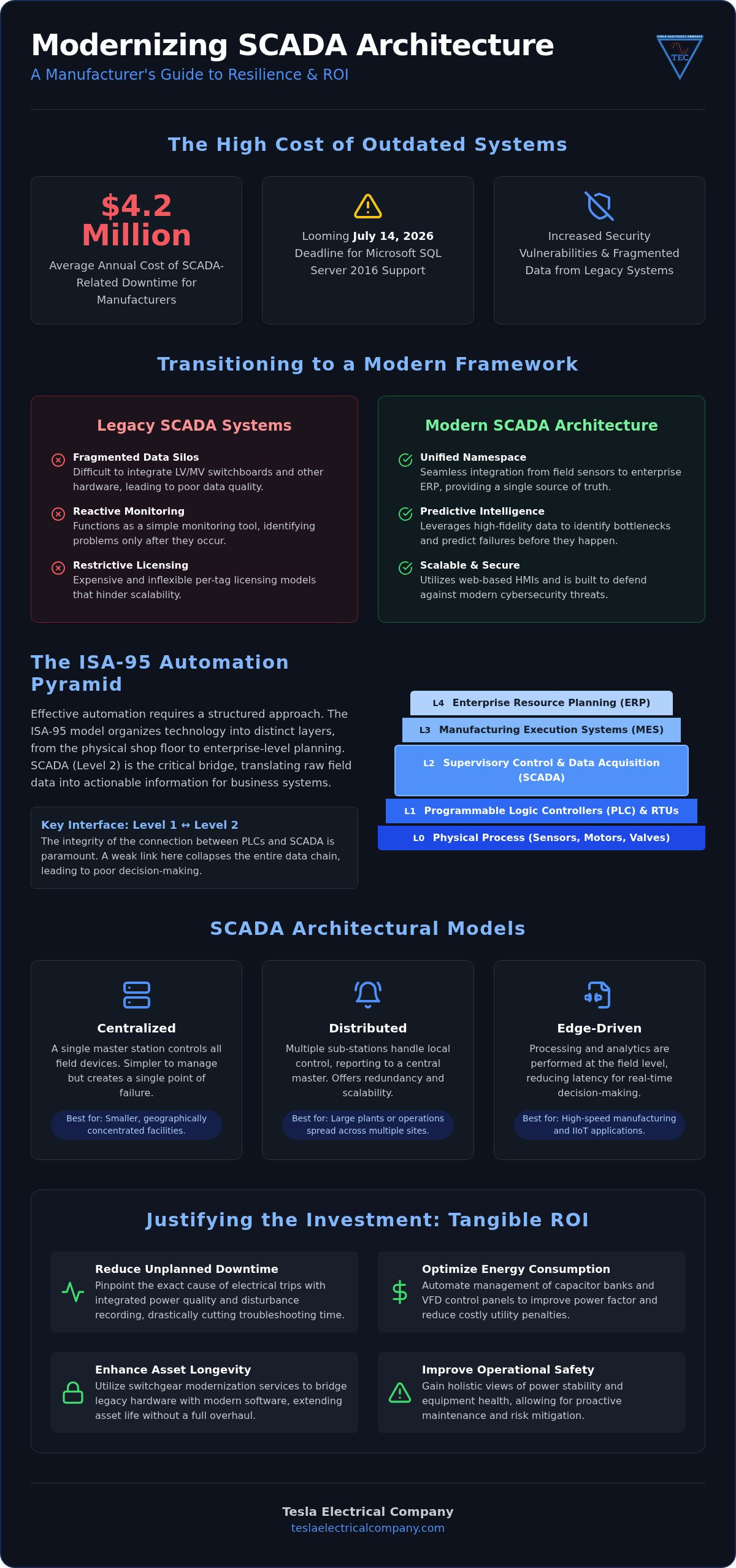
The average annual cost of SCADA-related downtime for manufacturers has reached $4.2 million. It’s a figure that underscores the critical need for architectural rigor, especially as the July 14, 2026, deadline for Microsoft SQL Server 2016 support approaches. Most facility directors recognize the difficulty of justifying automation expenses when existing SCADA system architecture for manufacturing fails to integrate seamlessly with legacy LV and MV switchboards. This misalignment often results in fragmented data, increased security vulnerabilities, and heightened operational risk.
We understand that your primary objective is a stable, high-performance environment that delivers a clear return on investment. This guide provides the technical roadmap to achieve that balance by leveraging the latest ANSI/ISA-112.00.01-2025 standards and sophisticated redundant systems. We will explore how to transition from restrictive per-tag licensing to scalable, web-based HMIs and unified namespaces. This methodical approach ensures your infrastructure, from VFD control panels to generator synchronizing units, is not only secure against 2026 cybersecurity threats but also optimized for long-term growth.
Key Takeaways
- Understand how a robust SCADA system architecture for manufacturing transitions your facility from basic monitoring to predictive intelligence, driving measurable ROI.
- Identify the essential hardware components, including high-performance PLCs and redundant systems, required to ensure resilient field-level data acquisition.
- Compare centralized, distributed, and edge-driven architectural models to select the framework that best supports your specific operational scale and security needs.
- Learn to justify capital expenditure by quantifying the cost of unplanned downtime and identifying efficiency gains through capacitor banks and power quality monitoring.
- Discover the engineering advantages of a “total solution” approach that seamlessly integrates automation software with high-quality LV/MV switchboards.
The Strategic Role of SCADA System Architecture in Manufacturing ROI
In the high-stakes environment of modern production, SCADA architecture functions as the definitive backbone of industrial data and control. It’s the central nervous system that translates raw electrical signals into actionable business intelligence. While legacy systems were often treated as simple monitoring tools, a sophisticated Supervisory control and data acquisition (SCADA) framework now serves as the primary driver for operational excellence. Decisions made during the design of your SCADA system architecture for manufacturing dictate your facility’s ability to scale, respond to market shifts, and maintain a competitive cost structure over a fifteen year lifecycle.
The industry has moved beyond reactive observation. We’ve entered an era of predictive manufacturing intelligence where the architecture must support advanced data modeling. If your data is siloed or inaccurate, your throughput suffers. High-fidelity data acquisition ensures that every millisecond of production is accounted for, allowing engineers to identify bottlenecks before they result in a line stoppage. This precision directly impacts long-term operational expenditure (OPEX) by reducing the labor hours required for troubleshooting and manual data entry.
Understanding the Layers of Industrial Automation
Effective automation relies on a hierarchical structure known as the ISA-95 model, which organizes technology into distinct levels. Level 0 and Level 1 represent the physical sensors and the PLC control systems for process control PID that execute immediate logic. Level 2 is where the SCADA layer resides, acting as the critical interface between the shop floor and the broader enterprise levels, such as Manufacturing Execution Systems (Level 3) and ERP (Level 4). SCADA architecture is the integration of hardware, software, and communication protocols for real-time industrial oversight. The integrity of the interface between Level 1 and Level 2 is paramount; if this connection is weak, the entire data chain collapses, leaving decision-makers with outdated or incorrect information.
The Business Case for Modern SCADA Integration
Justifying the capital investment for a new SCADA system architecture for manufacturing requires a focus on tangible asset performance. Modernization is not merely a software update; it is a strategic reinforcement of your physical infrastructure. By integrating a power quality and disturbance recording system directly into your SCADA framework, you can pinpoint the exact cause of electrical trips, significantly reducing the duration of unplanned downtime. Efficiency is further enhanced through the automated management of capacitor banks and VFD control panels, which optimize energy consumption and reduce utility penalties. For facilities operating on older platforms, utilizing professional switchgear modernization services provides a cost-effective path to bridge the gap between legacy LV/MV hardware and high-performance automation software, ensuring system longevity without the need for a total facility overhaul.
Critical Components of a Resilient SCADA Framework
Integrating the digital “brain” with the physical “body” of an industrial facility is the primary challenge in modern engineering. A resilient SCADA system architecture for manufacturing relies on high-performance PLCs and Remote Terminal Units (RTUs) that can withstand harsh environments while providing millisecond-accurate data acquisition. These field-level devices serve as the primary source of truth for the supervisory layer, making their reliability non-negotiable for facilities targeting high OEE standards.
Hardware Foundation: Switchboards and Control Panels
LV and MV switchboards must be designed as SCADA-ready assets rather than passive distribution points. This requires the integration of power quality and disturbance recording equipment to capture transient events that traditional monitoring might miss. When generator synchronizing control panels are tied into the SCADA layer, operators gain a holistic view of power stability, which is vital for maintaining uptime in high-stakes environments. Precision at the motor level is also essential, often achieved through sophisticated industrial VFD control panel design that allows for granular speed control and energy monitoring.
Software and Data Management Layers
The software architecture must support robust data management through centralized database servers, or Historians. These systems store vast quantities of process data for long-term trend analysis and regulatory compliance. With the July 2026 end-of-support deadline for Microsoft SQL Server 2016 approaching, migrating to modern database backends like PostgreSQL or updated SQL versions is a priority for architectural security. Effective alarm management strategies are equally critical; they prevent operator fatigue by prioritizing urgent alerts over routine status updates. Within this framework, PLC control systems handle complex process control PID loops, ensuring variables like temperature and pressure remain within precise tolerances.
Interoperability depends on balancing legacy Modbus communication with modern protocols such as MQTT and OPC UA. The recent release of OPC UA Part 14 PubSub (EN IEC 62541-14:2026) provides a new standard for native protocol coverage, reducing latency in data-heavy environments. Academic research into the Critical Components of a Resilient SCADA Framework confirms that protocol choice dictates the system’s overall security posture and its ability to integrate with cloud-based analytics. A well-engineered architecture ensures that every motor, switch, and sensor communicates effectively. If you’re planning a system overhaul, it’s beneficial to consult with experts who specialize in SCADA & automation systems to ensure your hardware and software layers are perfectly aligned.
Evaluating Architectural Models: Centralized, Distributed, and Edge-Driven SCADA
Selecting an appropriate SCADA system architecture for manufacturing is a decision that impacts every tier of production. A centralized model offers a unified management interface, making it an excellent choice for single-site facilities where simplicity and direct oversight are prioritized. However, as operations expand, the limitations of a single server become apparent. Distributed SCADA addresses this by spreading supervisory tasks across multiple nodes, providing the resilience and scalability required for multi-site manufacturing. This model ensures that a failure in one area doesn’t result in a total facility shutdown.
Edge-driven SCADA has emerged as a critical trend for 2026. By processing data at the “edge”, closer to the actual machinery, facilities can significantly reduce latency and bandwidth costs. This is particularly important for high-speed processes where deterministic control is mandatory. A hybrid approach often yields the best results, maintaining local control for real-time operations while utilizing cloud-based analytics for long-term strategic planning and predictive maintenance. This balance allows for high-level visibility without sacrificing the speed of local execution.
Redundancy: Engineering Industrial Resilience
System availability is the cornerstone of industrial success. Implementing a redundant control system architecture is the most effective way to eliminate single points of failure. In high-stakes environments, a hot-standby configuration ensures a seamless transfer of control between primary and secondary servers without data loss. Conversely, warm-standby models offer a cost-effective alternative for less critical processes where a brief transition period is acceptable. Network redundancy is equally vital; utilizing ring topologies and redundant managed switches ensures that communication remains intact even if a physical cable is damaged.
Selecting the Right Model for Your Infrastructure
The choice between centralized and distributed models depends on your facility’s size and data volume. It’s not just a software decision; the digital framework dictates the requirements for your physical hardware. For instance, the complexity of your industrial switchboard design must mirror the sophistication of your SCADA layer. A distributed system may require more intelligent, communicative switchgear at various points across the factory floor. Future-proofing your system for Industry 4.0 means ensuring your architecture supports IIoT integration, allowing for a “Unified Namespace” where SCADA acts as a structured data publisher for enterprise-wide AI and machine learning initiatives. This methodical alignment between hardware and software ensures that your investment remains relevant as industrial standards continue to evolve.
Justifying Automation Project ROI: A Practical Buying Framework
Securing capital for industrial upgrades requires a shift from technical specifications to financial outcomes. A well-designed SCADA system architecture for manufacturing is not a cost center; it’s a primary mechanism for value protection. To justify the investment to stakeholders, engineers must present a framework that accounts for both immediate savings and long-term risk mitigation. This methodical approach ensures that every dollar spent on automation correlates with a reduction in operational waste.
Step 1 involves quantifying the cost of unplanned downtime. With the average annual cost of SCADA-related downtime reaching $4.2 million according to 2026 iFactory Platform Intelligence data, the cost of inaction is often higher than the system investment. Step 2 focuses on energy savings. By integrating capacitor banks and VFD control panels, facilities can eliminate reactive power penalties and reduce peak demand charges through intelligent load shedding. Labor efficiency represents Step 3. Modern platforms can reduce operator response time by 60-80% through automated reporting and high-precision PLC control systems for process control PID. Step 4 evaluates the risk-mitigation value of a Redundant System, which ensures continuous operation during server failures. Finally, Step 5 projects equipment lifespan extension; SCADA-driven maintenance based on real-time wear data can improve Overall Equipment Effectiveness (OEE) by 12-22%.
The Financial Impact of Power Quality
Hidden costs often reside within the electrical distribution network, far below the visibility of standard monitoring. By interpreting power quality analysis reports, facilities can identify harmonic distortions that lead to premature component failure and increased energy consumption. SCADA-integrated disturbance recording prevents catastrophic motor and transformer failures by capturing high-speed transient data before a failure occurs. This proactive oversight shifts the maintenance model from reactive to predictive, ensuring that your SCADA system architecture for manufacturing protects your most expensive physical assets.
Total Cost of Ownership (TCO) vs. Initial CAPEX
Stakeholders often fixate on initial CAPEX, yet the TCO provides a more accurate financial picture over the system’s lifecycle. This includes software licensing, hardware maintenance, and training over a 10-15 year period. Retrofitting legacy infrastructure, such as the retrofit of circuit breakers and protection relays, allows for a phased modernization that reduces the initial capital requirement without sacrificing performance. Most facilities report a 3-5 year ROI timeline for comprehensive SCADA modernization, particularly when integrating power hardware with automation software. If you’re ready to build a business case for your facility, explore our SCADA and automation system solutions to see how integrated engineering drives profitability.
Partnering for Excellence: Implementing Tesla Electrical’s Automation Solutions
Achieving a resilient SCADA system architecture for manufacturing requires more than a software license; it demands a partner capable of bridging the gap between high-level data acquisition and physical power distribution. Tesla Electrical Company functions as a total solution provider, ensuring that the digital supervisory layer is perfectly synchronized with the facility’s electrical “body.” This holistic approach eliminates the common friction points between automation software and power hardware, such as LV and MV switchboards. By aligning these components from the design phase, we provide a foundation that supports both deterministic control and long-term operational stability.
Our engineering team specializes in the development of SCADA and automation system solutions that are tailored to high-stakes industrial environments. This includes the implementation of a Redundant System to eliminate single points of failure and the design of custom generator synchronizing control panels for reliable backup power. Every project we undertake is engineered to meet rigorous national industrial and electrical safety standards, providing the security and compliance necessary for modern manufacturing infrastructure.
End-to-End Project Management
Our methodology encompasses the entire lifecycle of industrial automation, beginning with initial design and engineering and culminating in rigorous site commissioning. We prioritize system longevity by ensuring that every deployment is supported by ongoing technical assistance and a comprehensive inventory of spare parts. For facilities operating with legacy equipment, we offer specialized retrofit of circuit breakers and protection relays. This service allows for the integration of modern monitoring capabilities into existing switchgear, providing a cost-effective path to digital transformation without the necessity of a total hardware overhaul. This systematic oversight ensures that your infrastructure remains reliable as your production requirements evolve.
Next Steps for Your Manufacturing Facility
Modernizing your SCADA system architecture for manufacturing is a strategic process that begins with a clear understanding of your current technical state. The first step involves conducting a comprehensive system audit and power quality assessment to identify vulnerabilities and hidden inefficiencies. Based on these findings, we develop a phased modernization roadmap that allows you to manage capital expenditure while achieving incremental performance gains. This structured progression ensures that your facility moves toward Industry 4.0 readiness with minimal disruption to active production lines. Contact Tesla Electrical Company today for a technical consultation to discuss how our integrated engineering services can secure your industrial future and drive measurable ROI.
Securing Your Industrial Future Through Integrated Engineering
The evolution of industrial automation requires a move away from fragmented systems toward a unified approach. A well-engineered SCADA system architecture for manufacturing acts as the definitive bridge between your physical power assets and digital intelligence. By prioritizing high-performance hardware, such as LV/MV switchboards and generator synchronizing panels, alongside advanced supervisory software, facilities can effectively mitigate the high costs associated with unplanned downtime. It’s a strategic shift that transforms raw data into a measurable competitive advantage.
Resilience is achieved through the intentional design of redundant systems and the strategic modernization of legacy infrastructure. Whether you’re implementing edge-driven processing to reduce latency or retrofitting circuit breakers to extend asset life, the objective remains a stable, high-OEE environment. As redundant system specialists and comprehensive switchboard manufacturers, we maintain an extensive spare parts inventory and dedicated technical support to ensure your facility operates at peak efficiency long after commissioning. This methodical alignment between hardware and software is the only way to ensure long-term stability.
Consult with our engineering experts to design your SCADA architecture and take the first step toward a more secure, data-driven production facility. Your path to measurable automation ROI begins with a robust architectural foundation.
Frequently Asked Questions
What is the difference between SCADA and PLC in manufacturing?
A PLC executes real-time logic and control for specific machinery, while SCADA provides the supervisory software layer for data visualization and facility-wide oversight. PLCs operate at Level 1 of the automation hierarchy, handling deterministic tasks. SCADA sits at Level 2, collecting data from various PLCs to provide a holistic view of the process. You don’t have a modern supervisory system without reliable PLC control systems for process control PID to handle the underlying field logic.
How does SCADA system architecture improve manufacturing ROI?
High-quality SCADA system architecture for manufacturing improves ROI by minimizing the average $4.2 million annual cost of unplanned downtime. It achieves this through predictive maintenance alerts and real-time disturbance recording. By optimizing the operation of capacitor banks and VFDs, the system reduces energy consumption and utility penalties. These efficiency gains, combined with automated reporting, typically result in a full return on investment within a three to five year timeline.
Can I integrate a new SCADA system with my existing legacy switchboards?
You can absolutely integrate modern SCADA with legacy LV and MV switchboards through professional retrofitting services. This process involves replacing outdated protection relays and circuit breakers with communicative versions that support modern protocols like MQTT or OPC UA. This approach allows you to gain advanced monitoring capabilities without the prohibitive cost of a complete hardware replacement. It’s an effective way to bridge the gap between aging infrastructure and Industry 4.0 standards.
What are the security risks associated with SCADA architecture?
Security risks often stem from the use of legacy software, such as systems still relying on Microsoft SQL Server 2016 after its July 2026 support expiration. These vulnerabilities allow for unauthorized access to industrial control networks. Modern architecture mitigates these risks by implementing ISA/IEC 62443 standards and utilizing encrypted communication protocols. Regular system audits and the use of redundant, secure servers are essential to protect your critical industrial data from cyber threats.
Why is redundancy critical in SCADA architecture design?
Redundancy is critical because it eliminates single points of failure that could lead to a total facility shutdown. A redundant system utilizes hot-standby or warm-standby configurations to ensure that if a primary server or controller fails, a secondary unit takes over seamlessly. This level of engineering is vital for high-stakes environments where even a few minutes of downtime results in significant financial loss. It provides the stability required for continuous manufacturing operations.
How do VFD control panels integrate into a SCADA system?
VFD control panels integrate into the SCADA layer via digital communication protocols to provide real-time data on motor speed, torque, and energy consumption. This connection allows the supervisory system to adjust drive parameters automatically based on process requirements. By centralizing the control of VFDs, operators can optimize throughput and identify mechanical wear before it leads to failure. This integration is a cornerstone of precise, energy-efficient SCADA system architecture for manufacturing.
What is the typical lifespan of a modern SCADA system?
A modern SCADA system typically has a functional lifespan of 10 to 15 years, though this requires periodic software updates and hardware maintenance. While the core physical infrastructure like switchboards lasts longer, the software and communication layers evolve more rapidly. We recommend a phased modernization roadmap to ensure your system remains compatible with new cybersecurity standards and industrial protocols. This proactive approach prevents the technical debt associated with running obsolete automation platforms.
How does power quality monitoring benefit a SCADA architecture?
Power quality monitoring provides the SCADA system with visibility into harmonic distortions, voltage sags, and transients that can damage sensitive electronics. By integrating a power quality and disturbance recording system, you can identify the root cause of electrical trips and equipment failure. This data allows for the intelligent management of capacitor banks to improve power factor. It ultimately protects your physical assets from premature wear and ensures the reliability of your entire electrical distribution network.
Disclaimer
Some content, images, text, or other materials on this website may have been created or assisted by artificial intelligence (AI).
While we review AI-generated content for accuracy and quality, we do not guarantee that all information is free from errors or omissions.
Content generated using AI is provided for informational purposes only and should not be solely relied upon without independent verification.