
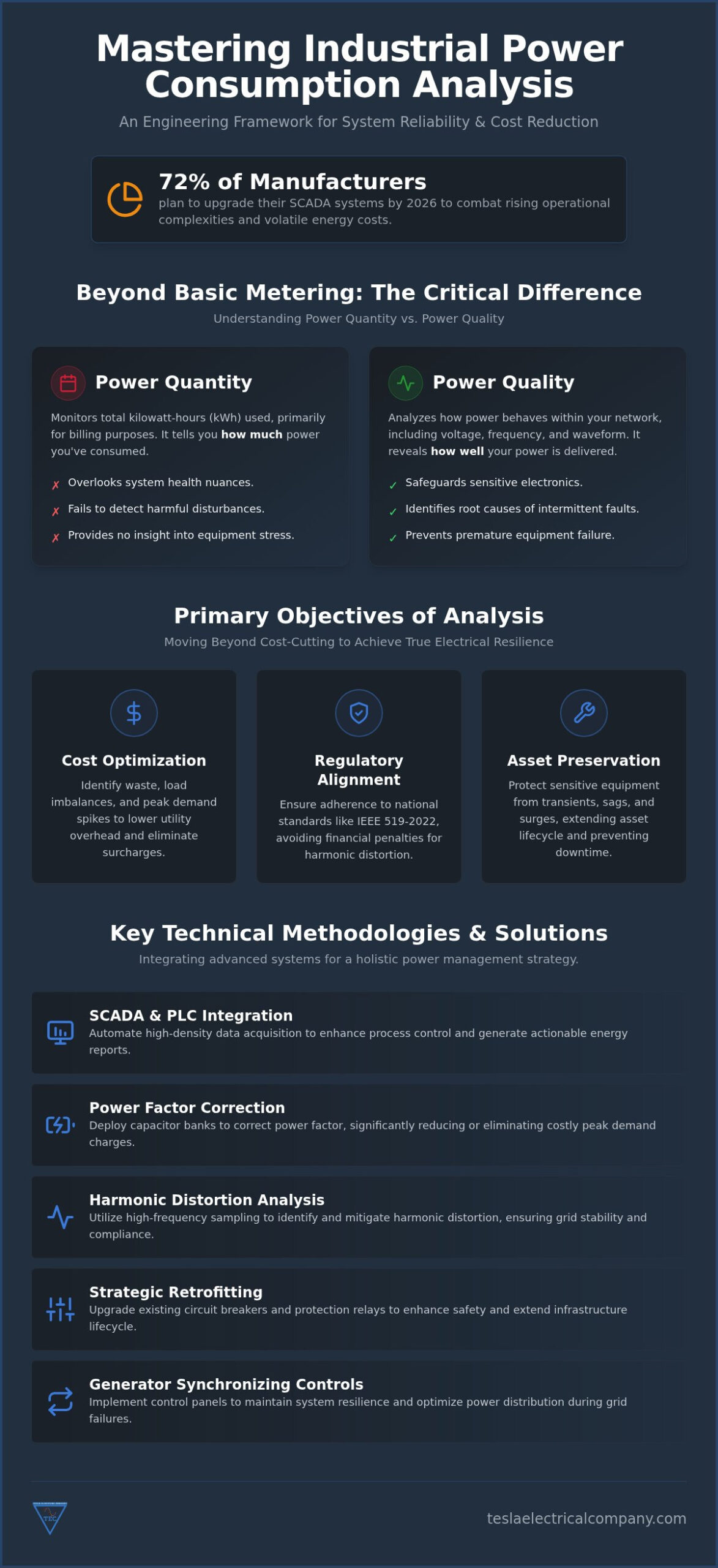
Recent industry data indicates that 72 percent of manufacturers intend to upgrade their SCADA systems by 2026 to combat rising operational complexities and volatile energy costs. You likely recognize that managing a modern industrial facility requires more than just maintaining basic uptime; it demands a rigorous industrial power consumption analysis to mitigate high energy overhead and prevent frequent electrical disturbances that threaten production continuity. Integrating legacy switchgear with sophisticated monitoring software remains a persistent technical hurdle for many engineering teams seeking to stabilize their infrastructure while maintaining high standards of excellence.
This article provides a comprehensive engineering framework to help you master the technical methodologies required to enhance system reliability and reduce operational costs. We will examine the diagnostic protocols necessary to identify harmonic distortion, the implementation of capacitor banks for power factor correction, and the deployment of SCADA systems to transform complex data into actionable energy reports. This systematic oversight ensures your facility operates with the precision and excellence required in a demanding industrial landscape, moving beyond simple cost-cutting to achieve true electrical resilience and asset longevity.
Key Takeaways
- Learn to differentiate between basic energy metering and comprehensive power quality analysis to safeguard your facility against complex system disturbances.
- Discover how a systematic industrial power consumption analysis serves as the diagnostic foundation for deploying capacitor banks and VFD control panels.
- Understand the integration of SCADA and PLC control systems for automating high-density data acquisition and enhancing process PID efficiency.
- Evaluate the technical advantages of retrofitting circuit breakers and protection relays to extend the lifecycle of existing electrical infrastructure.
- Explore the role of Generator Synchronizing Control Panels in maintaining system resilience and optimizing power distribution across MV and LV switchboards.
Defining the Scope of Industrial Power Consumption Analysis
Industrial power consumption analysis represents a rigorous, systematic evaluation of electrical loads across an entire facility. It isn’t a mere accounting exercise. Instead, it’s a diagnostic framework designed to map the flow of energy from the point of entry at MV switchboards down to individual process PID controls. With the industrial sector accounting for a significant portion of global electricity consumption, precision in monitoring is no longer optional. For high-stakes environments, data-driven decisions provide the stability needed to manage complex infrastructure without the risk of unplanned downtime. This systematic oversight allows facility managers to move from reactive maintenance to a predictive model, ensuring that every kilowatt utilized contributes to production efficiency rather than system strain.
The primary objectives of this analytical process extend beyond simple savings. A comprehensive framework focuses on several key performance indicators:
- Cost Optimization: Identifying specific areas of waste and load imbalances to lower operational utility overhead.
- Regulatory Alignment: Adhering to national standards for energy efficiency and stringent harmonic limits.
- Asset Preservation: Protecting sensitive electronic components from the destructive effects of transients, voltage sags, and surges.
The Distinction Between Quantity and Quality
Monitoring kilowatt-hours (kWh) provides a baseline for billing, but it fails to capture the nuances of system health. While quantity tells you how much power you’ve used, Power Quality reveals how that power behaves within your network. Modern industrial plants rely on sophisticated electronics that are highly sensitive to deviations in voltage and frequency. Poor power quality causes excessive heat and mechanical stress, which directly leads to premature equipment failure and costly production halts. By analyzing the quality of power, engineers can identify the root causes of intermittent faults that basic metering would overlook.
Regulatory and Economic Drivers for Analysis
National industrial standards and utility regulations place strict limits on harmonic distortion to ensure grid stability. Facilities that exceed these limits often face substantial financial penalties. Beyond simple consumption, peak demand charges often constitute a massive portion of an industrial utility bill. These charges are based on the highest level of power required during a specific interval. A thorough industrial power consumption analysis identifies these spikes, allowing engineers to implement strategies like load shedding or the installation of capacitor banks to correct power factor. This proactive approach ensures compliance with IEEE 519-2022 while eliminating utility-imposed surcharges. By understanding the economic drivers behind utility billing, companies can justify the investment in advanced monitoring hardware and automated control systems.
Technical Methodologies for Precision Power Monitoring
Precision in monitoring requires a deliberate selection of hardware capable of high-fidelity data acquisition across both Medium Voltage (MV) and Low Voltage (LV) systems. While basic meters provide cumulative totals, a professional industrial power consumption analysis demands instruments that sample at high frequencies to capture micro-second transients. High-frequency sampling is critical because many electrical disturbances occur within a fraction of a cycle, often bypassing standard detection methods. Given the scale of industrial sector energy consumption, even minor recording gaps can obscure critical system faults. Engineers must prioritize redundant system architectures to ensure monitoring continuity, especially in facilities where power interruptions lead to catastrophic production losses. Reliability isn’t just about the primary meter; it’s about having a secondary, synchronized layer of data that validates system health during extreme events.
The integration of specialized Power Quality and Disturbance Recording Systems allows for a granular view of the electrical network. These systems don’t just count units of energy; they record the waveform of every event. This capability is foundational for identifying the root causes of equipment stress. By maintaining a continuous log of electrical parameters, technical teams can ensure that their industrial power consumption analysis remains accurate and actionable, providing a steady hand in the management of complex power grids.
Disturbance Recording and Transient Analysis
Power Quality and Disturbance Recording Systems serve as the “black box” for electrical infrastructure. These systems identify voltage dips and swells that often remain invisible to standard protection relays until a failure occurs. By capturing high-resolution fault data, technical teams can perform root-cause analysis to prevent recurring equipment damage. This level of detail is essential for interpreting power quality analysis reports accurately. Understanding these transients allows for the calibration of protection settings that balance sensitivity with system stability. It’s a methodical process that transforms raw electrical noise into a clear roadmap for infrastructure hardening.
Harmonic Distortion and System Resonance
Total Harmonic Distortion (THD) represents a significant threat to transformer longevity and motor efficiency. Non-linear loads, such as those found in modern manufacturing, introduce harmonic currents that cause excessive transformer heating and vibration. Sophisticated power analyzers map these harmonic profiles across various load stages, providing the data necessary to design effective mitigation strategies. Addressing these distortions is a prerequisite for stable VFD operation, as harmonic interference can disrupt the sensitive control logic of variable frequency drives. Identifying resonance points before they damage sensitive electronics is a hallmark of a mature engineering strategy. Implementing a high-tier Power Quality and Disturbance Recording System ensures these issues are identified before they escalate into hardware failure.
Integrating Analysis with SCADA and Automation Systems
Supervisory Control and Data Acquisition (SCADA) systems serve as the central nervous system for modern electrical infrastructure. While precision meters capture raw parameters, SCADA platforms synthesize this information into actionable intelligence, allowing facility managers to visualize the entire power network in real time. A rigorous industrial power consumption analysis relies on this integration to identify inefficiencies that occur within milliseconds. By centralizing data from MV switchboards and LV distribution panels, these systems provide a holistic view of energy flow. This transparency is vital for managing the complexities highlighted in U.S. industrial energy consumption data, where diverse industrial subsectors face unique demands on their electrical grids. Real-time dashboards empower engineering teams to monitor load profiles and execute automated load-shedding protocols, ensuring that peak demand charges don’t erode operational margins.
SCADA vs. Traditional Energy Management Systems
SCADA systems offer a level of control that traditional Energy Management Systems (EMS) often lack. While an EMS typically focuses on passive reporting and historical trends, a SCADA solution provides bi-directional communication, enabling active responses to system disturbances. This capability is essential for architecting SCADA and automation system solutions that can manage complex infrastructure. The following table illustrates the technical differences between these two approaches:
| Feature | Standalone EMS | Integrated SCADA |
|---|---|---|
| Control Capability | Passive Monitoring | Active, Bi-directional Control |
| Scalability | Limited to Energy Nodes | Enterprise-wide Integration |
| Data Granularity | Interval-based (Minutes) | Real-time (Milliseconds) |
| Response Type | Historical Reporting | Automated Load-Shedding |
PLC-Driven Load Management and Process PID
Programmable Logic Controllers (PLCs) represent the execution layer of energy optimization. By ingesting real-time data from the industrial power consumption analysis, PLCs can adjust process PID (Proportional-Integral-Derivative) loops to maintain peak efficiency. For instance, if the system detects an impending demand spike, the PLC can automatically modulate motor speeds via a VFD control panel to remain within utility thresholds. This synergy ensures energy management isn’t a separate silo but a core component of process control. Strategic industrial VFD control panel design allows for seamless integration into the automation network, providing the flexibility needed to respond to volatile energy markets and stringent operational requirements. This methodical approach to automation ensures that every component, from the smallest relay to the largest switchboard, operates in a synchronized, efficient manner.
Strategic Retrofitting and Power Factor Correction
A rigorous industrial power consumption analysis frequently demonstrates that existing infrastructure remains fundamentally sound but lacks modern diagnostic capabilities. Total replacement of switchgear is often a capital-intensive solution that ignores the inherent value of legacy frames and buswork. Instead, a targeted modernization strategy allows facilities to integrate advanced monitoring without the downtime associated with full system overhauls. A critical component of this phase is a switchgear condition assessment, which identifies specific components that require immediate attention to support high-fidelity data acquisition. This diagnostic approach ensures that capital expenditure is directed precisely where it will yield the greatest improvement in system resilience.
Capacitor Banks for Efficiency Optimization
Reactive power is a primary driver of utility surcharges and system inefficiency. When motors and transformers operate, they draw reactive power that doesn’t perform useful work but occupies system capacity. Detailed industrial power consumption analysis determines the precise sizing and placement of capacitor banks to neutralize this effect. Strategic placement near large inductive loads reduces line losses and improves voltage stability across the entire network. Regular maintenance of these banks is essential to ensure long-term power factor stability and prevent harmonic resonance issues that can arise as load profiles shift. By maintaining a high power factor, facilities can eliminate utility-imposed penalties and reclaim lost system capacity for future expansion.
Circuit Breaker and Protection Relay Retrofits
Legacy circuit breakers often lack the communication protocols required for modern SCADA integration. Retrofitting these breakers with electronic trip units transforms them into intelligent nodes within the power network. These new protection relays provide real-time data on current, voltage, and power quality, feeding directly into the facility’s automation architecture. This upgrade path allows for sophisticated fault recording and remote monitoring without the need for extensive structural changes to the switchboard. The cost-benefit ratio of retrofitting protection relays is significantly more favorable than full switchboard replacement, typically delivering a return on investment through reduced maintenance and improved system transparency. Facilities aiming to stabilize their infrastructure should consider a targeted Retrofit of Circuit Breakers and Protection Relays to achieve end-to-end system transparency. This methodical approach ensures that legacy systems meet the rigorous standards of modern industrial operations while extending the service life of critical assets.
Engineering Holistic Power Management with Tesla Electrical Company
Tesla Electrical Company serves as a definitive partner for organizations requiring end-to-end industrial electrical solutions. We don’t merely provide hardware; we deliver a systematic framework that ensures every component of your infrastructure operates with technical rigor and long-term stability. A professional industrial power consumption analysis serves as the critical diagnostic phase that informs our broader engineering strategy. By understanding the specific nuances of your load profiles, we can design and manufacture LV and MV switchboards that are perfectly calibrated to your facility’s unique requirements. This holistic approach moves beyond surface-level fixes to provide a comprehensive oversight of your entire electrical network, ensuring that your system remains resilient against both internal disturbances and external utility volatility.
Our commitment to excellence extends to the maintenance of mission-critical systems through a robust inventory of specialized spare parts. We recognize that the value of an initial analysis is only realized if the system remains operational over its entire lifecycle. Our engineering team prioritizes human-centric expertise, valuing the skill required to manage complex projects from their initial design through to final execution. This dedication to quality ensures that your facility benefits from a steady hand and a visionary partner capable of navigating the most demanding technical requirements.
Generator Synchronizing Control Panels and Load Sharing
The data gathered during an industrial power consumption analysis directly informs the operational logic of our Generator Synchronizing Control Panels. These panels aren’t simple switches; they’re sophisticated controllers that manage the parallel operation of multiple power sources. By analyzing historical consumption patterns, we can program these systems to execute automatic load sharing, which significantly improves fuel efficiency and extends engine longevity. This precision ensures that no single generator is overstressed while others remain underutilized. For facilities where downtime isn’t an option, we implement a redundant control system architecture to safeguard mission-critical loads. This redundancy ensures that the monitoring and synchronization logic remains uninterrupted, even in the event of a primary controller failure, providing an extra layer of security for high-stakes industrial environments.
Total Solution Delivery: From Design to Retrofit
Tesla Electrical Company is dedicated to a “total solution” delivery model that emphasizes long-term partnership and high standards of excellence. Our capabilities span the entire lifecycle of industrial power management, from the design of custom SCADA and automation systems to the specialized retrofit of circuit breakers and protection relays. We invite you to consult with our engineering experts to conduct a comprehensive system audit and develop a roadmap for your facility’s modernization. Whether you require a new VFD control panel to optimize motor efficiency or a Capacitor Bank to eliminate utility penalties, we provide the grounded, dependable partnership necessary for success. Contact Tesla Electrical Company today to discuss a custom industrial electrical infrastructure design that aligns with your strategic operational goals.
Advancing Electrical Resilience through Strategic Oversight
Achieving system stability requires a transition from reactive maintenance to a structured engineering framework. A comprehensive industrial power consumption analysis serves as the indispensable diagnostic foundation for this shift. It allows technical teams to identify inefficiencies and mitigate harmonic distortion before hardware failure occurs. By integrating these findings with sophisticated SCADA platforms and PLC control systems, you transform raw data into a strategic asset that preserves equipment longevity. This methodical approach ensures your facility avoids utility penalties while maintaining peak operational efficiency.
Since our founding in 2015, Tesla Electrical Company has operated as an independent engineering firm dedicated to high-stakes technical requirements. We maintain a specialized inventory of spare parts for all LV and MV switchgear systems to ensure your infrastructure remains resilient. Our team provides the steady hand and technical rigor necessary to manage complex modernization projects from design through to execution. It’s time to move beyond basic metering toward total system transparency.
We invite you to consult our engineering team for a comprehensive industrial power infrastructure audit to begin optimizing your facility’s performance. Taking these methodical steps today ensures a secure and efficient operational future for your entire plant.
Frequently Asked Questions
What is the primary difference between energy auditing and industrial power consumption analysis?
Energy auditing focuses on total consumption patterns and identifying cost-saving opportunities, whereas industrial power consumption analysis is a deeper technical evaluation of system health and load behavior. Analysis includes recording wave-form disturbances and power quality metrics to identify the root causes of equipment stress. This methodical approach ensures that technical interventions, such as installing capacitor banks, are based on precise electrical data. It provides the stability required for high-stakes industrial environments.
How does harmonic distortion affect industrial power consumption reports?
Harmonic distortion introduces non-linear currents that increase the RMS current without providing additional useful power. This leads to higher transformer heating and increased I²R losses within the distribution network. In reports, high Total Harmonic Distortion (THD) signals system inefficiencies that often result in utility penalties. Identifying these distortions is a critical part of a comprehensive industrial power consumption analysis to ensure that VFDs and sensitive electronics operate within their design parameters.
Can power consumption analysis be performed without shutting down plant operations?
Yes, modern analysis is typically conducted while the plant is fully operational to capture real-time load profiles and transients. Engineers use non-invasive clamp-on current transformers and voltage probes to monitor the system under actual working conditions. This live data is essential for identifying intermittent faults and peak demand spikes that would be invisible during a shutdown. Continuous monitoring ensures that the resulting engineering framework reflects the true operational environment of the facility while avoiding production halts.
What are the most common indicators that an industrial facility needs a power quality audit?
Frequent equipment failures, unexplained circuit breaker trips, and overheating transformers are primary indicators of poor power quality. You might also notice flickering lights or communication errors in PLC networks. If the facility receives high utility penalties for poor power factor or experiences production downtime due to voltage sags, a professional audit is necessary. These symptoms suggest that the internal electrical environment is unstable. A systematic technical evaluation helps prevent catastrophic asset loss and maintains operational continuity.
How does a Generator Synchronizing Control Panel assist in managing peak power consumption?
A Generator Synchronizing Control Panel manages the parallel operation of multiple power sources to balance loads effectively during peak periods. It allows for automatic load sharing, ensuring that generators run at their most efficient points based on real-time demand. By synchronizing on-site generation with the grid or other units, the system can shave peak demand spikes. This integrated control prevents overloading individual units and reduces the risk of system-wide blackouts. It’s a vital tool for managing mission-critical loads.
What is the role of SCADA in long-term industrial energy trend analysis?
SCADA systems act as the central repository for high-density electrical data over extended periods. They transform raw millisecond readings into historical trends, allowing engineers to identify seasonal variations and gradual equipment degradation. This long-term visibility is vital for capacity planning and justifying infrastructure investments. By centralizing data from various nodes, SCADA provides the transparency needed to refine operational protocols. It verifies the success of energy-saving initiatives across the entire facility without requiring manual data collection or periodic manual audits.
How often should an industrial facility conduct a comprehensive power factor assessment?
Facilities should conduct a formal assessment annually or whenever significant new loads are added to the network. Changes in production machinery or the addition of large VFDs can shift the power factor, potentially leading to utility surcharges. Regular assessments verify that existing capacitor banks are functioning correctly and that the system remains optimized. This proactive schedule helps maintain high standards of excellence. It prevents the accumulation of reactive power costs and ensures compliance with national utility regulations.
What are the benefits of retrofitting protection relays compared to replacing an entire switchboard?
Retrofitting protection relays offers a cost-effective path to modernizing legacy infrastructure without the massive capital outlay of a full replacement. New relays provide advanced communication protocols for SCADA integration and more precise trip settings for improved fault coordination. This approach minimizes production downtime since the existing buswork and frames remain in place. It effectively extends the service life of the switchboard while providing the diagnostic capabilities required for modern industrial power consumption analysis. It’s a strategic investment in long-term reliability.
Disclaimer
Some content, images, text, or other materials on this website may have been created or assisted by artificial intelligence (AI).
While we review AI-generated content for accuracy and quality, we do not guarantee that all information is free from errors or omissions.
Content generated using AI is provided for informational purposes only and should not be solely relied upon without independent verification.