
Could a single technical intervention simultaneously eliminate unplanned downtime and defer massive capital expenditure for another two decades? As industrial facilities face the 2026 phase-out of critical ABB Tmax and XT series components, the decision between total replacement and a strategic ABB circuit breaker retrofit has become a pivotal financial crossroads. You’re likely managing the tension between maintaining operational integrity and the mounting risks of obsolete arc quenching capabilities. We understand that reliability isn’t just a metric; it’s the foundation of your facility’s security and productivity.
This engineering guide serves as your comprehensive framework for modernizing aging switchgear through targeted upgrades. You’ll master the technical requirements for integrating advanced digital monitoring and ensuring compliance with the 2026 NEC arc flash labeling standards. We’ll detail how a systematic retrofit extends equipment life by 15 to 20 years while maintaining the steady, rhythmic flow of your operations. By the end of this analysis, you’ll possess the roadmap needed to transition from reactive maintenance to a predictive, high-performance power distribution strategy.
Key Takeaways
- Identify the critical 2026 lifecycle transitions for Emax and Megamax series to determine the optimal modernization window for your infrastructure.
- Evaluate the technical advantages of an ABB circuit breaker retrofit, comparing the rapid installation of Direct Replacement with the comprehensive protection of Hard Bus Retrofill.
- Analyze the financial framework of modernization to achieve up to 60% savings in CAPEX by avoiding the complex cabling and civil works required for full switchgear replacement.
- Learn to transform legacy hardware into intelligent data nodes through seamless integration with modern SCADA and industrial automation systems.
- Master a phased execution strategy, beginning with a rigorous site audit and concluding with the selection of high-performance retrofit kits that ensure 15 to 20 years of equipment longevity.
The Strategic Imperative for ABB Circuit Breaker Retrofitting
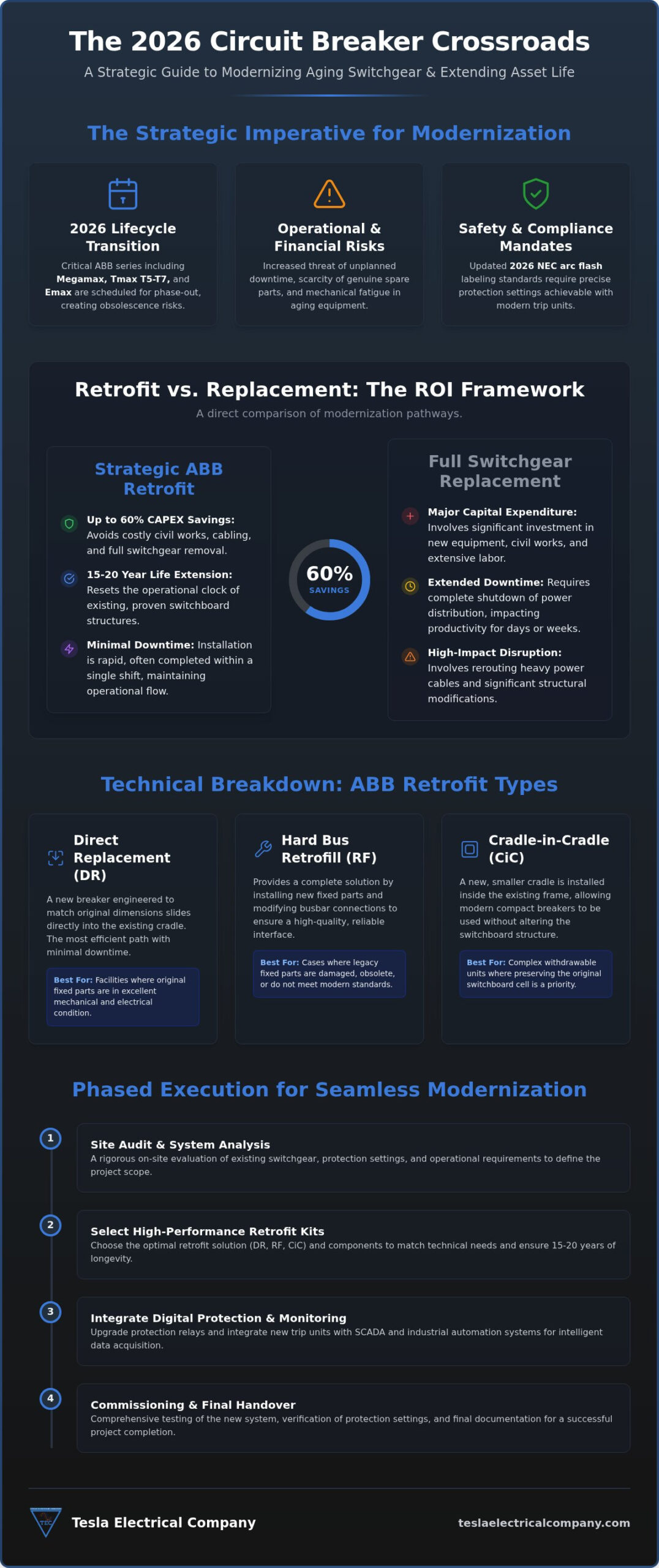
By 2026, the industrial power landscape faces a significant transition as several legacy ABB product lines move into the final stages of their lifecycle. Units such as the Megamax and HK series, alongside the standard Tmax T5, T6, and T7 models scheduled for discontinuation by December 2026, present a growing risk to operational continuity. An ABB circuit breaker retrofit provides a calculated solution to these obsolescence challenges. It allows facility managers to bypass the scarcity of genuine spare parts while maintaining the structural integrity of their existing switchgear.
The tipping point for modernization occurs when the cumulative cost of specialized maintenance and the financial risk of unplanned downtime outweigh the investment in new technology. Modern circuit breaker technology utilizes advanced materials and improved arc quenching capabilities that legacy frames simply cannot match. Beyond basic functionality, retrofitting addresses the mechanical fatigue and insulation degradation that naturally occur over decades of service, ensuring that your distribution layer remains a reliable asset rather than a liability.
Safety and regulatory compliance also drive this strategic shift. The 2026 National Electrical Code (NEC) updates, specifically Article 110.16(B), have expanded arc flash marking requirements for service and feeder equipment. Retrofitting with contemporary trip units enables precise protection settings that reduce incident energy levels. This enhancement not only protects personnel but also aligns with the rigorous standards required by industrial insurance providers, often resulting in improved risk ratings for the facility.
Extending Asset Life by 15+ Years
A primary benefit of the retrofit approach is the preservation of existing busbars and cabling infrastructure. By avoiding the removal of the entire switchboard, you eliminate the need for costly civil works and the disruption of rerouting heavy power cables. Modern retrofit kits use high-performance components that interface seamlessly with original fixed parts, effectively resetting the equipment’s operational clock. This methodology secures another 15 to 20 years of service life while utilizing the proven structural reliability of your current LV and MV switchboards.
Synchronizing Retrofits with Protection Relay Upgrades
The installation of a new breaker is the most logical time to implement a protection relay upgrade. Coordinating modern digital trip units with advanced relays ensures that the entire protection string is optimized for speed and selectivity. Tesla Electrical Company focuses on a holistic design philosophy where the breaker isn’t just a standalone component but a critical node in a synchronized system. Our engineering team ensures that new digital interfaces communicate correctly with upstream protection, creating a unified and resilient power distribution network.
Technical Breakdown: ABB Retrofit Types Defined
Selecting the appropriate ABB circuit breaker retrofit methodology depends on the mechanical integrity of the existing installation and the specific modernization goals of the facility. Engineering teams must distinguish between solutions that simply swap the moving part and those that require structural modifications to the switchgear housing. Each approach offers a different balance of installation speed, cost, and long-term reliability.
- Direct Replacement (DR): This is the most efficient modernization path for facilities where the original fixed parts remain in excellent condition. A new breaker, engineered to match the original dimensions and terminal points, slides directly into the existing cradle with minimal downtime.
- Hard Bus Retrofill (RF): When legacy fixed parts are damaged or technically obsolete, Retrofill provides a complete solution. This involves installing new fixed parts and modifying the busbar connections to ensure a high-quality electrical interface.
- Cradle in Cradle (CiC): Specifically designed for complex withdrawable units, this method installs a new, smaller cradle inside the existing frame. It allows for the use of modern, compact breakers without altering the original switchboard structure.
- Roll-in Retrofit (RiR): This technique is essential for Medium Voltage (MV) upgrades. It allows for the replacement of aging air or SF6 breakers with modern vacuum interrupters, improving reliability and reducing environmental risks.
Low Voltage (LV) vs. Medium Voltage (MV) Retrofit Strategies
Mechanical precision is paramount when integrating the ABB Emax 2 into legacy LV systems. These retrofits focus on enhancing electronic protection while preserving the thermal characteristics of the original enclosure. In MV environments, the transition to vacuum technology represents a significant leap in arc quenching efficiency. Tesla Electrical Company leverages deep expertise in LV and MV switchboards to ensure that every modernization project maintains structural integrity. Our engineers strictly adhere to OSHA wiring and protection standards, guaranteeing that retrofitted systems provide the highest levels of personnel safety.
Digital Trip Units and Communication Protocols
Modernization extends beyond mechanical parts. Upgrading to Ekip Touch or Hi-Touch trip units provides advanced metering and logic capabilities that legacy thermal-magnetic units cannot provide. Transitioning from Modbus RTU to IEC 61850 allows breakers to function as data nodes within a smart grid. This digital transformation enables remote monitoring and the implementation of predictive maintenance strategies. If you require a technical assessment of your current fleet, our team can help you evaluate the most cost-effective retrofit path for your infrastructure.
Retrofit vs. Replacement: The ROI Framework
Deciding between a full switchgear replacement and an ABB circuit breaker retrofit requires a rigorous analysis of both immediate capital expenditure and long-term operational costs. While a new switchboard might seem like a fresh start, the direct CAPEX for a retrofit typically ranges from 40% to 60% less than a total system overhaul. This financial advantage stems from the ability to retain the existing enclosure, busbars, and internal structural components. By modernizing only the active protection elements, facilities allocate capital more efficiently while achieving the same technical outcomes as new installations.
Beyond the sticker price of the hardware, engineers must account for the “hidden” costs associated with full replacement. These often include extensive cabling modifications, trenching, or even structural civil works to accommodate different enclosure footprints. An ABB circuit breaker retrofit bypasses these secondary expenses entirely. Over a 20-year horizon, the Total Cost of Ownership (TCO) remains significantly lower because the modernized system requires fewer specialized spare parts and benefits from the increased energy efficiency of modern electronic trip units. For a detailed technical comparison of retrofit, retrofill, and replacement strategies, our guide on breaker life extension services provides an in-depth engineering analysis to help maximize your return on investment.
Minimizing Downtime and Production Loss
The most persuasive argument for retrofitting is the preservation of operational uptime. A full switchboard replacement can take weeks of site preparation and execution, often requiring a complete facility shutdown. In contrast, a direct replacement retrofit can often be completed within a single shift. For continuous industrial processes, a phased implementation strategy allows for the modernization of individual cubicles during scheduled maintenance windows. This methodical approach ensures that safe electrical work practices are maintained without compromising the plant’s overall output. Keeping the existing enclosure also mitigates the risk of site errors that frequently occur when re-terminating hundreds of control wires in a new panel.
Sustainability and the Circular Economy
Modernization aligns perfectly with corporate ESG targets by promoting a circular economy. Retrofitting allows for the reuse of approximately 70% of the existing switchgear’s mass, drastically reducing the carbon footprint associated with manufacturing and transporting new steel enclosures and copper busbars. This sustainable model also simplifies waste management. It provides a structured opportunity for the responsible disposal of legacy components, such as SF6-insulated units or oil-filled breakers, which require specialized handling to meet environmental regulations. By choosing to modernize rather than discard, industrial leaders demonstrate a commitment to resource efficiency without sacrificing the reliability of their power infrastructure.
How to Execute a Successful ABB Breaker Retrofit
Executing a successful ABB circuit breaker retrofit requires a disciplined transition from theoretical design to precise field application. This process follows a structured five-phase lifecycle designed to eliminate technical discrepancies and ensure long-term system stability. It begins with a comprehensive switchgear condition assessment and site audit (Phase 1), followed by the engineering design and selection of the appropriate retrofit kit (Phase 2). Before any physical work occurs, Phase 3 involves pre-installation testing and a rigorous protection coordination study. The implementation concludes with Phase 4, site execution and mechanical fitting, and Phase 5, which covers commissioning and SCADA verification.
The Criticality of Site Audits
Phase 1 is the most vital stage for ensuring a zero-error installation. Engineers must measure busbar clearances and mechanical tolerances with extreme precision, as even a three-millimeter variance can lead to overheating or mechanical failure in withdrawable units. This audit also identifies auxiliary power requirements for new digital trip units, which often require external 24V DC supplies that legacy thermal-magnetic breakers didn’t need. Tesla Electrical Company utilizes a specialized methodology for site surveys that captures every mechanical and electrical detail, ensuring the selected retrofit kit interfaces perfectly with the existing enclosure without requiring on-site modifications.
Commissioning and Performance Verification
Once the mechanical fitting and secondary wiring are complete, the system enters the commissioning stage. This phase utilizes primary and secondary injection testing protocols to verify that the new breaker’s trip curves align with the protection coordination study. It’s essential to confirm that the modernized breaker communicates seamlessly with the generator synchronizing control panel to maintain system stability during load transitions. Verification isn’t complete until the secondary wiring is mapped to the SCADA system and all diagnostic data is visible to the operators.
The final step of a professional execution involves comprehensive documentation and training for site maintenance personnel. We provide detailed records of all test results and updated wiring diagrams, ensuring your team can manage the new hardware with confidence. If your facility is facing the 2026 obsolescence of legacy ABB frames, you can rely on our team to provide professional retrofitting of circuit breakers and protection relays that secures your infrastructure for the next two decades.
Integrating Retrofits into SCADA and Automation Systems
The final stage of a strategic modernization project involves transforming the physical breaker into a sophisticated data node within the industrial Internet of Things (IIoT). While previous sections focused on mechanical compatibility and ROI, the true value of a 2026 ABB circuit breaker retrofit lies in its ability to provide granular visibility into power distribution. Modern electronic trip units, such as the Ekip series, capture thousands of data points that were previously inaccessible in legacy systems. This digital layer allows facility managers to bridge the technical gap by architecting comprehensive SCADA and automation system solutions that integrate legacy switchgear into a unified plant-wide network.
Real-time energy monitoring and disturbance recording become standard features rather than expensive add-ons. By utilizing high-speed communication protocols, these retrofitted units stream voltage, current, and power factor data directly to the control room. This transparency is essential for identifying inefficiencies and managing peak demand. Tesla Electrical Company leverages deep automation expertise to ensure that every breaker functions as a reliable sensor, providing the total system visibility required for modern industrial oversight.
Redundant Control for Critical Infrastructure
For facilities where power continuity is non-negotiable, we configure a redundant control system architecture alongside the retrofitted hardware. This setup ensures that if a primary communication path fails, a secondary link maintains control over the breaker’s operation. Such fail-safe mechanisms are critical for data centers and hospitals, where a loss of control can lead to catastrophic system failures. Our engineering team designs these paths to be physically and logically separate, reinforcing the resilience of your critical power infrastructure.
Predictive Maintenance and Power Quality
Modernization shifts the maintenance paradigm from reactive to predictive. By analyzing breaker data, such as contact wear and the number of operations, we help facilities establish health-index monitoring and Reliability Centered Maintenance (RCM) strategies. Integrating disturbance recording allows for detailed post-fault analysis, helping engineers understand the root cause of a trip within seconds. Tesla Electrical Company stands as your partner for end-to-end industrial electrical infrastructure, providing the steady hand needed to manage complex automation integrations from initial design through to final execution.
Securing Your Power Infrastructure for the Next Two Decades
The transition to modernized power distribution is a strategic necessity for industrial resilience. By implementing a systematic ABB circuit breaker retrofit, you effectively bypass the 2026 obsolescence trap while securing significant savings in capital expenditure. This process doesn’t just replace a component; it transforms your legacy switchgear into an intelligent, SCADA-ready asset capable of predictive maintenance and enhanced arc flash protection. You’ve now seen how precise engineering and digital integration extend asset life by up to 20 years without the disruption of a full replacement.
As you evaluate your modernization roadmap, the expertise of your implementation partner remains the most critical variable. Tesla Electrical Company provides an expert industrial engineering team specialized in LV/MV switchboard design and comprehensive SCADA integration capabilities. We ensure your transition is seamless, methodical, and technically superior. Consult Tesla Electrical Company for Your Switchgear Modernization Project to establish a high-performance foundation for your facility’s future. We look forward to partnering with you to achieve operational excellence.
Frequently Asked Questions
What is the typical lifespan of an ABB circuit breaker retrofit?
An ABB circuit breaker retrofit typically extends the operational life of your switchgear by 15 to 20 years. This modernization process replaces the most critical wear components while retaining the robust structural enclosure. By integrating modern materials and digital trip units, the system achieves a level of reliability comparable to new installations. It’s a strategic method to reset the maintenance clock on aging assets without the capital intensity of a full replacement.
Can an ABB Emax 2 breaker be direct-replaced into a Megamax cradle?
Yes, the ABB Emax 2 is specifically designed to replace legacy Megamax frames through dedicated conversion kits. Depending on the condition of the existing cradle, engineers may utilize an ABB circuit breaker retrofit kit for a direct replacement or a hard bus retrofill if the original fixed parts show signs of degradation. This compatibility ensures that facilities can transition to the latest protection technology without modifying the primary copper busbar structure.
How long does the actual downtime last for a single breaker retrofit?
The actual downtime for a single Direct Replacement (DR) retrofit is typically limited to a single work shift, often between four and eight hours. This timeframe includes the mechanical installation, secondary wiring connections, and initial functional testing. Hard Bus Retrofill (RF) procedures may require additional time for busbar adjustments. Because the existing enclosure remains in place, the site execution is significantly faster than the weeks required for a total switchgear overhaul.
Is it necessary to upgrade the protection relays when retrofitting the breaker?
While not strictly mandatory for mechanical operation, upgrading protection relays during a breaker retrofit is highly recommended to ensure system-wide coordination. Modern breakers feature digital trip units that offer superior precision, but they must be synchronized with upstream relays to prevent nuisance tripping. This holistic approach allows your facility to leverage advanced diagnostic data and ensures that the entire protection string meets contemporary safety standards and industrial performance requirements.
What are the main differences between Hard Bus Retrofill and Direct Replacement?
Direct Replacement (DR) focuses on swapping the moving part of the breaker, utilizing the existing fixed cradle for a faster installation. In contrast, Hard Bus Retrofill (RF) involves installing entirely new fixed parts and modifying the internal busbar connections. RF is the preferred solution when legacy cradles are damaged or when the original frame is no longer supported. While DR offers the shortest downtime, RF provides a more comprehensive modernization of the electrical interface.
Are ABB retrofit kits compatible with non-ABB switchgear enclosures?
ABB retrofit kits are frequently engineered to modernize non-ABB switchgear enclosures through custom-designed mounting plates and busbar adapters. This flexibility allows industrial plants with mixed fleets to standardize their protection technology on a single platform. Tesla Electrical Company specializes in these complex integrations, ensuring that the new breaker maintains proper clearances and thermal performance within the original third-party housing. It’s a versatile solution for unifying diverse electrical infrastructure.
How does retrofitting impact the arc flash rating of my existing switchgear?
A retrofit significantly improves the arc flash rating by reducing the total clearing time of a fault. Modern digital trip units feature faster processing speeds and specialized maintenance modes that temporarily lower trip thresholds during site work. These enhancements directly reduce the incident energy levels at the switchboard. By upgrading the protection hardware, facilities can more easily comply with the updated arc flash labeling requirements mandated by the 2026 National Electrical Code.
What digital communication protocols do modern ABB retrofit units support?
Modern ABB retrofit units support a wide array of industrial communication protocols, including Modbus RTU, Modbus TCP/IP, and Profibus. For facilities moving towards smart grid integration, these units are fully compatible with the IEC 61850 standard. This connectivity allows the breakers to function as data nodes within a larger SCADA or automation system. It enables real-time monitoring of energy consumption, power quality, and mechanical health, providing the data necessary for predictive maintenance strategies.
Disclaimer
Some content, images, text, or other materials on this website may have been created or assisted by artificial intelligence (AI).
While we review AI-generated content for accuracy and quality, we do not guarantee that all information is free from errors or omissions.
Content generated using AI is provided for informational purposes only and should not be solely relied upon without independent verification.
2 Responses