
The operational efficiency of a modern industrial facility doesn’t rely on individual machines but on the invisible intelligence that orchestrates them. Many engineers face the daunting challenge of bridging the gap between aging legacy hardware and sophisticated digital control. You’re likely aware that a single failure in this communication layer can lead to catastrophic downtime and lost revenue. Understanding what is scada system architecture becomes essential when your objective is to maintain a stable, high-performance environment. It’s the critical link that transforms raw data into actionable insights for complex electrical systems.
This guide provides a comprehensive framework to master Supervisory Control and Data Acquisition fundamentals. We’ll demystify the distinct roles of SCADA, PLCs, and HMIs to eliminate common integration confusion. You’ll gain a clear perspective on how software and hardware, such as LV/MV switchboards and redundant control panels, work in synergy. We’ll explore the technical layers that ensure your infrastructure remains resilient and responsive. By the end of this article, you’ll possess the technical insight needed to evaluate your automation requirements and secure your facility’s future.
Key Takeaways
- Define the fundamental architecture and learn exactly what is scada system technology’s role in orchestrating complex industrial processes.
- Identify the four essential pillars of automation, ranging from field instrumentation and sensors to the logic provided by PLCs and RTUs.
- Evaluate the strategic benefits of real-time monitoring for power quality and the implementation of automated emergency shutdown procedures.
- Understand the importance of redundant control system architecture and cybersecurity measures in protecting critical infrastructure from failure.
- Gain insights into integrating custom SCADA solutions with specialized LV/MV switchboards to achieve a comprehensive, high-performance control environment.
Defining SCADA: Supervisory Control and Data Acquisition Fundamentals
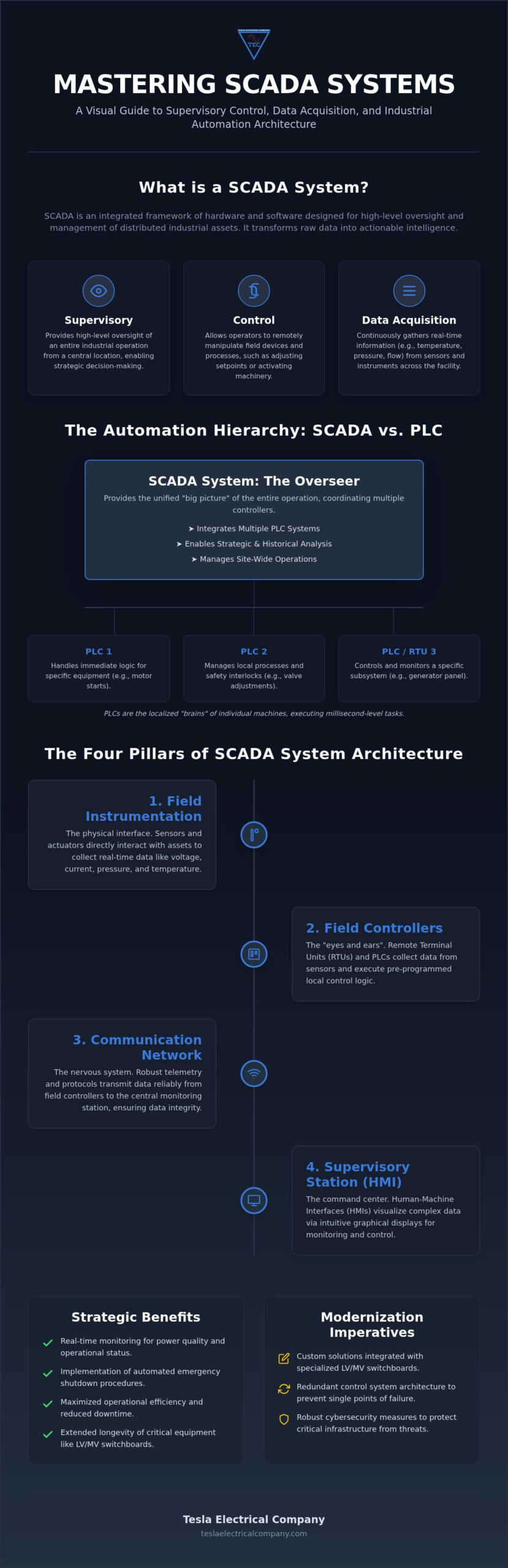
A sophisticated industrial operation requires more than just functional machinery; it demands a high-level architecture capable of orchestrating complex processes across vast distances. To understand what is scada system technology, one must view it as an integrated framework of hardware and software designed for high-stakes oversight. Unlike simple local controllers, a SCADA system provides centralized management for distributed assets, ensuring that every component of the industrial infrastructure operates in harmony. Its primary objective is to maximize operational efficiency while extending the longevity of critical equipment like LV/MV switchboards and generator panels.
The acronym itself defines the scope of its capability. Supervisory refers to the high-level oversight provided to operators. Control represents the ability to manipulate field devices and processes from a central location. Data Acquisition involves the continuous gathering of information from various points within the facility. While local control handles immediate, millisecond-level reactions, SCADA provides the wide-area oversight necessary for strategic decision-making and long-term stability.
The Core Functions of a SCADA System
The effectiveness of an automation solution depends on how well it executes three foundational tasks. These functions transform raw mechanical movement into intelligent industrial intelligence:
- Data Acquisition: The system utilizes field sensors and instruments to collect real-time information regarding temperature, pressure, and electrical flow.
- Networked Data Communication: This information travels through robust communication protocols from the field to the central monitoring station, ensuring no data loss occurs during transmission.
- Data Presentation: Human-Machine Interfaces (HMIs) visualize these complex processes, allowing engineers to interpret technical data through intuitive graphical displays.
SCADA vs. PLC: Understanding the Automation Hierarchy
Confusion often arises when distinguishing between SCADA and Programmable Logic Controllers (PLCs). It’s helpful to think of the PLC as the localized “brain” of a specific machine. These controllers handle the immediate logic required for tasks like motor starts or valve adjustments. In contrast, a SCADA system acts as the “overseer” that integrates multiple PLC systems across an entire industrial site. It doesn’t replace the PLC; rather, it coordinates the activities of many controllers to provide a unified “big picture” of the operation.
In a professional setting, such as managing PLC Control Systems for Process Control PID, the SCADA layer provides the interface where setpoints are adjusted and historical trends are analyzed. It bridges the gap between physical hardware controllers and supervisory software. This hierarchy ensures that even if the central supervisory link is interrupted, the local PLC continues to maintain safe operation based on its programmed logic, while the SCADA system remains ready to resume high-level optimization once connectivity is restored.
The Four Pillars of SCADA System Architecture
A functional SCADA implementation isn’t merely a software installation; it’s a multi-layered physical and digital architecture. When assessing what is scada system design, one must look beyond the screen to the four pillars that sustain industrial operations. This structure begins at the field level with instrumentation, moves through remote processing units, relies on robust telemetry, and culminates at the central monitoring station. Each layer must be engineered with precision to ensure the entire facility remains synchronized and secure.
The foundation of this architecture is field instrumentation. This includes the sensors and actuators that interact directly with your physical assets. In a high-stakes environment, these instruments provide the critical interface for Industrial Control Systems, monitoring variables such as voltage, current, and pressure. Without high-quality field devices integrated into your LV and MV switchboards, the supervisory layer lacks the accurate data needed for effective oversight.
Remote Terminal Units (RTUs) and Field Controllers
RTUs serve as the vital “eyes and ears” of the system. These devices collect data from field instrumentation and transmit it to the central hub. Unlike standard consumer electronics, these units require ruggedized hardware to survive the harsh temperatures and electromagnetic interference common in industrial settings. Their performance is directly tied to the reliability of the broader electrical infrastructure. If an RTU fails, the central station loses visibility into that specific sector of the plant. For organizations prioritizing operational continuity, implementing a redundant control system architecture ensures that remote stations maintain communication despite localized hardware failures.
Master Terminal Units (MTU) and Human-Machine Interfaces (HMI)
The MTU acts as the central brain of the operation. It processes incoming data from various RTUs and issues commands back to the field. While this central processing happens behind the scenes, operators interact with it through the HMI. A well-designed HMI transforms complex electrical data into intuitive dashboards, allowing for a rapid response when anomalies occur. Clarity in visualization is paramount. A cluttered interface can lead to delayed decisions during critical events, such as a sudden drop in power quality or an unexpected breaker trip.
Communication Protocols: Modbus, DNP3, and Beyond
Communication is the nervous system that connects the pillars. Industrial languages like Modbus and DNP3 allow different hardware components to speak to one another. There’s been a significant shift from restrictive proprietary protocols toward open standards, which simplifies the integration of new equipment. However, engineers must still account for latency and bandwidth constraints. In critical control networks, even a few seconds of delay in data transmission can compromise system safety. Ensuring a high-speed, low-latency telemetry link, whether through fiber optics or cellular networks, is essential for maintaining a real-time operational picture.
Industrial Applications and Strategic Benefits of SCADA
Implementing a robust automation framework is a strategic investment in long-term reliability. To fully appreciate what is scada system implementation offers, one must analyze the immediate impact on operational safety and financial performance. These systems provide continuous, real-time monitoring of power quality and disturbance recording, which is essential for protecting expensive industrial assets. By capturing transients and voltage sags as they occur, engineers can diagnose underlying issues before they lead to catastrophic hardware failure.
Safety is significantly enhanced through automated emergency shutdown procedures. These protocols operate independently of human intervention, triggering protective actions within milliseconds of a detected anomaly. This rapid response is a core component of CISA’s Unified Initiative for ICS Security, which emphasizes the need for resilient control systems in critical infrastructure. Beyond safety, SCADA provides a meticulous historical record of all process variables. This data logging is indispensable for regulatory compliance and provides the empirical evidence needed for deep process optimization and troubleshooting.
The transition from reactive to predictive maintenance is a significant financial advantage. Traditional manual inspections are time-consuming and often fail to catch intermittent faults. SCADA eliminates this inefficiency by providing a digital watch over every sensor and relay. This shift doesn’t just save on labor costs; it fundamentally changes how engineers approach equipment health. Instead of following a rigid calendar, maintenance is performed based on actual wear and performance data, ensuring that resources are only deployed when they’re truly necessary. For facilities looking to take this further, a structured approach to industrial plant automation provides a phased roadmap for upgrading legacy systems while preserving existing capital investments.
Power Management and Generator Synchronization
In facilities where power continuity is non-negotiable, SCADA plays a decisive role in managing generator synchronizing control panels. The system utilizes complex load-sharing logic to balance the electrical demand across multiple units, preventing any single generator from becoming overloaded. If the primary supply fluctuates, the SCADA layer initiates load-shedding protocols to preserve critical operations. Operators gain a complete view of engine health, fuel consumption, and electrical output without needing to be physically present at the generator site.
Water, Oil, and Gas Infrastructure Oversight
Managing distributed assets in the utility and energy sectors requires constant vigilance over vast distances. SCADA systems monitor flow rates, pressure levels, and tank volumes across expansive pipeline networks. This capability allows for the immediate detection of leaks or equipment malfunctions that could otherwise lead to environmental damage or significant product loss. By centralizing this data, organizations maintain high safety standards while reducing the frequency of manual field inspections, which lowers overall operational expenditure and minimizes human exposure to hazardous environments.
Modernizing SCADA: Security, Redundancy, and Resilience
Modernizing an industrial facility requires a shift from standalone equipment to integrated, resilient networks. As operators investigate what is scada system modernization, they must prioritize security and uptime. Historically, these systems relied on “security through obscurity,” assuming that isolation from the public internet provided sufficient protection. However, the rise of the Industrial Internet of Things (IIoT) has dissolved these barriers, exposing legacy hardware to sophisticated cyber threats. Protecting critical infrastructure now demands a “defense-in-depth” strategy that combines physical hardware redundancy with robust digital safeguards.
The transition from isolated networks to IIoT integration offers immense data advantages but increases the attack surface. For this reason, modernizing your control layer isn’t just about adding features; it’s about building a foundation that can withstand both equipment failure and external intrusion. A comprehensive approach involves hardware-level resilience and software-level security protocols working in tandem to maintain a stable operational state.
Implementing High-Availability Redundant Systems
True resilience starts with eliminating single points of failure. In critical applications, a redundant control system architecture is mandatory rather than optional. This often involves a “Hot-Standby” configuration where a secondary SCADA server mirrors the primary unit in real-time. If the primary server fails, the secondary takes over immediately without data loss or process interruption.
Reliability also extends to the physical layer. Redundant communication paths, such as dual fiber optic rings, ensure that data reaches the control center even if a cable is physically severed. Within the control panels themselves, redundant power supplies protect against local electrical faults. These layers of protection ensure that the supervisory system remains operational even during significant hardware disruptions, providing a sense of security for high-stakes technical requirements.
Cybersecurity for Industrial Control Systems (ICS)
Securing the digital perimeter is as vital as the physical one. Effective SCADA security for industrial control systems involves strict network segmentation and, where possible, air-gapping critical control networks from corporate IT environments. Role-based access control (RBAC) ensures that only authorized personnel can modify system parameters or setpoints, preventing both accidental and malicious changes to the process logic.
Legacy systems are particularly vulnerable because they often lack modern encryption and authentication. Addressing these gaps requires more than software patches; it often involves a methodical retrofit of circuit breakers and protection relays to include modern, secure communication modules. Regular firmware updates and continuous monitoring are essential to stay ahead of evolving threats. If you’re ready to secure your infrastructure, explore our comprehensive SCADA & Automation Systems designed for the highest levels of industrial resilience.
Engineering High-Performance SCADA Solutions with Tesla Electrical Company
Tesla Electrical Company provides the end-to-end expertise required to design, manufacture, and deploy industrial-grade SCADA & Automation Systems. We understand that a truly effective solution isn’t just about software; it’s about the seamless integration of sophisticated digital oversight with robust electrical hardware. When organizations ask what is scada system excellence, the answer lies in the synergy between the control layer and the physical infrastructure. Our team manages complex projects from initial design through to final execution, ensuring that every LV and MV switchboard or motor control center functions as a synchronized component of your facility’s nervous system.
We don’t just provide a platform; we provide a steady hand for high-stakes technical requirements. Our commitment to quality is reflected in our selection of industrial-grade components and the availability of critical spare parts, ensuring that your investment remains resilient over the long term. This holistic approach to engineering minimizes the risk of system downtime and provides the established reliability that modern industrial leaders demand.
Custom Automation and PLC Integration
We specialize in PLC Control Systems for Process Control PID, providing the granular logic needed for sophisticated industrial operations. Our engineering team doesn’t just install generic templates. We tailor SCADA HMIs to match your specific operational workflows, ensuring that your staff can interpret data and issue commands with absolute confidence. This human-centric approach guarantees that the communication between diverse field devices remains fluid and transparent. Whether you’re integrating VFD Control Panels or synchronizing multiple power sources, our custom logic ensures your hardware speaks a unified language.
Comprehensive Industrial Infrastructure Support
Our capability extends beyond new installations to the modernization of aging infrastructure. We provide professional retrofit services for circuit breakers and protection relays, allowing legacy facilities to enjoy the benefits of modern digital oversight without a total teardown. This comprehensive support includes:
- Integrated power quality monitoring to detect and record electrical disturbances in real-time.
- The deployment of Capacitor Banks for power factor correction and improved energy efficiency.
- Redundant System configurations to eliminate single points of failure in critical control paths.
By combining these advanced monitoring tools with our expertise in generator synchronizing control panels and switchgear, we offer a total solution for industrial power management. Our engineers are ready to assist with a detailed system assessment to identify opportunities for optimization and resilience. Contact our engineering team today to discuss how we can elevate your facility’s automation standards and secure your operational future.
Securing the Future of Industrial Control
Mastering the fundamentals of what is scada system architecture is the first step toward achieving total operational oversight. We’ve explored how a methodical approach to four-pillar design ensures that field instrumentation, remote controllers, and central processing units work in absolute harmony. Transitioning from legacy hardware to a modernized, redundant framework isn’t merely a technical upgrade; it’s a commitment to long-term facility stability and data-driven efficiency.
Tesla Electrical Company stands as an established leader in the design and manufacturing of specialized LV/MV switchboards and generator synchronizing control panels. Our comprehensive industrial SCADA integration expertise provides the steady hand needed to manage high-stakes technical requirements from initial design through to final execution. By prioritizing hardware-software synergy, we help you eliminate system downtime and protect your critical infrastructure against emerging threats.
Ready to optimize your facility? Consult with our Automation Experts at Tesla Electrical Company to begin your comprehensive system assessment. We look forward to partnering with you to engineer a more resilient industrial future.
Frequently Asked Questions
What is the primary difference between SCADA and HMI?
SCADA is the overall supervisory system, while the HMI is the specific graphical interface within that system. SCADA handles the data collection, processing, and high-level control logic across the entire plant. The HMI is simply the window that allows a human operator to see and interact with that data. Think of SCADA as the entire brain and nervous system, whereas the HMI is the visual display through which you monitor the brain’s activity.
How does a SCADA system collect data from field devices?
A SCADA system collects data by polling remote devices like RTUs and PLCs via specific industrial communication protocols. These field controllers gather electrical signals from sensors and transducers connected to equipment like VFD control panels. Once collected, the data is packaged into a digital format and transmitted over a network to the central Master Terminal Unit. This process ensures that every change in voltage, pressure, or temperature is recorded for real-time supervisory oversight.
Can SCADA systems be used for small-scale industrial plants?
Yes, SCADA systems are highly scalable and provide significant value even for small-scale industrial operations. While often associated with massive utility networks, smaller plants benefit from the centralized monitoring and historical data logging that these systems provide. Implementing a tailored solution helps small facilities reduce manual inspection costs and improve equipment longevity. Understanding what is scada system scalability allows smaller operators to start with essential monitoring and expand their automation capabilities as production requirements grow.
What are the main security risks associated with SCADA systems?
The main security risks include unauthorized access to control logic and the potential for malware to disrupt physical processes. Many legacy systems lack modern encryption, making them vulnerable to cyberattacks if connected to the internet. Risks also arise from improper network segmentation and weak role-based access controls. To mitigate these threats, engineers implement SCADA security best practices such as defense-in-depth strategies, which include air-gapping critical networks and performing regular firmware updates on protection relays to ensure the system’s integrity remains uncompromised.
Is it possible to integrate a new SCADA system with legacy PLCs?
It is entirely possible to integrate modern SCADA software with legacy PLCs through the use of communication gateways and protocol converters. This process often involves retrofitting older hardware with modules that support open standards like Modbus or OPC UA. Such integration allows businesses to enjoy advanced data visualization and reporting without the high cost of replacing their entire controller inventory. This approach is a core part of modernizing what is scada system infrastructure while preserving existing capital investments in field hardware.
How does SCADA improve industrial power management?
SCADA improves industrial power management by providing real-time visibility into load distribution and power quality. It coordinates the activity of generator synchronizing control panels to ensure a stable supply during peak demand or utility failures. The system can automatically trigger capacitor banks for power factor correction or initiate load-shedding protocols to prevent blackouts. This centralized control minimizes energy waste and protects sensitive electrical equipment like LV and MV switchboards from damage caused by voltage fluctuations.
What role do RTUs play in a SCADA architecture?
Remote Terminal Units (RTUs) act as the primary interface between the physical field devices and the central SCADA server. They are responsible for converting analog and digital signals from sensors into a format suitable for transmission over the telemetry network. RTUs are designed for rugged environments and often possess localized logic to handle basic control functions if communication with the master station is lost. They serve as the critical outposts that maintain visibility across distributed industrial assets.
Why is redundancy critical in SCADA system design?
Redundancy is critical because it ensures that a single hardware failure doesn’t lead to a complete loss of visibility or control. In high-stakes environments, a redundant system configuration typically includes secondary servers, backup communication paths, and dual power supplies. If the primary controller or network link fails, the standby unit takes over instantly. This level of resilience is essential for preventing catastrophic downtime in critical infrastructure, such as water treatment plants or power generation facilities.
Disclaimer
Some content, images, text, or other materials on this website may have been created or assisted by artificial intelligence (AI).
While we review AI-generated content for accuracy and quality, we do not guarantee that all information is free from errors or omissions.
Content generated using AI is provided for informational purposes only and should not be solely relied upon without independent verification.