
Could your plant’s reliance on legacy control panels be the single greatest threat to your operational continuity? Many facility managers recognize that aging electrical systems eventually become a significant liability, often resulting in unpredictable downtime and a frustrating search for obsolete spare parts. It’s a common challenge to maintain high standards of performance when your hardware lacks real-time visibility into power quality. This guide provides a technical roadmap for industrial plant automation that prioritizes intelligent power management and phased infrastructure upgrades rather than a total system teardown.
We’ll examine the specific requirements for modernizing your facility, focusing on how integrated VFD control panels and capacitor banks enhance energy efficiency. You’ll learn the steps to implement seamless generator synchronization and load sharing through advanced PLC systems and SCADA integration. By the end of this technical overview, you’ll have a clear strategy for retrofitting existing switchboards and protection relays to ensure your infrastructure remains resilient, efficient, and fully optimized for the demands of modern industry.
Key Takeaways
- Discover how modern industrial plant automation shifts from isolated machinery to interconnected, SCADA-driven environments for enhanced operational visibility.
- Learn to optimize motor-driven processes by integrating VFD control panels within a structured LV and MV switchboard architecture.
- Identify when to choose retrofitting for circuit breakers and protection relays as a cost-effective method to upgrade safety and performance.
- Follow a methodical approach to implementing PLC control systems for process control PID, ensuring logic aligns with specific field requirements.
- Secure your facility against failure by deploying redundant system architectures and monitoring power quality to protect sensitive automation hardware.
The Evolution of Industrial Plant Automation in 2026
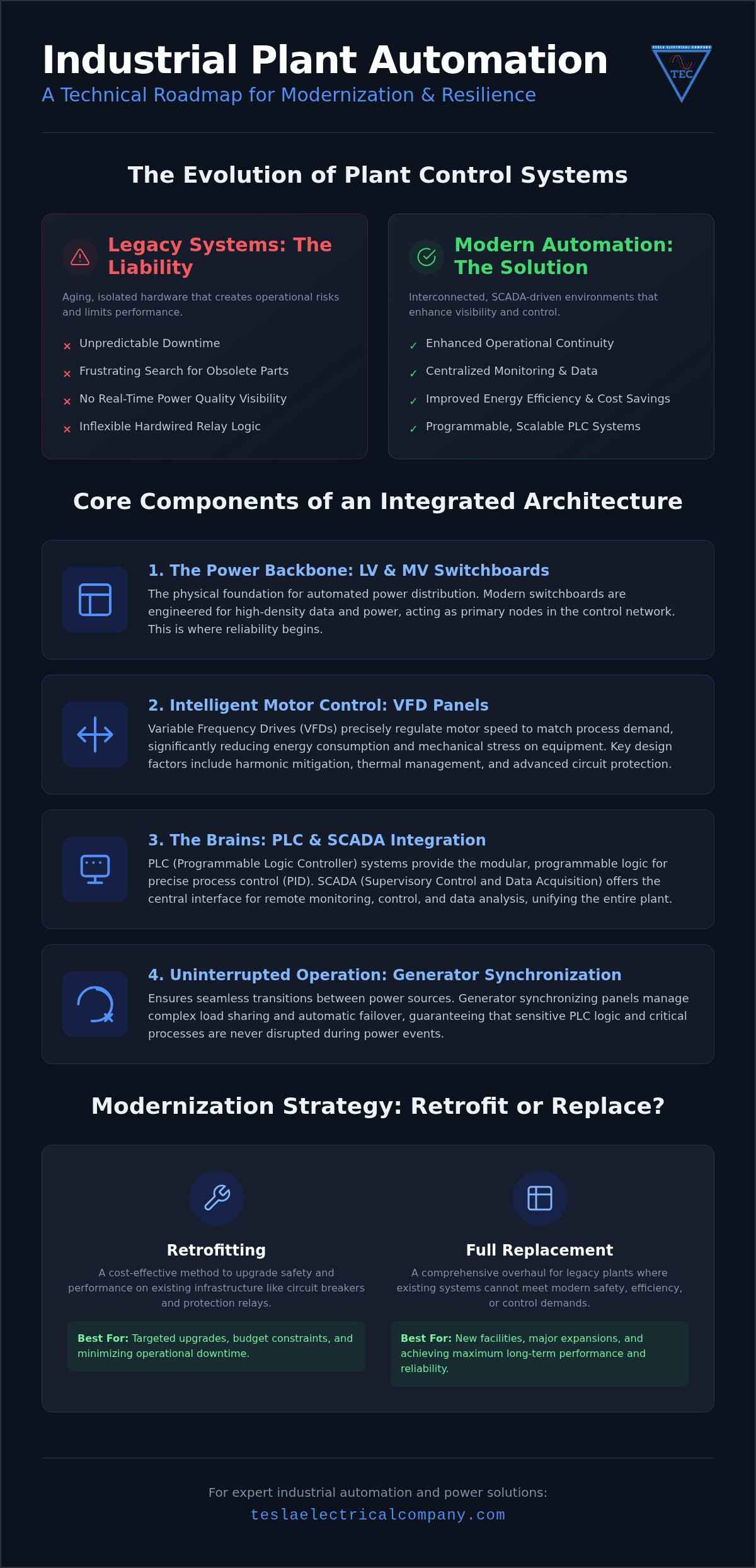
Modern industrial plant automation represents more than the digital overlay of software on hardware. It is the systematic integration of sophisticated control logic with robust electrical power infrastructure. By 2026, the industry has transitioned away from isolated machinery toward fully interconnected, SCADA-driven environments. These systems prioritize energy efficiency and rigorous power factor correction, utilizing capacitor banks to reduce operational costs and meet tightening environmental standards. It’s a technical reality that visibility alone isn’t enough; true modernization requires the physical capacity to act on data in real time through a unified architecture.
From Hardwired Logic to Programmable Automation
Historically, industrial processes relied on complex, hardwired relay logic that offered limited flexibility and required extensive physical troubleshooting. The adoption of PLC control systems for process control PID has revolutionized this space by providing a programmable, modular framework that accommodates future plant scalability. PLC systems serve as the brain of industrial automation. Modern modular architectures allow engineers to expand control capabilities without replacing the entire foundation, ensuring that the control logic evolves alongside the facility’s production requirements. These systems manage variables like temperature, pressure, and flow with a level of precision that hardwired systems simply can’t achieve.
The Interdependence of Power and Control
Sophisticated software remains ineffective if the underlying electrical distribution is unstable. Reliable automation depends on high-quality LV and MV switchboards that provide the physical backbone for power distribution. A truly modernized plant integrates a Power Quality and Disturbance Recording System into the central automation narrative to identify transients before they cause hardware failure. Continuity is further reinforced by generator synchronizing control panels. These panels manage complex load sharing and ensure that automated transitions between power sources occur without disrupting sensitive PLC logic or process flows. Redundant systems are now a foundational requirement for 24/7 operations, providing a steady hand that prevents plant-wide failure during critical events.
Designing an Integrated Power and Control Architecture
Successful industrial plant automation requires a physical architecture that mirrors the sophistication of its control logic. This foundation begins with the strategic layout of LV and MV switchboards, which function as the primary nodes for automated power distribution. These switchboards must be engineered to handle high-density data and power requirements simultaneously. Integrating capacitor banks within this distribution network is essential for maintaining a high power factor, which directly reduces energy costs and prevents penalties from utility providers. Effective integration starts with high-quality LV and MV switchboards designed for high-demand environments.
Optimizing Motor Control with VFD Panels
VFD control panels are indispensable for modernizing motor-driven processes. By utilizing Variable Frequency Drives, facilities can precisely regulate motor speed to match actual demand, which significantly reduces energy consumption and mechanical stress on equipment. These panels shouldn’t exist in isolation. Integrating VFDs into the broader SCADA network allows for comprehensive remote monitoring and predictive maintenance. When designing these panels, engineers must prioritize several technical factors:
- Harmonic Mitigation: Implementing filters to prevent electrical noise from disrupting sensitive automation hardware.
- Thermal Management: Ensuring robust cooling systems to maintain component longevity in harsh industrial environments.
- Circuit Protection: Utilizing advanced relays to safeguard against overcurrent and voltage transients.
Synchronizing Power Sources for Uninterrupted Operation
Maintaining continuity in an automated facility requires a sophisticated approach to power management. Generator synchronizing control panels provide the necessary logic to manage parallel operations between multiple power sources. These panels facilitate automatic synchronization, ensuring that the voltage, frequency, and phase angle of the generator match the busbar before connection. This precision allows for seamless load sharing, where the system intelligently distributes the electrical demand based on the capacity and efficiency of each source.
To eliminate single points of failure, a redundant system architecture is mandatory for 24/7 operations. By duplicating critical control paths and power links, the facility remains operational even if a primary component fails. This methodical approach to power synchronization ensures that the automation logic remains energized and stable, preventing the costly restarts and data loss associated with sudden power fluctuations. Reliability isn’t an accident; it’s the result of a deliberate, well-executed power and control design.
Modernizing Legacy Plants: Retrofit vs. Full Replacement
Deciding whether to overhaul or replace aging electrical infrastructure is a critical juncture for industrial facility managers. Many plants currently operate with 20-year-old legacy hardware that, while physically robust, lacks the digital intelligence required for sophisticated industrial plant automation. Evaluating the lifecycle of circuit breakers and protection relays requires a methodical audit of trip history, thermal wear, and the availability of specialized spare parts. Retrofitting serves as a strategic alternative to full replacement, offering updated safety and minimal downtime without the prohibitive capital expenditure of a total greenfield project. Full replacement only becomes an operational necessity when the physical busbars or enclosures show signs of structural fatigue that compromise safety beyond the scope of a component upgrade.
Circuit Breaker and Protection Relay Retrofitting
Upgrading protection relays to modern digital standards is a high-precision process that bridges the gap between old and new. It begins with identifying legacy electro-mechanical units that lack the communication ports required for contemporary SCADA integration. By replacing these with digital relays, you gain the ability to monitor real-time data and implement complex protection logic. Access to specialized spare parts is essential; it allows you to maintain the existing physical chassis while the internal “intelligence” is completely refreshed. This methodical approach ensures that your protection systems remain compatible with current cybersecurity protocols while extending the operational life of your switchboards.
Life Extension Strategies for Industrial Switchgear
Analyzing the ROI of modernization reveals that retrofitting often provides superior value by preserving the existing physical footprint. You don’t need to relocate heavy cabling or modify switchroom layouts, which are usually the most labor-intensive aspects of a full replacement. During a retrofit, you can integrate a Power Quality and Disturbance Recording System to capture high-resolution data on electrical transients. This visibility is vital for protecting the sensitive electronics used in modern industrial plant automation. Implementing a redundant system architecture during this phase further enhances reliability, ensuring that your modernized plant is as resilient as a new build. When the structural integrity of the switchgear remains sound, a technical retrofit is the most efficient path toward comprehensive system optimization.
How to Implement SCADA and PLC Systems for Process Optimization
Implementing industrial plant automation requires a disciplined, step-by-step methodology that moves from the physical field layer to the supervisory level. The process begins with a comprehensive audit of all field devices and sensors. This step ensures that every instrument is calibrated and capable of providing the high-fidelity data required for modern control. Once the hardware foundation is confirmed, engineers must design the PLC logic to meet specific process control PID requirements. Establishing secure communication protocols follows, creating a hardened industrial network that resists external interference. Finally, the implementation of a Human-Machine Interface (HMI) provides the real-time oversight necessary for operators to manage complex workflows with total confidence.
Architecting SCADA for High Visibility
A robust SCADA architecture functions across multiple layers, starting from field instrumentation and ascending to master control stations. Understanding these layers is critical for facility managers who need to bridge the gap between the plant floor and the enterprise level. For a deeper dive into these technical layers, consult our guide on What is a SCADA System? Modern SCADA integration must also incorporate a Power Quality and Disturbance Recording System. This capability is essential for post-event analysis. It allows your technical team to pinpoint the exact millisecond a power fluctuation occurred and determine its specific impact on the automation logic. This level of visibility transforms reactive maintenance into a proactive, data-driven management strategy.
PLC Programming and PID Loop Tuning
Developing robust PLC code in industrial environments requires a commitment to modularity and precision. PID loops serve as the primary mechanism for maintaining stability across variables such as pressure, temperature, and flow. Proper tuning of these loops is vital. It prevents oscillations that can lead to equipment wear or product defects, ensuring the process remains within tight operational tolerances. To safeguard these critical functions, the design should incorporate a redundant system for the PLC architecture. This redundancy ensures that if a primary controller encounters a fault, a secondary unit assumes control instantly. This transition happens without disrupting the process, maintaining the continuity of the entire plant. For organizations seeking to modernize their control logic, our team designs and commissions custom PLC Control Systems for Process Control PID tailored to unique industrial requirements. To understand how these control systems unify with supervisory platforms, our comprehensive resource on PLC SCADA system integration provides the strategic framework for building a high-performance, unified automation ecosystem.
Ensuring Reliability with Redundant Systems and Power Quality
Reliability in 24/7 industrial environments isn’t just a goal; it’s a technical mandate. In the context of industrial plant automation, the cost of a single hour of unplanned downtime can be astronomical. To mitigate this risk, facilities must deploy a redundant system architecture that ensures continuous operation even during component failure. This involves a holistic approach that combines hardware redundancy with sophisticated power quality monitoring to protect sensitive electronics from electrical transients. You can’t leave your infrastructure’s health to chance when the stakes involve high-volume production and safety. A steady hand in design prevents the cascading failures that often plague less resilient systems.
Designing for High Availability
Achieving high availability requires the implementation of hot-standby redundancy for both PLCs and SCADA servers. In this configuration, a secondary controller remains synchronized with the primary unit, ready to take command within milliseconds if a fault is detected. This level of resilience extends to the power distribution layer through the use of dual-fed switchboards, which allow for power sourcing from independent feeders. These switchboards ensure that even if one power source or feeder cable fails, the automated processes remain energized. Redundancy serves as the ultimate insurance policy for automated plants by eliminating single points of functional failure. For organizations interested in these complex configurations, more information is available on Architecting SCADA and Automation Solutions.
Advanced Power Quality Monitoring
Protecting the hardware layer of industrial plant automation requires advanced monitoring to detect voltage dips and harmonics before they trigger system trips. Harmonics can cause overheating and premature failure in motor drives and control logic, leading to unexpected maintenance costs. Integrating capacitor banks provides automated power factor correction, which stabilizes the voltage profile and improves overall system efficiency. Implementing a Power Quality and Disturbance Recording System allows for forensic electrical analysis. This system captures high-resolution data during an event, providing the technical evidence needed to identify the root cause of disturbances. As cyber-physical threats evolve, maintaining this visibility is a core component of SCADA Security in 2026. By combining redundant control paths with rigorous power oversight, industrial facilities achieve a standard of reliability that meets the uncompromising demands of modern production.
Securing Operational Excellence Through Technical Modernization
Modernizing industrial infrastructure requires a methodical approach that synchronizes physical power distribution with sophisticated digital logic. By prioritizing the integration of LV and MV switchboards with advanced SCADA and PLC systems, facilities achieve a level of operational visibility that is vital for modern production. Successfully executing industrial plant automation ensures your facility remains resilient against the risks of legacy equipment failure and inefficient energy management. This technical foundation allows for precise process control while maintaining the flexibility needed for future scalability.
Tesla Electrical Company serves as a total solution provider, specializing in the design of redundant systems and the manufacturing of generator synchronizing panels. Our expert team provides comprehensive switchgear retrofit and modernization services, allowing you to upgrade your protection relays and circuit breakers without the disruption of a full replacement. We’re committed to establishing long-term partnerships built on technical rigor and established reliability.
Consult with our Automation Experts for a Custom Solution to begin your facility’s transformation. We’re ready to help you navigate the complexities of modernizing your infrastructure with confidence and precision.
Frequently Asked Questions
What is the first step in industrial plant automation?
The initial phase of any industrial plant automation project is a comprehensive audit of the existing electrical infrastructure and field devices. This technical assessment identifies bottlenecks in power distribution and evaluates the compatibility of legacy hardware with modern control protocols. By establishing a clear baseline of current capabilities, engineers can design a phased roadmap that prioritizes critical upgrades, such as PLC integration or switchboard modernization, while ensuring minimal disruption to ongoing operations.
How much does it cost to automate an existing industrial plant?
Determining the investment for industrial plant automation depends on the facility’s scale, the complexity of the control logic, and the condition of existing switchgear. A modular approach often provides the best value, allowing for phased implementation of SCADA systems and VFD control panels. While total system replacements represent a higher capital expenditure, strategic retrofitting of circuit breakers and protection relays offers a cost-effective alternative that achieves modern performance standards without the expense of new physical enclosures.
Can legacy switchboards be integrated into a new SCADA system?
Legacy switchboards can be integrated into modern SCADA environments through the systematic installation of digital protection relays and communication gateways. This process involves replacing electro-mechanical components with digital units that support contemporary industrial protocols. By retrofitting these panels, you gain real-time visibility and remote control capabilities without the need to relocate heavy cabling or modify the existing switchroom layout. It’s a precise method for extending the operational lifecycle of robust physical infrastructure.
What is the difference between a PLC and a SCADA system?
A PLC serves as the localized brain of a specific process, executing high-speed control logic for PID loops and mechanical tasks. In contrast, a SCADA system provides the supervisory layer, aggregating data from multiple PLCs to offer a plant-wide view of operations. While the PLC handles immediate, real-time decisions at the machine level, the SCADA platform manages data acquisition, historical logging, and operator visualization across the entire industrial network. Both are essential for a unified automation architecture, and understanding how they work together is the foundation of effective PLC SCADA system integration.
Why is power quality monitoring essential for automated plants?
Power quality monitoring is essential for automated plants because modern control hardware is highly sensitive to voltage transients and harmonic distortion. Fluctuations that might not affect traditional machinery can cause PLC logic errors or hardware failure in digital systems. Implementing a Power Quality and Disturbance Recording System allows for the identification of dips and surges before they trigger system-wide trips. This proactive oversight ensures the longevity of your automation investment and maintains consistent production standards.
How does a generator synchronizing panel improve plant reliability?
A generator synchronizing control panel improves reliability by managing the parallel operation of multiple power sources. It ensures that incoming generators are perfectly matched in frequency, voltage, and phase angle before they connect to the main busbar. This technical precision allows for seamless load sharing and prevents power interruptions during transitions between the utility grid and backup systems. In critical facilities, these panels are the foundation of a redundant system that maintains continuous operation during power disturbances.
Is retrofitting circuit breakers safer than buying new ones?
Retrofitting circuit breakers is a technically sound strategy that updates the safety and performance of existing switchgear to current standards. This process involves installing modern trip units and mechanisms within the existing chassis, providing the same protection levels as a new unit. When the structural integrity of the original switchboard remains sound, a retrofit is often preferred because it avoids the mechanical risks associated with re-terminating aged cables in a full replacement scenario.
What are the security risks of industrial plant automation in 2026?
Industrial automation in 2026 faces increased risks from cyber-physical threats that target the intersection of IT and operational technology. Vulnerabilities often arise from insecure communication protocols or unauthorized access to remote SCADA nodes. Protecting critical infrastructure requires the implementation of hardened network architectures and rigorous encryption standards. It’s vital to maintain up-to-date security patches for PLC systems and utilize redundant control paths to ensure that the facility remains safe and operational even during a network compromise event.
Disclaimer
Some content, images, text, or other materials on this website may have been created or assisted by artificial intelligence (AI).
While we review AI-generated content for accuracy and quality, we do not guarantee that all information is free from errors or omissions.
Content generated using AI is provided for informational purposes only and should not be solely relied upon without independent verification.
One Response