
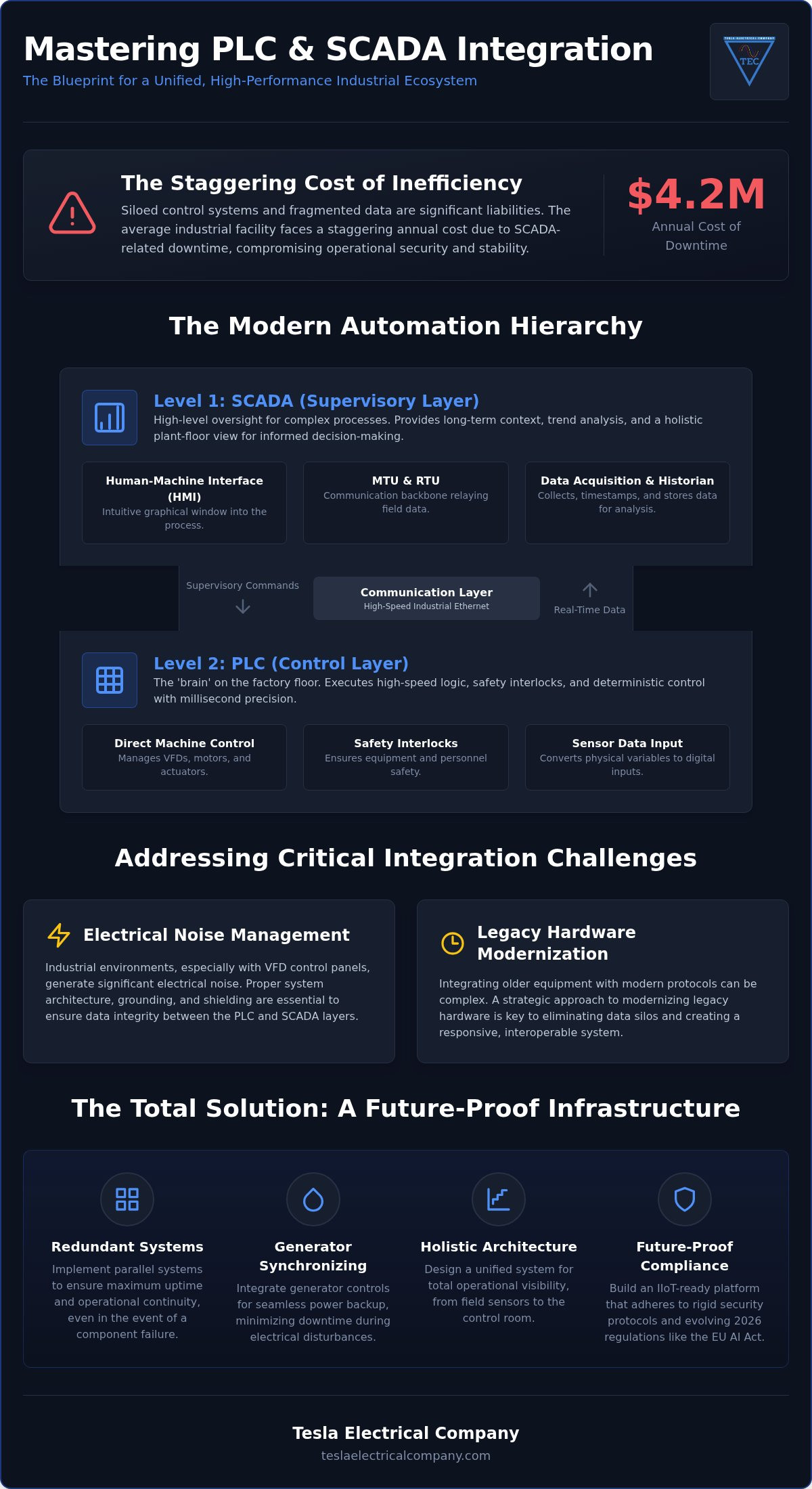
With the average industrial facility facing an annual cost of $4.2 million due to SCADA-related downtime, the margin for error in your automation strategy has never been thinner. You likely recognize that siloed control systems and fragmented data aren’t just technical nuisances; they’re significant liabilities that compromise your operational security and bottom-line stability. Mastering plc scada system integration is the definitive step toward eliminating these vulnerabilities and transforming your infrastructure into a unified, high-performance ecosystem.
This comprehensive guide provides the strategic roadmap you need to unify real-time PLC precision with SCADA supervisory intelligence. We’ll show you how to optimize your industrial infrastructure’s reliability and efficiency while addressing the complexities of modern automation. You’ll learn how to establish a seamless data flow from field sensors to the control room, leverage redundant systems for maximum uptime, and future-proof your architecture against evolving 2026 regulations like the EU AI Act. By the end of this article, you’ll have the insights required to move beyond legacy limitations and achieve total operational visibility through a sophisticated, well-integrated control environment.
Key Takeaways
- Differentiate between real-time deterministic control and supervisory data acquisition to establish a more structured and efficient automation hierarchy.
- Master the technical nuances of plc scada system integration to facilitate a seamless flow of information from field sensors to the supervisory layer.
- Evaluate the transition to high-speed Industrial Ethernet to eliminate data silos. Modernizing your communication architecture ensures your system remains responsive and interoperable.
- Address critical integration challenges, including the management of electrical noise in VFD control panel environments and the modernization of legacy hardware.
- Implement a holistic architecture using redundant systems and generator synchronizing control panels to ensure continuous operation and future-proof your industrial infrastructure.
Defining the Automation Hierarchy: What is SCADA Supervisory Control and Data Acquisition?
Industrial automation relies on a structured hierarchy where every component has a distinct, critical role. At the top of this architecture sits Supervisory Control and Data Acquisition (SCADA), acting as the high-level oversight system for complex processes. While some oversimplify the technology as mere software, it’s a comprehensive framework that integrates hardware and communications to provide a holistic view of the plant floor. Achieving successful plc scada system integration requires a deep understanding of how these layers interact to ensure both safety and operational continuity.
Modern industrial facilities distinguish between real-time deterministic control and data-driven monitoring. While a PLC manages immediate machine movements, SCADA provides the long-term context. This evolution from isolated monitoring to integrated IIoT-ready platforms allows for the ingestion of massive datasets while maintaining the rigid security protocols required by 2026 standards. Without this supervisory layer, an industrial facility lacks the visualization needed for informed decision-making, leaving operators blind to long-term trends or systemic inefficiencies. The synergy found in plc scada system integration allows for a transition from reactive maintenance to proactive optimization.
The Core Components of a SCADA System
A robust SCADA architecture consists of several specialized layers designed for reliability and transparency:
- Human-Machine Interface (HMI): This serves as the operator’s window into the process, translating complex machine data into intuitive graphical representations.
- Master Terminal Units (MTU) and Remote Terminal Units (RTU): These components form the communication backbone. The MTU acts as the central hub, while RTUs serve as the field outposts that relay signals from remote locations to the supervisory level.
- Data Acquisition: This process ensures that field data is collected, timestamped, and stored for historical analysis. It’s the essential foundation for identifying operational patterns and verifying compliance with safety regulations.
The Role of PLC in the Automation Stack
The Programmable Logic Controller (PLC) functions as the ‘brain’ on the factory floor, executing high-speed logic and managing safety interlocks with millisecond precision. It’s built for the harsh environments of the industrial sector, handling PID loops and complex sequences that keep production moving. In a unified architecture, the PLC interfaces directly with hardware such as a VFD control panel or motor centers. It provides the raw, real-time data that the SCADA system then aggregates and visualizes, creating a closed-loop environment where execution and oversight work in perfect tandem.
The Synergy of PLC and SCADA System Integration
The true power of industrial automation lies in the seamless exchange of data between the execution layer and the supervisory layer. In a well-designed environment, plc scada system integration transforms raw electrical signals into high-level operational intelligence. The process begins at the sensor level, where physical variables are converted into digital inputs for the PLC. Once the PLC executes its logic, it relays critical status updates to the SCADA server. This hierarchy ensures that while the PLC maintains deterministic control over specific machinery, the SCADA system provides the historical context and trend analysis necessary for long-term optimization.
Control isn’t a one-way street. Effective integration enables bidirectional communication, allowing operators to send supervisory setpoints or emergency overrides from the control room back to the field controllers. This capability is vital during electrical disturbances. For instance, when a fault is detected, the integrated system can automatically trigger a sequence in a Generator Synchronizing Control Panel while simultaneously logging the event in the SCADA historian for post-incident analysis. This rapid response minimizes downtime and protects expensive hardware from damage. Achieving this level of plc scada system integration requires a methodical approach to both hardware selection and software configuration.
Bridging the Gap Between Field Devices and the Control Room
Integrating physical hardware like LV and MV switchboards into the digital network is a cornerstone of modern infrastructure. By connecting these assets through established PLC and SCADA communication protocols, facilities gain real-time visibility into power quality and disturbance recording. This level of granularity is essential for large-scale plants where data must travel over significant distances without losing integrity. Maintaining a steady hand over these connections ensures that every breaker status and voltage fluctuation is accounted for in the central repository.
SCADA and Automation System Solutions for Power Management
Specialized SCADA and automation system solutions are particularly effective in managing complex power requirements. In facilities utilizing multi-generator setups, the SCADA interface visualizes load sharing and synchronizing data in real-time. This allows for precise adjustments to capacitor banks to optimize power factor correction, reducing energy waste and utility penalties. When you implement a Redundant System for these critical controls, you eliminate single points of failure and ensure that your power management remains resilient under all conditions.
Communication Protocols and Architecture in SCADA Design
The effectiveness of plc scada system integration is fundamentally defined by the communication protocols that facilitate data exchange. It’s the nervous system of your facility. While older infrastructures may still rely on serial standards like Modbus RTU, the industry has largely transitioned to high-speed Industrial Ethernet. Standards such as Profinet and EtherNet/IP offer the deterministic performance required for high-stakes environments where timing is everything. For facilities operating with diverse hardware, OPC UA has emerged as the essential standard for cross-platform interoperability. It provides a vendor-neutral data modeling layer that ensures seamless communication between disparate PLCs and SCADA servers, regardless of the original manufacturer.
Beyond protocol selection, the logical layout of the network determines long-term stability. Network segmentation is no longer optional in a modern industrial setting. By isolating control traffic from enterprise data through VLANs and firewalls, you prevent traffic congestion and create a critical layer of security. This structured approach ensures that supervisory commands aren’t delayed by non-essential data packets, maintaining the integrity of the control loop. It’s about creating a predictable environment where data arrives exactly when it’s needed.
Selecting the Right Protocol for Your Infrastructure
Choosing a protocol involves balancing simplicity with performance requirements. Modbus remains a popular choice for its straightforward implementation in basic monitoring and power quality recording. However, Profinet is superior for high-speed deterministic control where precision is critical. In multi-vendor environments, the challenge often lies in bridging legacy fieldbus systems with modern SCADA platforms. Gateways act as translators in these scenarios. They allow older RS-485 devices to coexist with modern Ethernet-based architectures, protecting your previous investments while enabling modern data analytics.
Network Topology for Industrial Reliability
Reliability is reinforced through intelligent network topology. While Star topologies are simple to manage, Ring topologies provide the path redundancy essential for critical infrastructure. If one segment of the ring fails, data is instantly rerouted through the alternate path, maintaining the vital link between the PLC and the control room. Implementing managed switches further enhances this by providing deep diagnostic capabilities that allow for rapid troubleshooting. This level of technical rigor is a core component of industrial plant automation, ensuring that your communication backbone is as resilient as the hardware it controls.
Overcoming Challenges in PLC SCADA System Integration
Successful plc scada system integration requires navigating more than just software compatibility. One of the most persistent physical challenges involves mitigating electromagnetic interference (EMI). In environments with a high concentration of power electronics, such as those utilizing a VFD control panel, electrical noise can corrupt data packets and trigger false alarms. Addressing this requires rigorous grounding strategies and the use of shielded communication cables to ensure that the supervisory layer receives a clean, accurate signal from the field controllers. Precision in the physical installation layer is just as critical as the logic programmed into the software.
While the complexity and initial cost of these upgrades often serve as a deterrent, the alternative is far more costly. Legacy systems are prone to high downtime and lack the diagnostic depth needed for modern efficiency. Investing in a robust integration strategy isn’t merely an expense; it’s a commitment to long-term industrial resilience. As operations become more connected, the focus must also shift toward protecting the integrity of the data being exchanged between the PLC and the SCADA server. You can’t afford to leave your control architecture vulnerable to either physical interference or digital intrusion.
Securing the Automation Layer
The convergence of IT and OT networks has made SCADA security a non-negotiable priority in 2026. Protecting critical infrastructure requires implementing industrial-grade firewalls and Demilitarized Zones (DMZs) to isolate sensitive control traffic from the corporate network. You must also manage user access levels with precision. SCADA software should maintain comprehensive audit trails, ensuring that every command is logged and every operator action is traceable. This level of oversight is essential for maintaining accountability and meeting modern regulatory standards for industrial data protection.
Achieving System Redundancy and High Availability
A single point of failure can halt an entire production line or compromise critical safety systems. To prevent this, high-stakes environments rely on a Redundant System architecture. This involves designing redundant PLC processors that provide seamless failover; if the primary controller fails, the secondary takes over without interrupting the process. On the supervisory side, implementing dual-SCADA servers ensures continuous data acquisition even during hardware maintenance or unexpected server issues. You should also ensure that your control panels feature redundant power supplies to prevent system crashes during voltage fluctuations. If you’re ready to eliminate vulnerabilities in your architecture, explore our comprehensive SCADA & Automation Systems to find a solution tailored to your facility’s needs.
The Total Solution: Modernizing Infrastructure with Integrated Automation
Adopting a holistic strategy for industrial infrastructure is the only way to ensure absolute reliability. While piecemeal upgrades might seem cost-effective initially, they often lead to fragmented data and integration bottlenecks that compromise long-term performance. A total solution for plc scada system integration aligns your electrical hardware with your digital oversight. This creates a unified ecosystem that’s far easier to manage and maintain than a collection of siloed systems. It’s about looking beyond individual components to see the entire facility as a single, synchronized machine.
Understanding what is scada system architecture allows you to see how it acts as the glue between disparate hardware. This approach ensures that every sensor, breaker, and motor controller contributes to a centralized pool of actionable data. By treating the automation and electrical layers as a single entity, you eliminate the “grey areas” where faults often hide. This methodology has been a core focus since our establishment in 2015, prioritizing high-performance infrastructure over temporary fixes.
Integrating Power Generation and Automation
Power resilience is a cornerstone of any integrated approach. By incorporating a Generator Synchronizing Control Panel into your automation stack, you can manage multiple power sources with extreme precision. This integration allows for a more responsive and reliable power grid within your facility.
- Automated Synchronization: The PLC handles high-speed logic to bring multiple generators online and in phase seamlessly.
- Centralized Health Monitoring: Operators can view generator health and load sharing data via a dedicated SCADA dashboard.
- Mains Failure Response: The system automatically triggers backup sequences to ensure critical processes continue without interruption.
Retrofitting and Modernization Strategies
Modernization doesn’t always require a complete, disruptive overhaul. The business case for the Retrofit of Circuit Breakers and Protection Relays is compelling for facilities looking to improve reliability without massive capital expenditure. This approach leverages existing assets while introducing modern intelligence.
- Relay Upgrades: Upgrading legacy protection relays to modern digital units with SCADA connectivity provides advanced diagnostic depth.
- Breaker Retrofitting: This process enhances system reliability and safety without the need to replace entire LV and MV Switchboards.
- Longevity and Support: Utilizing a consistent inventory of Spare parts and expert technical oversight extends the useful life of your industrial infrastructure.
Specialized engineering plays a vital role in this transition. It ensures that new digital components communicate perfectly with older physical hardware, maintaining the integrity of the plc scada system integration. By focusing on these targeted upgrades, you achieve a modern, IIoT-ready facility with significantly lower capital requirements.
Securing Your Industrial Future through Unified Automation
Achieving industrial excellence in the modern era requires a strategic shift from fragmented control to a unified architecture. By mastering plc scada system integration, you move beyond simple machine monitoring to achieve the comprehensive supervisory oversight that drives long-term efficiency. We’ve explored how robust communication protocols and redundant architectures serve as the primary defenses against the high costs of industrial downtime. These integrated systems don’t just solve today’s operational hurdles; they ensure your facility remains compliant with evolving 2026 standards while providing a clear path for future scalability.
True automation resilience isn’t found in software alone; it’s anchored in the physical integrity of your electrical hardware. Whether you’re implementing a Generator Synchronizing Control Panel for power resilience or performing a Retrofit of Circuit Breakers and Protection Relays, a holistic approach is essential for system longevity. Our specialists focus on creating end-to-end solutions that bridge the gap between the factory floor and the control room, ensuring data flows without interruption. We’re committed to helping you navigate these technical complexities to secure a more stable and profitable future for your operations.
Partner with Tesla Electrical Company for Your Total Automation Solution to leverage our expert design services and specialists in redundant, high-availability control systems. Let’s work together to build an infrastructure you can depend on for years to come.
Frequently Asked Questions
What is the main difference between PLC and SCADA in industrial automation?
PLC (Programmable Logic Controller) serves as the hardware-level executor on the factory floor, handling high-speed deterministic logic and machine control. In contrast, SCADA is the supervisory software layer that aggregates data from multiple controllers for visualization and historical analysis. While the PLC makes immediate, local decisions, SCADA provides the comprehensive oversight necessary for facility-wide coordination. Successful plc scada system integration ensures these two layers communicate with minimal latency to maintain both safety and operational productivity.
Can a SCADA system operate without a PLC?
A SCADA system can operate without a PLC by interfacing directly with Remote Terminal Units (RTUs) or smart field devices. However, this configuration is rarely ideal for complex manufacturing environments. PLCs provide the robust, real-time processing power required for intricate sequences and safety interlocks that RTUs often lack. Most high-performance industrial architectures utilize PLCs as the primary data source to ensure the supervisory layer receives high-resolution, reliable information for critical decision-making.
How does PLC SCADA system integration improve energy efficiency?
Integrating these systems allows for the precise monitoring and automated adjustment of power-consuming assets. By analyzing real-time data from a Power Quality and Disturbance Recording System, the SCADA layer can trigger a PLC to adjust a VFD Control Panel or engage capacitor banks for power factor correction. This closed-loop approach reduces energy waste and prevents utility penalties. Effective plc scada system integration transforms raw power data into actionable strategies for reducing your facility’s overall carbon footprint.
What are the security risks associated with SCADA supervisory control and data acquisition?
Security risks include unauthorized remote access, malware injection, and vulnerabilities within legacy hardware that lacks modern encryption. As of August 2026, the EU AI Act requires manufacturers to classify automation systems by risk level, emphasizing the need for robust technical documentation. Protecting your supervisory control and data acquisition framework requires implementing industrial firewalls, DMZs, and strict user authentication. Failure to secure these connections can lead to operational sabotage or the theft of sensitive industrial intellectual property.
How do I choose the right communication protocol for my PLC and SCADA integration?
Protocol selection depends on your specific requirements for speed, distance, and hardware interoperability. Modbus RTU is suitable for simple, short-distance monitoring, while Profinet offers the high-speed deterministic control required for synchronized machine movements. For multi-vendor environments, OPC UA is the industry standard for ensuring cross-platform compatibility. You should evaluate your existing network topology to determine if Industrial Ethernet or legacy serial connections will best support your long-term data acquisition goals and overall system reliability.
What is the role of a Redundant System in PLC SCADA architecture?
A Redundant System acts as a critical safeguard against hardware failure by providing secondary controllers or servers that take over instantly if the primary unit fails. This architecture ensures that a single component malfunction doesn’t lead to a total process shutdown or catastrophic data loss. In a high-availability PLC SCADA design, redundancy extends to power supplies and communication paths. This methodical approach to hardware design is essential for maintaining continuous operation in critical infrastructure and high-value production lines.
Is it possible to integrate legacy electrical panels into a modern SCADA system?
Yes, legacy electrical panels can be modernized through targeted retrofitting rather than total replacement. By installing modern digital protection relays and communication gateways, you can connect older LV and MV Switchboards to a central SCADA network. This allows you to extract real-time status data from aging assets that were previously siloed. This strategy extends the life of your existing infrastructure while providing the visibility needed for predictive maintenance and improved safety oversight across the entire plant.
How does a Generator Synchronizing Control Panel interface with a SCADA system?
A Generator Synchronizing Control Panel utilizes a PLC to manage the complex timing and phase matching required to bring multiple power sources online. This PLC relays synchronizing data, load sharing status, and mains failure alerts to the SCADA system via standard industrial protocols. Operators can then monitor the entire backup power sequence from a centralized dashboard. This integration ensures that your facility remains powered during disturbances while providing a detailed historical log of every synchronization event for regulatory compliance.
Disclaimer
Some content, images, text, or other materials on this website may have been created or assisted by artificial intelligence (AI).
While we review AI-generated content for accuracy and quality, we do not guarantee that all information is free from errors or omissions.
Content generated using AI is provided for informational purposes only and should not be solely relied upon without independent verification.