
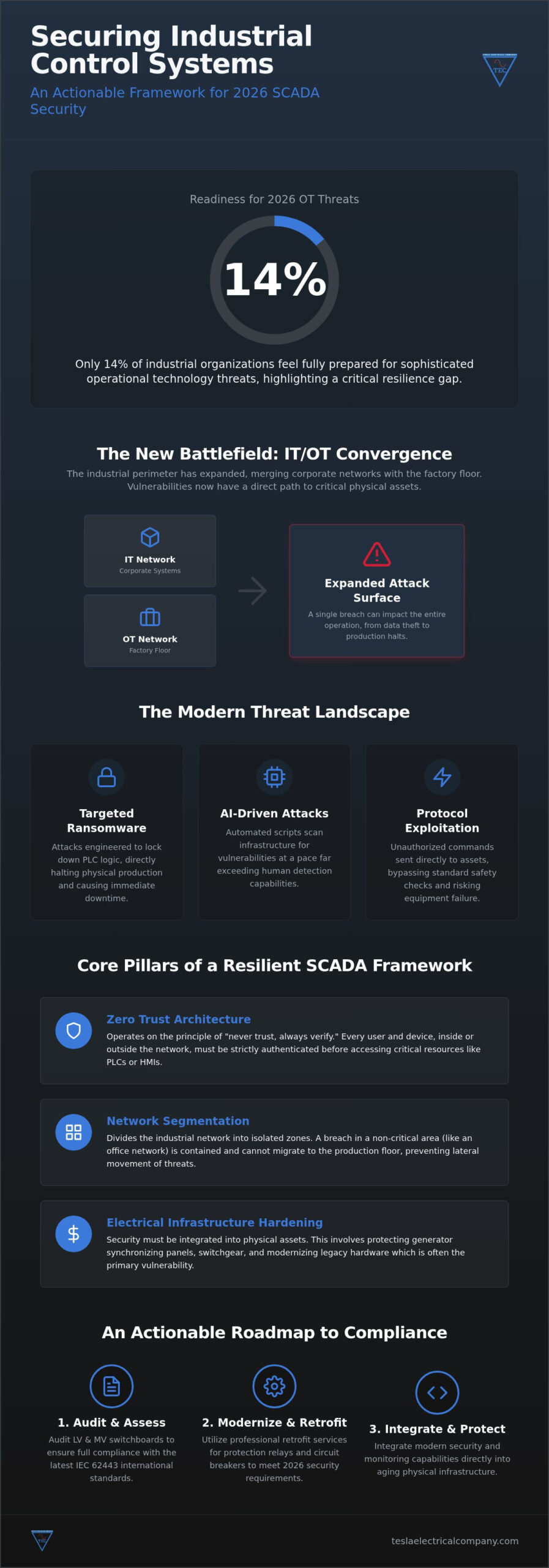
Only 14% of industrial organizations report feeling fully prepared for the sophisticated operational technology threats present in 2026. This statistic highlights a critical gap in global infrastructure resilience, particularly as the convergence of IT and OT networks increases the attack surface for vital systems. Ensuring robust scada security is no longer just a software concern. It requires a methodical integration of protection protocols into the very physical assets that drive production, from generator synchronizing control panels to low voltage switchboards.
You likely recognize the immense pressure of maintaining uptime while managing the vulnerabilities inherent in legacy hardware. It’s a complex balance to strike, especially with the recent enforcement of NERC CIP-012-2 and the expanded ISA/IEC 62443 standards. This article provides a comprehensive framework for securing your industrial control systems against modern cyber threats through a security by design approach. We will examine the most pressing risks of the current landscape, detail how to integrate security into physical assets through professional retrofitting, and provide an actionable roadmap for achieving long-term industrial stability and regulatory compliance.
Key Takeaways
- Understand the evolving role of IT and OT convergence and why the industrial perimeter must now encompass both digital and physical layers.
- Learn how to apply Zero Trust principles and network segmentation to effectively contain potential security breaches within your facility.
- Discover the critical link between electrical infrastructure and scada security, focusing on the protection of generator synchronizing panels and switchgear.
- Gain an actionable framework for auditing LV and MV switchboards to ensure full compliance with the latest IEC 62443 international standards.
- Identify how professional retrofit services for protection relays and circuit breakers can modernize legacy hardware to meet 2026 security requirements.
What is SCADA Security? Defining the Industrial Perimeter
The year 2026 represents a definitive shift in how we approach industrial protection. For decades, many facilities relied on “security through obscurity,” assuming that isolated networks were safe from interference. This era has ended. As Information Technology (IT) and Operational Technology (OT) converge, the industrial perimeter has expanded. Modern scada security is the comprehensive practice of protecting the hardware, software, and communication protocols of Supervisory control and data acquisition (SCADA) systems, ensuring the integrity of both digital data and the physical assets they control.
This convergence means that vulnerabilities in a corporate network can now directly impact the factory floor. Proactive defense-in-depth is no longer optional; it’s a requirement for operational continuity. We’ve moved beyond simple firewalls to a model where every layer of the infrastructure, from the cloud down to the individual sensor, requires rigorous oversight. It’s about establishing a steady hand over the entire ecosystem to prevent unauthorized access and maintain system reliability.
The Evolution of Industrial Cyber Threats
Industrial cyber threats have grown significantly more sophisticated. We’ve seen a sharp rise in ransomware specifically engineered to target PLC control systems. These attacks don’t just steal data; they lock down the logic that governs physical processes, leading to immediate production halts. AI-driven threats are also emerging. These automated scripts scan infrastructure for vulnerabilities at a pace that far exceeds human detection capabilities. Inadequate protocol security has caused documented disruptions where unauthorized commands were sent directly to industrial assets, bypassing standard safety checks and risking catastrophic equipment failure.
Why Legacy Infrastructure is a Primary Vulnerability
Legacy hardware remains one of the greatest risks to modern security. Many LV and MV switchboards and protection relays currently in operation were designed long before the threat of internet-based attacks existed. These systems often utilize communication protocols that lack encryption or authentication. The “air-gap myth” has also been thoroughly debunked. In 2026, the idea that a system is safe because it’s not “connected” is dangerous. Maintenance laptops, USB drives, and remote access points for vendors create hidden bridges into isolated networks. Protecting these assets requires more than just digital patches. It often necessitates professional circuit breaker retrofit services to integrate modern monitoring and security capabilities into aging physical infrastructure.
Core Pillars of a Resilient SCADA Security Framework
Building a resilient scada security framework requires a departure from traditional perimeter-only thinking. In 2026, the industry standard has shifted toward a Zero Trust architecture. This model operates on the principle that no user or device, whether inside or outside the network, is trusted by default. Every request for access to a PLC or HMI must be verified through strict authentication protocols. This approach is particularly vital when implementing SCADA and automation system solutions that handle critical process data. By ensuring data integrity through encrypted communication between controllers and visualization layers, operators can prevent man-in-the-middle attacks that might otherwise inject malicious commands into the control loop.
Network Segmentation and Air-Gapping Strategies
Effective defense relies on dividing the industrial network into distinct functional zones and conduits. This ensures that a breach in one area, such as the business office or a non-critical utility, doesn’t migrate to the production floor. The NIST Guide to Industrial Control Systems (ICS) Security emphasizes that these zones must be isolated to contain potential threats. Implementing hardware-based firewalls at the machine level provides a secondary, granular layer of protection that software alone cannot match. When remote access is required for maintenance, it must be managed through secure, temporary gateways that don’t expose the core process network. This methodical isolation preserves the integrity of the most sensitive operations while allowing for necessary technical support.
Hardware-Level Protections in Control Panels
Security isn’t just a digital concern; it’s a physical one. Robust scada security starts with the physical enclosures housing your equipment. Tamper-evident seals and high-security locks on VFD control panels prevent unauthorized local access to critical drive parameters. At the component level, disabling unused Ethernet and USB ports on industrial switches and PLCs eliminates common entry points for intruders. Modern protection relays should utilize secure boot protocols and firmware signing to ensure that only authorized code runs on the hardware. These hardware-level safeguards act as the final line of defense against both internal and external threats. If you’re looking to strengthen your facility’s resilience, integrating these features into your redundant systems is a logical next step to ensure total reliability.
The Convergence of OT Security and Electrical Infrastructure
Electrical infrastructure serves as the physical manifestation of digital logic. When scada security protocols are insufficient, the consequences manifest as tangible damage to the power distribution network. The ultimate goal of any security program isn’t merely to protect data packets; it’s to ensure the reliability and longevity of the physical assets that drive production. For instance, malicious manipulation of a VFD control panel can result in subtle changes to voltage and frequency. While these changes might bypass standard software alerts, they significantly degrade motor insulation and bearing life over time, leading to premature failure and unplanned downtime.
A sophisticated defense strategy utilizes a Power Quality and Disturbance Recording System as a secondary layer of anomaly detection. These systems act as a high-speed “black box” for the electrical network. By recording transients and harmonic distortions, they can identify the electrical signatures of a cyber-induced process disruption before mechanical failure occurs. This integration of electrical monitoring and cybersecurity allows operators to distinguish between routine equipment wear and intentional interference.
Security by Design in Generator Synchronizing Panels
Synchronization requires absolute precision between multiple power sources. When malicious actors gain access to setpoints within Generator Synchronizing Control Panels, they can induce phase mismatches that result in catastrophic mechanical stress or grid-level cascading failures. Hardening these panels involves securing logic controllers against unauthorized setpoint changes and implementing redundant communication links. We also advocate for the inclusion of physical override switches. These manual controls ensure that operators can safely isolate the system and maintain command during a total network compromise.
Role of Redundant Systems in Mitigating Cyber Attacks
A robust redundant system architecture provides a critical safety net during a controller compromise. If a primary PLC is targeted, automated failover protocols can shift control to a secondary, isolated unit to maintain power stability. This diversity in hardware serves as a defense against supply chain vulnerabilities. By utilizing different manufacturers or firmware versions for redundant controllers, you reduce the risk of a single exploit disabling your entire facility. This methodical approach ensures that even if one layer is breached, the core electrical infrastructure remains stable and operational.
Implementing Modern Security Protocols: A Strategic Approach
A systematic approach to scada security begins with a comprehensive audit of the physical electrical infrastructure. It’s not enough to scan your network for open ports. You must physically inspect all LV and MV switchboards for unauthorized modifications or outdated protection relays. This evaluation ensures that every component in the power distribution chain meets current safety and security benchmarks. Once the baseline is established, organizations can develop a methodical roadmap to address vulnerabilities without disrupting ongoing operations.
The human element remains a critical factor in maintaining a secure industrial environment. Engineering teams must be trained on OT-specific security hygiene. This training differs significantly from standard IT practices. It includes protocols for using removable media on the factory floor and recognizing social engineering attempts targeted at maintenance staff. Engineering teams should also be familiar with the incident response plan, ensuring they know how to isolate critical segments if a breach is detected. By fostering a culture of vigilance, facilities transform their workforce into an active layer of defense.
Transitioning from Reactive to Proactive Monitoring
Modern monitoring goes beyond simple uptime tracking. By leveraging a Power Quality and Disturbance Recording System, operators can identify ‘phantom’ loads or unusual harmonic patterns. These anomalies often indicate a compromised controller or unauthorized process changes. These systems act as a high-fidelity diagnostic tool, providing the granular data necessary to distinguish between electrical noise and a coordinated cyber assault. Integrating these industrial logs into a Security Information and Event Management (SIEM) system allows for centralized oversight. Real-time alerting for protection relay trips that deviate from normal parameters provides an early warning system. This allows for immediate investigation before a minor anomaly escalates into a full-scale production halt.
Compliance and International Standards (IEC 62443)
Aligning operations with international standards like IEC 62443 is essential for managing risk in 2026. This series of standards defines specific Security Levels (SL) for industrial automation and control systems. These levels range from basic protection to defense against sophisticated, state-sponsored attacks. Compliance doesn’t just improve scada security. It’s often a prerequisite for insurance eligibility and significantly reduces corporate liability in the event of a breach. Third-party certifications serve as an objective verification of system integrity. They provide stakeholders with confidence in the facility’s resilience. To ensure your facility meets these rigorous benchmarks, consider a professional audit of your switchgear and automation systems today.
Future-Proofing Industrial Assets with Tesla Electrical Company
Tesla Electrical Company stands as a definitive partner for organizations seeking to align their physical infrastructure with the digital requirements of 2026. We understand that effective scada security is not a bolt-on feature. It’s a fundamental engineering requirement. By integrating advanced security protocols directly into custom LV and MV switchboards, we eliminate the vulnerabilities often introduced by disparate systems. Our approach ensures that the “brain” of your facility is protected by the same rigorous standards as the power distribution it governs. Partnering with an engineering firm that speaks the language of both power and data provides the steady hand necessary for complex industrial environments.
Integrated SCADA and Automation Design
Our methodology focuses on building secure-by-default automation systems that prioritize both stability and resilience. Tesla’s custom PLC control systems are specifically engineered for PID process stability, ensuring that critical control loops remain operational even under digital stress. When a single provider manages the end-to-end design of both the electrical and automation layers, it significantly reduces security “seams.” These seams are the traditional points of failure where IT and OT systems interface. By providing a unified architecture, we ensure that data flows securely from field devices to the supervisory level without unnecessary exposure.
Retrofitting and Modernization as a Security Strategy
Many facilities face the challenge of securing legacy equipment that was never intended for modern connectivity standards. Full system replacement is often cost-prohibitive and causes extensive downtime. Professional circuit breaker retrofit services offer a strategic, cost-effective alternative. This process involves replacing aging protection relays with modern, secure-capable units and upgrading distribution boards to support advanced monitoring sensors. This modernization allows legacy assets to participate in a modern scada security framework without the capital expenditure of a total plant overhaul.
A thorough cost-benefit analysis often reveals that retrofitting provides the highest return on investment for industrial protection. It allows for the integration of modern encryption and authentication without the need for massive civil works. We also maintain a dedicated inventory of secure spare parts. This ensures that when a component reaches its end-of-life, it’s replaced with a verified, secure asset rather than a potentially compromised third-party alternative. This commitment to longevity and systematic oversight ensures your system remains a grounded, dependable partner in your production process for years to come. For a deeper technical perspective on phased infrastructure upgrades and intelligent power management, our guide to industrial plant automation and modernizing infrastructure provides a comprehensive roadmap for facilities at every stage of transition.
Securing Your Industrial Future Through Engineering Excellence
The industrial landscape of 2026 demands a shift from isolated software defenses to a holistic engineering approach. We’ve explored how robust scada security depends on the seamless integration of digital protocols with physical assets like LV and MV switchboards. By prioritizing Zero Trust architectures and leveraging advanced monitoring through Power Quality and Disturbance Recording, facilities can detect anomalies before they result in production downtime. Compliance with international standards like IEC 62443 isn’t just a regulatory checkbox. It’s a fundamental strategy for long-term operational resilience.
Achieving this level of protection requires a partner who understands the intricate relationship between power and data. Tesla Electrical Company brings specialized expertise in Generator Synchronizing Control Panels and a proven track record in redundant control system architecture to every project. As expert LV and MV switchboard manufacturers, our team provides the steady hand needed to navigate high-stakes technical requirements. Whether you’re modernizing legacy hardware through professional retrofitting or designing a new automated facility, we ensure your infrastructure is secure by design.
Partner with Tesla Electrical Company for secure, resilient industrial automation solutions and ensure your critical infrastructure remains a dependable asset for years to come.
Frequently Asked Questions
What are the most common threats to SCADA security in 2026?
The most common threats in 2026 include ransomware specifically engineered for PLC control systems and AI-driven scripts that scan infrastructure for vulnerabilities. Supply chain compromises and the risk of aggregated “low-impact” asset failures, as highlighted by the 2026 NERC CIP Roadmap, are also significant. These threats prioritize process disruption over data theft, aiming to cause physical damage or production halts through unauthorized setpoint manipulation.
Can a SCADA system be fully secured if it is connected to the internet?
A SCADA system can be secured while connected to the internet, but it requires a Zero Trust architecture rather than traditional perimeter defense. This involves multi-factor authentication, end-to-end encryption, and rigorous network segmentation. Modern connectivity is often necessary for remote monitoring and data analysis. However, it necessitates a security by design approach that treats every external connection as a potential threat vector requiring continuous verification.
How does IEC 62443 differ from IT-focused security standards like ISO 27001?
IEC 62443 differs from ISO 27001 by focusing specifically on the availability and integrity of Industrial Automation and Control Systems (IACS). While ISO 27001 prioritizes data confidentiality in IT environments, IEC 62443 addresses the physical safety and operational continuity of the factory floor. In 2026, the updated IEC 62443-6-2 provides specific security evaluation methodologies tailored for the high-stakes requirements of industrial electrical infrastructure and hardware.
What is the role of a protection relay in a cybersecurity framework?
A protection relay serves as the final physical line of defense in a scada security framework. While software firewalls manage data packets, relays monitor electrical parameters like current and voltage. If a cyber attack attempts to induce a phase mismatch or overload, a modern, secure-capable relay can independently trip the circuit to prevent catastrophic equipment damage. This hardware-level protection ensures that even a compromised network cannot bypass fundamental safety limits.
How often should an industrial plant conduct a SCADA security audit?
Industrial plants should conduct a comprehensive security audit at least annually, or immediately following any significant hardware or software modification. Given that only 14% of organizations feel fully prepared for OT threats in 2026, regular assessments are vital. These audits must go beyond digital scanning to include physical inspections of LV and MV switchboards, ensuring that all protection settings and firmware versions align with current safety standards.
Is it possible to secure legacy electrical panels without replacing them entirely?
It’s entirely possible to secure legacy electrical panels without a total replacement through professional retrofitting. This strategy involves upgrading circuit breakers and replacing aging protection relays with modern units that support encrypted communication and secure boot protocols. Retrofitting allows facilities to integrate legacy hardware into a modern scada security stack, providing a cost-effective path to achieving current IEC 62443 compliance while maintaining existing physical infrastructure.
What is the impact of a SCADA breach on industrial power quality?
A SCADA breach can severely degrade industrial power quality by introducing harmonic distortions or frequency instability. Malicious manipulation of VFD control panels or capacitor banks can create electrical transients that damage sensitive equipment and reduce motor longevity. By utilizing a Power Quality and Disturbance Recording System, operators can identify these cyber-induced anomalies early, distinguishing intentional process interference from routine equipment wear or external grid fluctuations.
Why is redundancy considered a core component of SCADA security?
Redundancy is a core component of security because it provides fault tolerance during a controller compromise or network outage. A robust redundant system architecture ensures that if a primary PLC or communication link is disabled by an attack, an isolated secondary unit can immediately assume control. This automated failover maintains process stability and prevents the “cascading failures” often targeted by sophisticated threats, ensuring that critical industrial assets remain operational.
Disclaimer
Some content, images, text, or other materials on this website may have been created or assisted by artificial intelligence (AI).
While we review AI-generated content for accuracy and quality, we do not guarantee that all information is free from errors or omissions.
Content generated using AI is provided for informational purposes only and should not be solely relied upon without independent verification.