
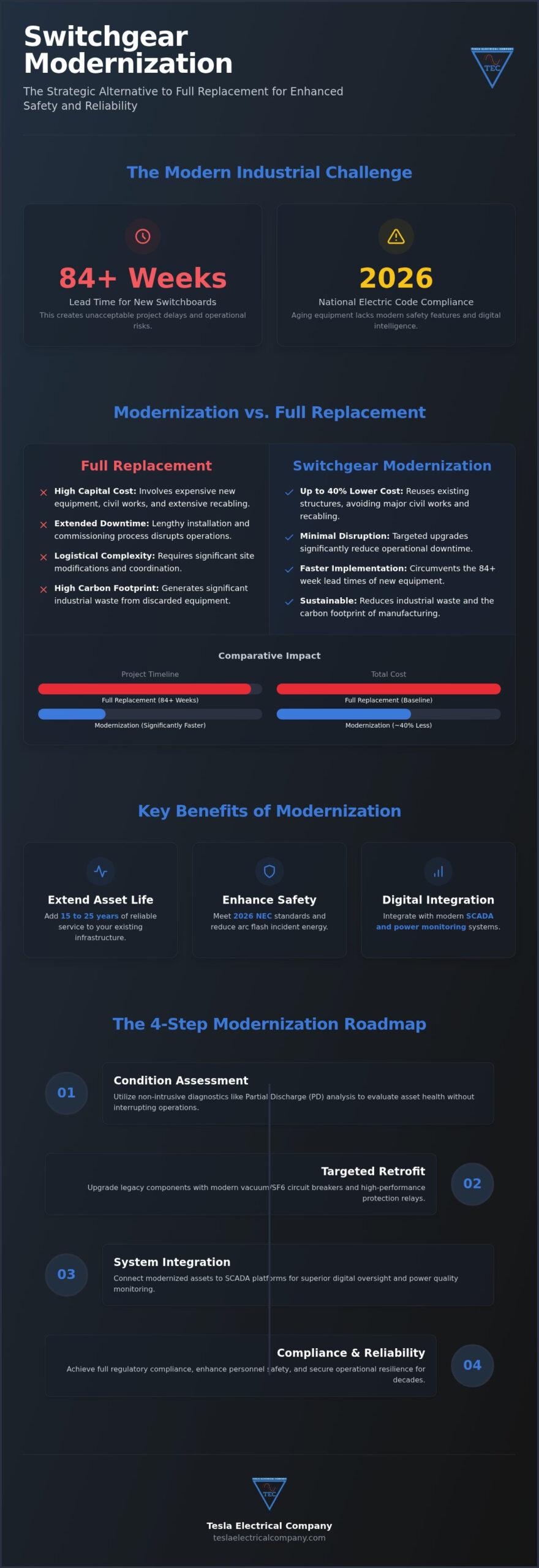
With lead times for new power circuit breaker switchboards now exceeding 84 weeks, the traditional strategy of full system replacement has become a liability for industrial continuity. Maintaining aging infrastructure while facing the risk of unplanned outages due to obsolete protection relays creates a high-stakes environment for facility managers. You likely recognize that your legacy equipment remains robust in its core construction, yet it lacks the digital intelligence and safety features required by the 2026 National Electric Code. A systematic switchgear condition assessment provides the empirical data needed to bridge this gap without the capital intensity of a complete overhaul.
This guide demonstrates how a structured modernization program can extend your asset’s operational life by 15 to 20 years while enhancing personnel safety through modern relay upgrades. We will examine the technical transition from obsolete breakers to high-performance retrofits and explore how these systems integrate with modern SCADA and automation platforms. By prioritizing data-driven interventions over total replacement, industrial leaders can secure their power quality and operational resilience for the next two decades.
Key Takeaways
- Understand why modernization serves as a strategic alternative to the multi-year lead times currently impacting the procurement of new switchgear systems.
- Learn how a data-driven switchgear condition assessment utilizes non-intrusive testing to evaluate asset health without interrupting critical industrial processes.
- Discover the economic advantages of retrofitting, specifically how it eliminates the need for expensive civil works and extensive recabling required by full replacements.
- Explore the technical process of upgrading legacy enclosures with modern vacuum or SF6 circuit breakers to enhance safety and operational reliability.
- Identify the roadmap for integrating aging infrastructure with modern SCADA systems and power quality monitoring for superior digital oversight.
The Strategic Necessity of Switchgear Modernization Services
Industrial reliability hinges on the integrity of the power distribution network. While routine maintenance focuses on basic functional checks and lubrication, modernization represents a systematic technical upgrade of core components. This approach bridges the gap between legacy hardware and modern digital requirements. It’s a high-precision engineering intervention that transforms an aging asset into a modern, data-ready system. By retaining the existing steel structures and busbars, companies avoid the massive logistical hurdles associated with total replacement.
The urgency for these upgrades has intensified as we move through 2026. Modern industrial processes require sophisticated power quality and disturbance recording systems to protect sensitive electronics from harmonics and voltage fluctuations. Modernization also serves as a critical tool for ESG and sustainability initiatives. By reusing existing enclosures, facilities significantly reduce industrial waste and the carbon footprint associated with manufacturing and transporting new heavy equipment. This transition begins with a rigorous switchgear condition assessment to identify which components are candidates for digital integration and which require mechanical replacement.
Lifecycle Extension vs. Equipment Obsolescence
Every facility eventually reaches a tipping point where the cost of maintaining legacy equipment exceeds the value of modernization. Sourcing spare parts for obsolete breakers often leads to extended downtime and inflated procurement costs. Modernization addresses this by implementing a targeted retrofit of circuit breakers and protection relays. This strategy provides several key advantages:
- Extended Asset Life: Targeted upgrades can add 15 to 25 years of reliable service to your existing infrastructure.
- Lead Time Mitigation: With new power circuit breaker switchboards facing lead times of up to 84 weeks, retrofitting offers a significantly faster route to system reliability.
- Cost Efficiency: Modernizing the internal components typically costs 40% less than a full system replacement when civil works and cabling are considered.
Safety and Regulatory Compliance Standards
Safety remains the primary driver for engineering upgrades. The 2026 National Electric Code (NEC) mandates expanded arc flash labeling and boundary assessments for Switchgear and industrial control panels. Legacy systems often lack the high-speed clearing capabilities required to minimize incident energy during a fault. By performing a switchgear condition assessment and subsequently upgrading to modern protection relays, facilities can drastically reduce the risk to personnel during switching operations. These modern systems provide the granular data and fast-acting protection logic necessary to meet international MV and LV performance standards while ensuring full compliance with updated safety regulations.
Conducting a Robust Switchgear Condition Assessment
Effective asset management requires more than a cursory walkthrough. A comprehensive switchgear condition assessment follows a structured hierarchy, beginning with visual inspections and culminating in advanced diagnostic analytics. This methodical approach ensures that engineers identify latent defects that aren’t visible to the naked eye. By utilizing non-intrusive testing techniques, facilities can gather critical performance data while the system remains energized. This eliminates the need for costly operational shutdowns during the initial evaluation phase.
Reliable decision-making relies on empirical evidence rather than guesswork. We analyze historical disturbance recording data to assess the thermal stress placed on busbars and connections over time. These records reveal how the system has responded to past faults, providing a roadmap for necessary engineering interventions. Turning these assessment reports into actionable plans allows for a prioritized modernization strategy that targets the most vulnerable components first. This systematic oversight is what distinguishes a professional life-extension program from a simple repair job.
Advanced Diagnostic Testing Methods
Precision diagnostics are the cornerstone of a total solution approach. Partial Discharge (PD) analysis is employed to detect insulation breakdown in its earliest stages, preventing catastrophic failure before it occurs. Thermographic surveys identify ohmic heating caused by loose or corroded connections, which are common in aging infrastructure. For medium-voltage lineups, vacuum interrupter integrity testing confirms that the arc-extinguishing capability of the breakers remains within manufacturer specifications. These tests provide a clear baseline of the current physical state of your equipment.
Evaluating Protection Relay and Breaker Health
The health of the protection system is as vital as the primary equipment. Secondary injection testing verifies the accuracy and response speed of protection relays, ensuring they’ll trip correctly during a fault. For the breakers themselves, we perform contact resistance and timing tests to evaluate mechanical wear and arc-clearing efficiency. A critical part of this process is determining the integration potential of legacy panels with SCADA and automation systems. Modernizing these interfaces allows for real-time monitoring and remote control, which are essential for 2026 industrial standards. If your current switchgear condition assessment indicates significant mechanical wear, exploring a comprehensive retrofit strategy is the most reliable way to secure your facility’s future.
Switchgear Modernization vs. Full Replacement: A Comparative Framework
Deciding between a total system replacement and a targeted modernization program requires a rigorous analysis of the total cost of ownership (TCO). While the allure of entirely new equipment is strong, the engineering reality often favors the retention of existing steel enclosures and busbars. A data-driven switchgear condition assessment often reveals that the passive components of a system remain in excellent health, even when the active components are nearing obsolescence. By focusing on the internal mechanisms, facilities avoid the disruptive “hidden” costs of replacement, such as extensive civil works, foundation modifications, and the high-risk task of re-terminating thousands of control cables.
Execution speed is another critical differentiator. Modernization projects are typically 40% to 60% faster to implement than full replacements. This efficiency stems from the ability to reuse the existing footprint, eliminating the need for structural re-engineering of the electrical room. When you consider that a new power circuit breaker switchboard currently carries a lead time of 84 weeks or more, the ability to modernize existing assets within a standard maintenance window becomes a strategic necessity rather than just a cost-saving measure.
Financial Justification and CAPEX Optimization
Modernization offers a superior path for CAPEX optimization by allowing for phased budgeting. Unlike a full replacement, which requires a massive upfront capital injection, a systematic upgrade can be spread across multiple fiscal years based on the priorities identified during your switchgear condition assessment. This approach improves ROI by significantly reducing maintenance frequency and enhancing energy efficiency through modern power quality monitoring. You aren’t just buying time; you’re investing in a high-performance system at a fraction of the cost of new procurement.
Minimizing Operational Downtime
The “Plug-and-Play” nature of modern circuit breaker retrofits is a primary driver for industrial facilities. These upgrades are engineered to fit precisely within legacy cradles, allowing for rapid installation during scheduled plant shutdowns. This strategy mitigates the severe risks associated with total power system re-cabling, which can introduce new failure points and extend outages by weeks. By maintaining the existing cable infrastructure, the transition to modern protection technology is seamless, predictable, and far more reliable than a ground-up reconstruction.
Technical Core: Retrofitting Circuit Breakers and Protection Relays
Retrofitting is the technical heart of modernization. It requires a deep understanding of legacy mechanical interfaces and modern electrical performance. Once the switchgear condition assessment identifies a breaker frame as a candidate for upgrade, the engineering focus shifts to the racking mechanism and cradle design. We replace aging air-circuit breakers with modern vacuum or SF6 technology, which offers superior arc-extinguishing properties and reduced maintenance requirements. These new units are engineered to fit the existing footprint, ensuring that the primary busbar connections remain undisturbed while the internal switching mechanism is entirely renewed.
This technical transition extends to the protection layer. We replace outdated electromechanical relays with digital multi-function units that provide granular visibility into system health. Integrating industrial VFD control panels into the lineup further enhances motor protection by managing inrush currents and providing precise speed control. This holistic approach ensures that every component, from the breaker contact to the automation interface, operates at peak efficiency.
Breaker Retrofit Solutions for ABB and Schneider
Industrial facilities often utilize a mix of legacy ABB and Schneider equipment. We provide standardized retrofit kits for common frames, but our expertise lies in custom engineering for obsolete or rare breaker models. For facilities managing the 2026 phase-out of critical ABB Tmax and XT series components, a structured ABB circuit breaker retrofit program provides a proven technical framework for extending equipment life while maintaining full compliance. Every retrofit undergoes rigorous testing to ensure that mechanical and electrical interlocking remains fully compliant with the original design intent. Our commissioning protocols verify that the new breaker performs with the exact timing and contact resistance required for high-reliability industrial environments. This precision ensures that the modernized unit exceeds the performance of the original equipment while maintaining its physical footprint.
Protection Relay Upgrades and Logic Integration
Modern protection goes beyond simple overcurrent tripping. We implement advanced logic to support a redundant control system architecture, ensuring that a single component failure doesn’t compromise the entire network. These digital relays utilize IEC 61850 communication protocols, making your infrastructure smart-grid ready and enabling real-time data exchange with SCADA systems. By synchronizing these upgrades with industrial switchboard design best practices, we create a unified, resilient power distribution network. If your facility requires high-precision engineering for legacy assets, contact Tesla Electrical Company to discuss our specialized retrofit services.
The Modernization Roadmap: Implementation with Tesla Electrical Company
Successful asset life extension requires a seamless transition from diagnostic data to engineering execution. Tesla Electrical Company provides a comprehensive “total solution” that integrates every stage of the process, ensuring that technical insights lead directly to operational improvements. Unlike traditional consultancies that deliver reports without implementation, we manage the entire lifecycle of the project. This systematic roadmap begins with a rigorous switchgear condition assessment to establish a baseline of existing equipment health and identify the most critical components for upgrade.
Our methodology is divided into four distinct phases to ensure precision and transparency. Phase 1 involves a detailed site audit where we gather empirical data on the physical and electrical state of your infrastructure. In Phase 2, our engineering team develops custom retrofit components and protection logic tailored to your specific operational requirements. Phase 3 focuses on factory testing and quality assurance, where modernization kits are verified in a controlled environment. Finally, Phase 4 covers site execution, commissioning, and the full integration of the new hardware with your existing control systems.
Integrating Smart Automation and Monitoring
Modernization is incomplete without digital visibility. We connect modernized switchgear to centralized SCADA platforms, allowing for real-time oversight of all electrical parameters. By implementing advanced power quality and disturbance recording systems, facilities gain the ability to analyze transients and harmonics that threaten sensitive industrial equipment. This data-driven approach enables predictive maintenance strategies, where interventions are based on actual component stress rather than arbitrary calendar schedules. Leveraging this intelligence ensures that your energy management remains optimized for both performance and long-term reliability.
Long-term Support and Spare Parts Management
Reliability extends far beyond the initial commissioning date. We establish a dedicated inventory of critical spare parts for all retrofitted assets, effectively mitigating the risks associated with component obsolescence. Our team provides post-modernization training for site maintenance staff to ensure they’re proficient with the new digital interfaces and protection logic. Ongoing disturbance analysis and power quality monitoring services provide a continuous feedback loop, maintaining the integrity of the system for decades. This commitment to long-term partnership ensures that your investment remains protected and your facility remains resilient against evolving electrical challenges. If your current infrastructure requires a professional switchgear condition assessment, our engineering team is ready to provide the systematic oversight necessary for a successful life extension program.
Securing the Future of Industrial Power Distribution
Modernizing your electrical infrastructure is a high-precision engineering commitment that bridges the gap between legacy reliability and modern digital intelligence. By prioritizing a systematic upgrade over a full system replacement, you bypass the 84-week lead times currently affecting the market while ensuring full compliance with 2026 safety standards. A data-driven switchgear condition assessment serves as the foundation for this transition, allowing for a phased approach that optimizes capital expenditure and minimizes operational risks.
Tesla Electrical Company provides the end-to-end expertise required for these complex projects. Our team specializes in ABB and Schneider retrofit solutions, ensuring that your existing enclosures are equipped with the latest vacuum or SF6 technology. We also offer comprehensive SCADA and automation design along with specialized knowledge in industrial generator synchronizing panels. This holistic oversight transforms aging assets into resilient, smart-grid-ready systems prepared for the next two decades of service.
Take the first step toward securing your facility’s operational continuity. Consult with Tesla Electrical Company for a Professional Switchgear Condition Assessment to discover the most efficient path for your asset life extension. Your infrastructure deserves the steady hand of an industry leader.
Frequently Asked Questions
What is the difference between switchgear maintenance and modernization?
Maintenance involves routine tasks like cleaning, lubrication, and basic testing to keep existing parts functional. Modernization is a strategic technical upgrade that replaces aging components, such as circuit breakers and protection relays, with modern equivalents. It transforms the system’s capabilities rather than just preserving its current state. This process often begins with a thorough switchgear condition assessment to determine which specific parts require engineering intervention to extend the overall asset life.
How long does a typical switchgear condition assessment take?
A professional switchgear condition assessment typically takes one to three days on-site depending on the size and complexity of the lineup. We utilize non-intrusive testing methods to gather data while the system remains energized. This allows for a comprehensive evaluation of insulation health, thermal performance, and mechanical integrity without disrupting your operations. The final engineering report, which includes a prioritized modernization roadmap, is usually delivered within two weeks of the site visit.
Can I modernize switchgear from different manufacturers in one project?
Yes, our engineering team specializes in multi-brand integration, particularly for legacy ABB and Schneider frames. We design custom retrofit kits that allow modern vacuum or SF6 breakers to fit into legacy enclosures from various OEMs. This total solution approach ensures that a facility with a mixed equipment base can achieve a uniform standard of protection and communication. It simplifies spare parts management and creates a consistent interface for your maintenance personnel.
What are the primary benefits of retrofitting circuit breakers over replacement?
Retrofitting offers significant advantages in terms of cost and lead times. By retaining the existing steel structures and busbars, you avoid the civil works and extensive re-cabling required for a new installation. Modernization is typically 40% to 60% faster to execute than a full replacement. This strategy also mitigates the 84-week lead times currently affecting new switchboard procurement, providing a faster route to enhanced safety and system reliability without the capital intensity of new equipment.
Is it possible to perform modernization without a total plant shutdown?
Modernization is specifically designed to minimize downtime by utilizing a phased execution strategy. We perform much of the engineering and factory testing before arriving on-site, allowing for a plug-and-play installation during scheduled maintenance windows. Since the existing cable infrastructure remains in place, we can upgrade individual cubicles or sections of the lineup independently. This targeted approach prevents the need for a total facility blackout and ensures that critical processes remain operational during the upgrade.
How does modernization improve my plant’s SCADA and automation capabilities?
Upgrading to digital protection relays allows for full integration with modern SCADA and automation systems using protocols like IEC 61850. These units provide real-time data on current, voltage, and power quality, which legacy electromechanical systems cannot offer. This visibility enables remote monitoring, automated disturbance recording, and seamless communication with PLC control systems. It effectively transforms a passive distribution board into an intelligent node within your industrial internet of things (IIoT) architecture.
What standards govern switchgear modernization services in 2026?
The 2026 National Electric Code (NEC) introduces more stringent requirements for arc flash labeling and ground fault circuit interrupter (GFCI) protection. Modernization services ensure that legacy equipment meets these updated safety mandates by installing fast-acting protection relays that reduce incident energy during a fault. We also adhere to international IEC and ANSI/IEEE standards for MV and LV switchgear performance. Compliance is verified through rigorous secondary injection testing and primary contact resistance measurements during commissioning.
Will modernization help with power factor correction and energy efficiency?
Modernization provides the infrastructure needed for advanced energy management. By integrating capacitor banks and VFD control panels into the existing lineup, facilities can significantly improve their power factor and reduce energy waste. Modern protection relays also include precise power quality and disturbance recording systems, allowing engineers to identify and correct inefficiencies. These upgrades reduce the thermal stress on your components, leading to a more efficient and sustainable power distribution network for the long term.
Disclaimer
Some content, images, text, or other materials on this website may have been created or assisted by artificial intelligence (AI).
While we review AI-generated content for accuracy and quality, we do not guarantee that all information is free from errors or omissions.
Content generated using AI is provided for informational purposes only and should not be solely relied upon without independent verification.
7 Responses