
What if the primary cause of your system downtime isn’t a faulty drive, but a fundamental imbalance in your enclosure’s thermal and electrical architecture? In heavy industrial environments, a variable frequency drive is only as reliable as the environment engineered to protect it. Achieving a high-performance industrial VFD control panel design requires more than just mounting hardware. It demands a precise equilibrium between protection, thermal management, and seamless automation integration.
You likely recognize that poor heat dissipation and harmonic interference are the silent killers of motor efficiency and SCADA stability. It’s frustrating to watch sensitive electronics succumb to electromagnetic interference or high energy costs despite significant capital investment. This guide provides the technical roadmap to master these complexities, ensuring your systems achieve maximum longevity and comply with the latest 2026 NFPA 70 and UL 508A standards. We will examine critical component selection, advanced cooling strategies, and the integration of modern solutions like Danfoss iC7 series drives to build a truly robust, future-proof motor control system.
Key Takeaways
- Shift your perspective from simple motor starters to a holistic ecosystem approach that treats the control panel as an intelligent hub for comprehensive motor management.
- Apply the “Sizing for the Worst Case” framework to ensure your components are correctly derated for ambient temperature and altitude, preventing premature hardware failure.
- Master the engineering requirements of industrial VFD control panel design to eliminate electromagnetic interference and implement high-efficiency cooling strategies for sealed panels.
- Evaluate the specific technical advantages of leading Mitsubishi and Danfoss drive ecosystems to determine which platform offers the best software integration and diagnostic capabilities for your facility.
- Follow a structured integration roadmap to seamlessly connect your VFD panels with existing SCADA layers or execute successful retrofits of legacy Motor Control Centers.
The Fundamentals of Industrial VFD Control Panel Design
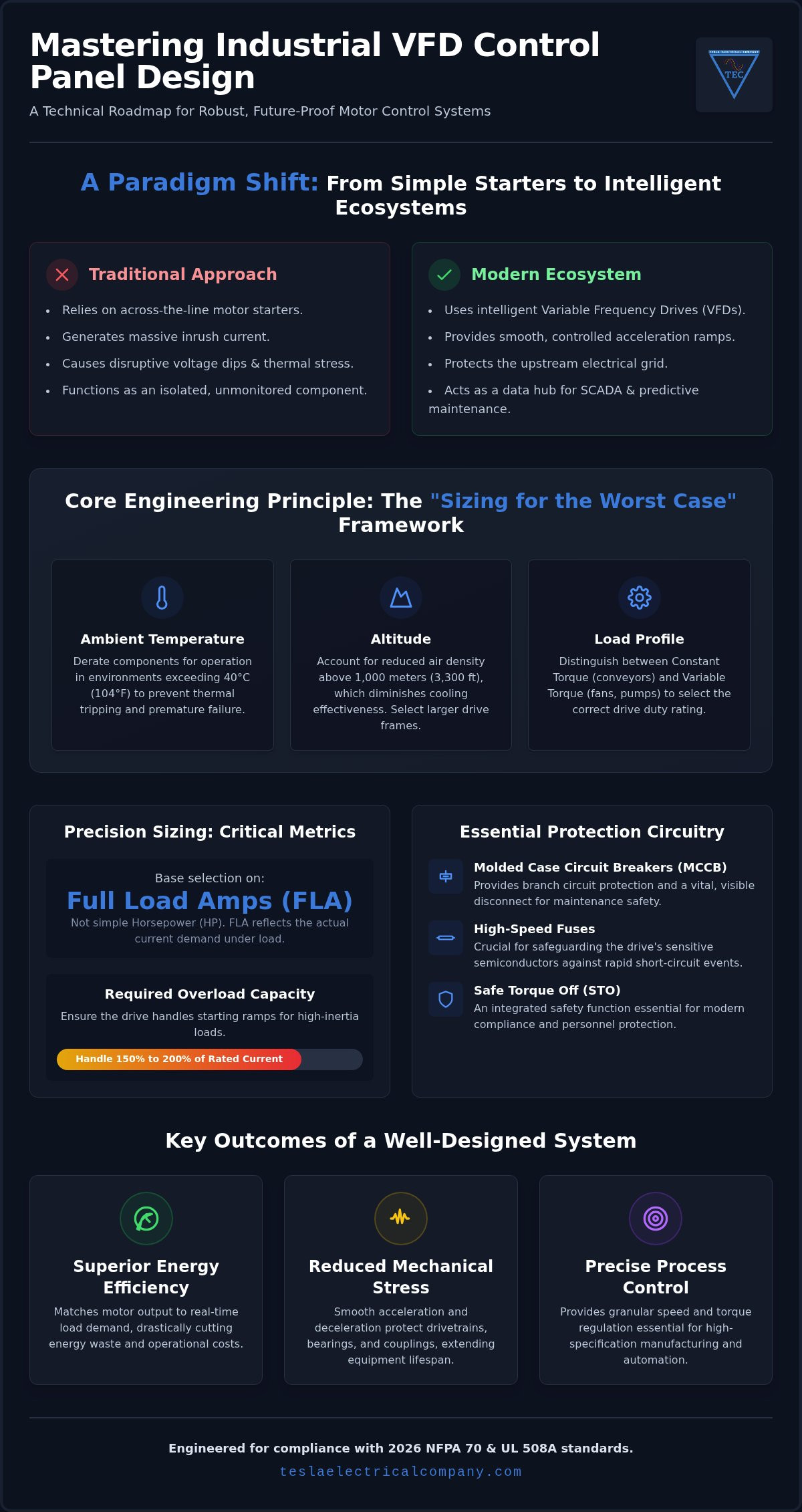
Modern industrial operations view the control panel not merely as an enclosure, but as a sophisticated motor management ecosystem. This perspective represents a significant evolution from traditional across-the-line motor starters to intelligent, frequency-based control. By utilizing a Variable-frequency drive (VFD), engineers can manipulate the frequency and voltage supplied to an electric motor, allowing for precise speed and torque regulation across the entire operational range.
Custom engineering remains non-negotiable for industrial-scale infrastructure. Standardized, off-the-shelf solutions often fail to account for the specific harmonics, thermal loads, and integration requirements of complex facilities. A tailored industrial VFD control panel design ensures that every component, from the busbars to the ventilation system, is optimized for the specific operational demands of the plant. This rigorous approach yields three primary benefits: superior energy efficiency, reduced mechanical stress on drivetrains, and the precise process control necessary for high-specification manufacturing.
Defining the Application and Load Profile
Engineering excellence begins with a methodical assessment of the load profile. Constant torque applications, such as conveyors, mixers, or extruders, require consistent torque regardless of speed and often demand heavy-duty drive ratings with high overload capacities. Conversely, variable torque loads like fans and pumps follow affinity laws where torque requirements decrease significantly as speed drops. Designers must evaluate duty cycles and peak starting torque requirements to ensure the drive isn’t undersized for heavy-duty machinery. For harsh environments, selecting the correct IP rating or NEMA standard is critical to protect sensitive power electronics from ingress and extreme ambient heat.
The Role of the VFD in Modern Automation
VFDs function as the primary bridge between physical motor hardware and digital control layers. They provide the granular data necessary for predictive maintenance and real-time performance tracking within a central SCADA system. Effective implementation often relies on a robust industrial switchboard design to support high-density VFD clusters and manage power distribution effectively. By precisely controlling the acceleration ramp of the motor, the VFD eliminates the massive inrush current typically associated with direct-on-line starting, protecting the upstream electrical grid from disruptive voltage dips and thermal stress.
Critical Component Selection and Sizing Framework
Precision in industrial VFD control panel design begins with the “Sizing for the Worst Case” rule. This methodology requires engineers to look beyond nominal ratings and account for environmental derating factors that often go ignored in standard specifications. In high-ambient environments, typically exceeding 40°C, or at altitudes above 1,000 meters, the reduced cooling capacity of air necessitates a larger drive frame to prevent thermal tripping. Neglecting these variables leads to frequent drive failures and significantly shortened component lifespans in demanding industrial settings.
Sizing the Drive for Heavy-Duty Industrial Loads
Base your equipment selection on Full Load Amps (FLA) rather than simple horsepower (HP). HP is a general estimate, but FLA provides the actual current demand the drive must sustain under load. For high-inertia applications like large centrifugal fans or heavily loaded conveyors, calculate the required overload capacity to ensure the drive can handle 150% or 200% of its rated current during the starting ramp. It’s also vital to match the VFD voltage rating precisely to the incoming LV or MV supply; a mismatch here can lead to immediate equipment damage or persistent under-voltage faults that disrupt production cycles.
Essential Protection and Power Circuitry
A robust panel incorporates Molded Case Circuit Breakers (MCCB) to provide essential branch circuit protection and a visible disconnect point for maintenance personnel. While MCCBs protect the wiring, high-speed fuses are often necessary to safeguard the drive’s sensitive semiconductors from rapid short-circuit events. For safety compliance, modern designs integrate Safe Torque Off (STO) functionality, which allows the drive to be safely disabled without removing the main power supply. When selecting contactors for emergency isolation, ensure they’re rated for the motor’s AC-3 duty cycle to handle the stress of breaking full load current.
For mission-critical infrastructure where downtime is unacceptable, integrating a VFD control panel with a dedicated bypass circuit allows the motor to run directly from the line if the drive requires service. Local diagnostic transparency is achieved through high-resolution Human Machine Interfaces (HMI), providing operators with real-time fault codes and performance metrics without opening the enclosure. This combination of protective hardware and digital visibility creates a system that isn’t just functional, but inherently resilient against the rigors of industrial operation.
Advanced Engineering: Harmonics, Cooling, and Redundancy
Achieving operational excellence in industrial VFD control panel design requires addressing the invisible stressors that compromise system integrity. Electromagnetic Interference (EMI) and Radio Frequency Interference (RFI) can wreak havoc on sensitive SCADA systems and communication networks if not properly managed through rigorous grounding and shielding protocols. By treating the enclosure as a Faraday cage, engineers can isolate high-frequency noise and prevent it from migrating into low-voltage control circuits.
Thermal Management and Enclosure Design
Every variable frequency drive generates significant heat proportional to its operational load. Calculating the total heat dissipation of the drive, along with internal transformers and reactors, is a prerequisite for reliable engineering. While forced air cooling via filtered fans is common, sealed panels in harsh or dusty environments often require heat exchanger solutions or closed-loop air conditioning to maintain internal temperatures below the drive’s derating threshold. Material selection is equally critical; while painted carbon steel serves most indoor applications, 316L stainless steel is necessary for corrosive chemical or coastal environments to prevent structural degradation. Careful airflow pathing ensures that no internal hot spots develop around the drive’s intake vents.
Harmonic Mitigation and Power Quality Compliance
VFDs are non-linear loads that inevitably introduce harmonics into the power system. To ensure compliance with IEEE 519 standards for total harmonic distortion (THD), designers must strategically deploy line reactors on the input to protect the drive from line surges and load reactors on the output to safeguard motor insulation from reflected wave phenomena. In facilities with high VFD density, Active Harmonic Filters provide a sophisticated total solution, dynamically injecting current to cancel out harmonic signatures in real-time. A comprehensive approach to harmonic mitigation for industrial plants protects the entire plant’s power quality and prevents the overheating of upstream transformers.
Engineering for 99.99% uptime demands a redundant control system architecture. This involves implementing dual-path control logic where a secondary system stands ready to take over motor management if the primary controller fails. To complement this, cable management must prioritize VFD-grade shielded cables. These specialized cables contain high-frequency noise within the jacket, preventing the crosstalk that often leads to ghost signals in PLC and SCADA layers. Properly executed, these advanced engineering choices transform a standard panel into a resilient, high-availability industrial asset.
Comparing Leading VFD Solutions for Industrial Infrastructure
Selecting the optimal drive platform is a strategic decision that dictates the long-term performance of your industrial VFD control panel design. While several manufacturers compete in the global market, Mitsubishi Electric and Danfoss remain the preferred choices for high-stakes industrial infrastructure. Each ecosystem offers distinct technical advantages that must be aligned with your facility’s specific load profiles and automation requirements.
Mitsubishi and Danfoss VFD Capabilities
Mitsubishi Electric’s FR Series is renowned for its exceptional robustness in high-torque, heavy-industry applications. These drives are engineered to withstand the rigorous demands of extruders, cranes, and heavy-duty conveyors, providing stable speed control even under fluctuating loads. Conversely, the Danfoss VLT and the newer iC7 series provide specialized features optimized for HVAC and water treatment facilities. Danfoss drives are particularly effective in variable torque scenarios, where their inherent energy-saving algorithms can significantly reduce power consumption. Both manufacturers prioritize software integration, offering sophisticated commissioning tools that provide deep diagnostic transparency and simplify the integration of drives into existing PLC networks.
When evaluating these solutions, engineers must consider the global availability of spare parts and the longevity of manufacturer support. High-end drive series from these brands ensure that your investment is protected by a reliable supply chain. This long-term support is a critical factor in the cost-benefit analysis, shifting the focus from initial capital expenditure (CAPEX) to long-term operational efficiency (OPEX). A drive that offers superior energy efficiency and reduced maintenance requirements will invariably provide a lower total cost of ownership over its service life.
Custom vs. Off-the-Shelf Control Panel Solutions
Standard off-the-shelf enclosures frequently fail in high-dust or high-humidity industrial zones because they lack the specific sealing and thermal management necessary for these environments. A bespoke industrial VFD control panel design provides the flexibility to create a layout that prioritizes maintenance access and future expansion. Tesla Electrical Company’s “Total Solution” engineering philosophy focuses on building custom-engineered panels that integrate Mitsubishi or Danfoss technology into a hardened, application-specific enclosure.
If your facility requires a system that balances peak motor efficiency with uncompromising reliability, you can consult with our experts to develop a custom VFD Control Panel tailored to your operational needs.
Implementing VFD Panels: From Design to Commissioning
The successful deployment of an industrial VFD control panel design concludes with a rigorous implementation phase that bridges the gap between engineering drawings and operational reality. This process involves a structured integration roadmap, ensuring the drive system communicates effectively with the broader facility infrastructure. Before any equipment arrives on site, Factory Acceptance Testing (FAT) serves as the primary validation gate. During FAT, engineers simulate various load conditions and communication loss scenarios to verify that the panel performs according to the specific design parameters and safety requirements defined during the engineering phase.
SCADA Integration and Remote Monitoring
Modern drives are no longer isolated components; they’re data-rich nodes within a connected network. Utilizing industrial protocols such as Modbus TCP, Profinet, or EtherNet/IP allows for the seamless transmission of real-time performance data to the central control room. Implementing advanced SCADA and automation system solutions significantly enhances VFD diagnostics by providing granular visibility into motor temperature, torque profiles, and energy consumption. This digital layer enables remote reset capabilities and predictive monitoring, which drastically reduces the need for physical site visits and allows for faster response times during process upsets.
Retrofitting VFDs into Legacy Industrial Systems
Many facilities face the challenge of modernizing aging infrastructure while managing limited floor space. Retrofitting legacy Motor Control Centers (MCC) with modern VFDs offers a cost-effective path to improved efficiency without the capital burden of a full panel replacement. This phased modernization often involves replacing traditional Direct-On-Line (DOL) starters with compact drives that fit within existing buckets. Engineers must carefully address space constraints and thermal loads when introducing power electronics into enclosures originally designed for electromechanical components. During these implementations, the role of Protection Relay Upgrades is critical to ensure that the updated system maintains compliance with modern arc flash and overcurrent protection standards.
The final stage of implementation is on-site commissioning, where field engineers fine-tune PID loops to achieve an optimal process response. This methodical calibration ensures that the motor reacts precisely to setpoint changes, eliminating overshoot and mechanical hunting. By following this end-to-end roadmap, industrial operators can transition from legacy hardware to a robust, integrated, and future-proof motor control ecosystem. This systematic approach ensures that every industrial VFD control panel design delivers on its promise of maximum motor efficiency and system longevity.
Advancing Your Industrial Motor Control Infrastructure
Engineering a high-performance industrial VFD control panel design is a meticulous process that balances electrical protection with thermal management and digital integration. As industrial infrastructure becomes increasingly complex, the transition from simple motor control to intelligent, SCADA-integrated ecosystems is essential for maintaining competitive efficiency. By prioritizing rigorous component sizing and harmonic mitigation, you ensure your systems remain resilient against the stressors of heavy-duty operation.
Tesla Electrical Company brings over 10 years of industrial experience to every project, utilizing ISO-certified manufacturing processes to deliver uncompromising reliability. Our expert team specializes in comprehensive SCADA and automation integration, ensuring your motor control systems are both future-proof and compliant with international standards. We invite you to Consult with Tesla Electrical Company for Your Custom VFD Panel Design and secure a total solution for your facility’s automation needs. Investing in precision engineering today will protect your system’s longevity and optimize your operational output for years to come.
Frequently Asked Questions
What is the primary difference between a VFD panel and a standard Motor Control Center (MCC)?
A VFD panel provides variable speed and torque control for specific loads, whereas a standard Motor Control Center typically serves as a centralized hub for multiple fixed-speed motor starters. While an MCC can house variable frequency drives, a dedicated panel is engineered for precise frequency regulation and sensitive electronic protection. MCCs focus on power distribution and basic switching; however, VFD panels prioritize process optimization and sophisticated power electronics management for high-performance applications.
How do I determine if my VFD panel requires a line reactor or a harmonic filter?
You should use a line reactor for basic protection against line surges and to reduce low-level harmonic distortion at the drive input. If your facility must strictly adhere to IEEE 519 standards due to a high density of non-linear loads, an active or passive harmonic filter is necessary. Line reactors are cost-effective for individual drive protection, but harmonic filters provide the comprehensive mitigation required to protect upstream transformers and sensitive SCADA equipment from significant total harmonic distortion. For a deeper understanding of these requirements, our harmonic mitigation for industrial plants technical guide provides a systematic engineering approach to identifying and neutralizing these disturbances.
Can a VFD control panel be used with an existing older motor?
Yes, you can use a VFD with older motors, but you must evaluate the motor’s insulation class and cooling capabilities. Older non-inverter-duty motors often lack the insulation required to withstand the high-voltage spikes produced by modern drives. In these cases, installing a dV/dt filter or a sine-wave filter at the drive output is essential to prevent premature winding failure and ensure long-term reliability in your industrial VFD control panel design.
What are the cooling requirements for a high-power VFD control panel?
High-power VFD panels require robust thermal management to dissipate the heat generated by power semiconductors, which typically accounts for 2% to 3% of the drive’s rated power. For indoor environments with controlled temperatures, filtered forced-air cooling using high-volume fans is often sufficient. For sealed panels in harsh industrial zones, you must implement air-to-air heat exchangers or dedicated enclosure air conditioning units to maintain internal temperatures below the drive’s critical derating threshold, usually 40°C.
How does a VFD panel contribute to industrial energy savings?
A VFD panel reduces energy consumption by matching the motor’s speed and torque output to the actual process demand rather than running at full speed against a mechanical brake. In variable torque applications like centrifugal pumps and fans, reducing the motor speed by 20% can result in energy savings of nearly 50% due to the cube law of centrifugal loads. This precise control eliminates the wasted energy associated with traditional fixed-speed starting methods and throttled mechanical systems.
What information is required for a custom VFD control panel design quotation?
To provide an accurate engineering quotation, we require the motor’s nameplate data, specifically the Full Load Amps, voltage, and horsepower. You should also specify the load type, such as constant or variable torque, and the environmental conditions of the installation site. Information regarding required communication protocols, such as Modbus or Profinet, and any specific safety requirements like Safe Torque Off functionality is also vital for a comprehensive and technically accurate proposal.
Is it possible to include a bypass starter within the VFD panel design?
It’s entirely possible and often recommended to include a bypass starter within the panel design for mission-critical applications. This configuration utilizes a set of interlocked contactors that allow the motor to run directly from the main power line if the VFD requires maintenance or experiences a fault. Including a bypass ensures continuous operation and prevents costly production downtime, provided the application can safely handle a direct-on-line start at full speed during the bypass period.
How do I ensure my VFD panel design complies with international safety standards?
Verify compliance by adhering to the 2026 edition of NFPA 70 and the UL 508A standard updated in June 2025. These regulations dictate specific requirements for short-circuit current ratings, wire sizing, and component spacing within the enclosure. Conducting Factory Acceptance Testing and ensuring all components carry recognized marks from testing laboratories are necessary steps to guarantee international safety and quality. This rigorous approach is fundamental to every industrial VFD control panel design we execute.
Disclaimer
Some content, images, text, or other materials on this website may have been created or assisted by artificial intelligence (AI).
While we review AI-generated content for accuracy and quality, we do not guarantee that all information is free from errors or omissions.
Content generated using AI is provided for informational purposes only and should not be solely relied upon without independent verification.
6 Responses