
What if the most significant threat to your facility’s uptime isn’t a sudden component failure, but an architectural philosophy that prioritizes reactive repairs over systemic resilience? For many engineering teams, the burden of unplanned downtime and the complexities of managing aging legacy infrastructure have become unsustainable. You likely recognize that maintaining high standards of power quality is no longer optional in an era where even minor disturbances can lead to catastrophic equipment failure. It’s a reality where the cost of inaction often exceeds the investment in modernization.
This guide provides the technical roadmap required to transform your infrastructure into a bastion of industrial electrical system reliability. We’ll move beyond the limitations of patchwork maintenance to focus on comprehensive engineering excellence and architectural integrity. You’ll discover how to leverage advanced redundant system designs, the precision of generator synchronizing control panels, and the strategic necessity of retrofitting circuit breakers. By the end of this analysis, you’ll possess the knowledge to implement a robust power quality and disturbance recording system that ensures your facility remains operational through 2026 and beyond.
Key Takeaways
- Distinguish between system availability and true reliability to accurately quantify the financial impact of transient faults in 2026.
- Identify the architectural requirements for N+1 and 2N redundancy to maintain continuous operation during critical industrial processes.
- Analyze the strategic benefits of retrofitting MV and LV switchboards to extend the service life of existing power infrastructure.
- Strengthen industrial electrical system reliability by implementing high-precision generator synchronizing control panels for seamless load sharing.
- Integrate SCADA and automation systems to establish a centralized framework for monitoring power quality and system performance.
Defining Industrial Electrical System Reliability and Its Economic Impact
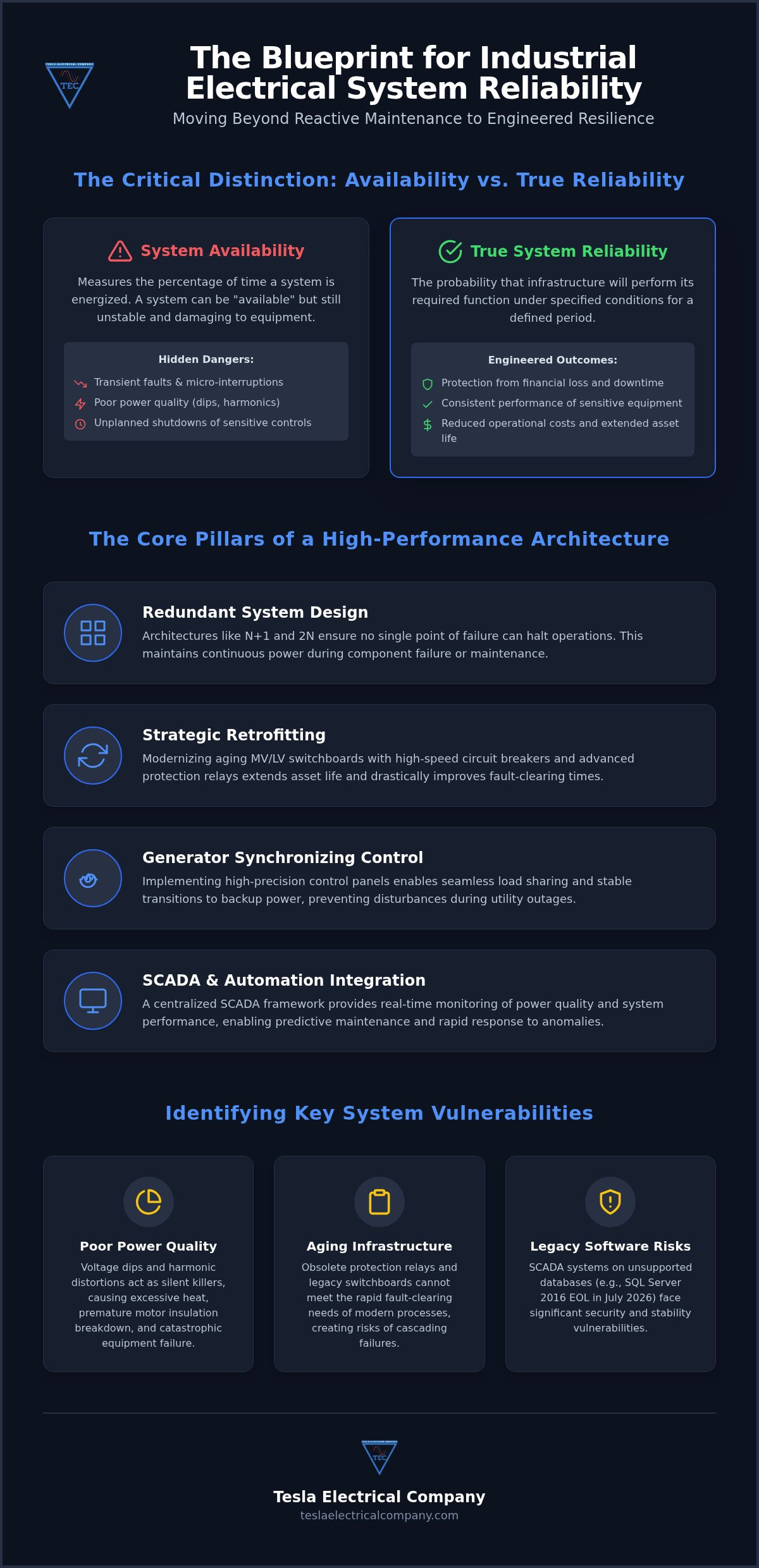
Defining industrial electrical system reliability requires a shift from viewing power as a simple utility to treating it as a precision-engineered asset. While availability measures the percentage of time a system is energized, reliability focuses on the probability that the infrastructure will perform its required function under specified conditions for a defined period. In high-stakes environments, a system that’s “available” but plagued by transient faults isn’t truly reliable. These micro-interruptions often result in significant financial losses, as they can trigger unplanned shutdowns of sensitive PLC control systems or damage high-value manufacturing equipment.
Effective Power system reliability isn’t an accidental outcome of routine maintenance; it’s a deliberate architectural achievement. By 2026, the economic stakes have risen significantly. For instance, the North American Electric Reliability Corporation (NERC) has introduced stricter registration requirements for large computational loads exceeding 50 MW. This regulatory shift underscores the necessity of designing infrastructure that can withstand disturbances without compromising the broader grid or internal processes. Reliability must be designed into the infrastructure from the outset to prevent the erosion of system integrity.
The Role of Power Quality in System Stability
Power quality serves as the foundational health metric for any industrial facility. Voltage dips and harmonic distortions act as silent killers of industrial motors, causing excessive heat and premature insulation breakdown. These issues often go unnoticed until a catastrophic failure occurs. Engineers must prioritize interpreting power quality analysis reports to identify baseline health and mitigate risks before they escalate. Implementing capacitor banks for power factor correction is a critical step in this process, as it optimizes efficiency and reduces the thermal strain on the distribution network.
Identifying the Vulnerabilities of Aging Infrastructure
Legacy infrastructure remains a primary point of failure in modern plants. Aging MV and LV switchboards often contain obsolete protection relays that can’t keep pace with the rapid fault-clearing requirements of modern processes. With Microsoft ending extended support for SQL Server 2016 in July 2026, many SCADA systems running on legacy databases face increased security and stability risks. A single failure in these outdated components can trigger a cascading failure, which is a process where the failure of one element leads to the successive failure of adjacent components, eventually resulting in a total system blackout. Maintaining industrial electrical system reliability requires a proactive approach to modernizing these vulnerable nodes before they compromise the entire operation.
The Core Pillars of a High-Performance Reliable Architecture
Achieving industrial electrical system reliability requires a methodical integration of hardware redundancy and intelligent protection logic. Architectural resilience prevents failures from propagating through the network by design rather than by chance. Protection coordination is central to this effort. It ensures that faults are isolated at the source, preventing a localized short circuit from triggering a total facility shutdown. This requires precise relay settings and high-speed circuit breakers capable of clearing faults within milliseconds. Intelligent load sharing further enhances stability by distributing electrical stress evenly across assets. This prevents any single transformer or generator from operating beyond its thermal limits, which is essential during peak demand periods or when operating on backup power.
Engineering Resilience through Redundant Control Systems
Mission-critical sites require a transition from single-point failure risks to redundant control system architecture. This involves both hardware-level redundancy, such as dual-processor PLCs, and sophisticated software-level failover mechanisms that engage without process interruption. Hardware redundancy provides physical backups, while software failovers manage the logic transfer between active and standby units. VFD control panels play a vital role here. They maintain process continuity during transient fluctuations by regulating motor speeds and absorbing minor power variances. Implementing an N+1 or 2N configuration ensures that even during a primary component failure, the secondary system maintains full operational capacity. This level of oversight is a standard requirement for data centers and high-precision manufacturing in 2026.
Advanced Monitoring with Disturbance Recording
The shift toward industrial electrical system reliability is defined by the move from periodic testing to real-time disturbance recording. Standard meters often fail to capture high-speed transients that degrade insulation over time. By utilizing specialized voltage dip recording systems, engineers can analyze the precise characteristics of industrial dips and surges. This data, when integrated into a SCADA framework, allows for predictive analytics that identify component failure signatures before they manifest as downtime. Effectively maintaining power system reliability depends on this continuous visibility. Modern systems can now process over 200,000 data points per second, feeding AI models that detect anomalies in real-time. This aligns with the updated EN IEC 62541-14:2026 standard, which integrates Industrial IoT and cloud-based analytics directly with field devices.
Facilities prioritizing uptime often find that implementing a redundant control system provides the necessary security for high-stakes operations.
Strategic Retrofitting: Extending Asset Life without Total Replacement
Retrofitting serves as a strategic pillar for maintaining industrial electrical system reliability when total capital replacement is financially or logistically impractical. By 2026, the industrial sector has recognized that while the physical steel of MV and LV switchboards often lasts for decades, the internal active components reach obsolescence much sooner. A targeted retrofit program allows engineers to integrate modern safety and performance standards into existing footprints. This methodology significantly reduces downtime compared to full system replacement, as it avoids the extensive civil works and cabling reruns typically required for new installations. It’s a pragmatic solution for facilities that can’t afford the weeks of outage required for a complete teardown.
Success in these projects depends on a rigorous approach to planning and execution. A dedicated spare parts inventory must be maintained for any remaining legacy components to ensure continuous support during the phased upgrade process. This dual-track strategy, modernizing critical nodes while supporting existing hardware, provides a stable transition path that preserves operational integrity. It ensures that even if a full modernization takes place over several years, the system remains robust and serviceable at every stage.
Circuit Breaker and Protection Relay Modernization
Upgrading legacy ABB or Schneider circuit breakers with modern technical equivalents is a cornerstone of asset life extension. These modern units offer superior arc flash protection and higher interrupting ratings within the same physical dimensions. A detailed switchgear condition assessment is the first step in identifying which breakers are candidates for replacement versus those that require only secondary injection testing. Modern protection relays utilize advanced microprocessor logic to significantly reduce fault clearing times, thereby preventing upstream damage to transformers and main busbars. This precision is vital for protecting high-value downstream loads from the thermal and mechanical stresses of short circuits.
Retrofitting for Automation and SCADA Integration
Modernizing the physical layer is only half the battle; the digital layer must also be addressed to ensure long-term industrial electrical system reliability. Many legacy systems operate as “dark” assets with no remote visibility. Retrofitting these systems involves adding communication modules to existing hardware, enabling them to publish data to a SCADA framework. Integrating PLC control systems for precise PID process control allows for more granular management of industrial loads. This integration must ensure seamless compatibility between legacy physical wiring and modern digital interfaces, such as the updated EN IEC 62541-14:2026 standard. By bridging this gap, facilities move from reactive maintenance to a data-driven model that identifies vulnerabilities before they lead to failure.
The Brain of Reliability: Generator Synchronizing and SCADA
The intelligence of an industrial power network resides in its ability to manage transitions between multiple energy sources with absolute precision. Industrial electrical system reliability depends heavily on Generator Synchronizing Control Panels to bridge the gap between grid failure and onsite generation. Without precise synchronization, connecting a generator to a live busbar can result in catastrophic mechanical failure or electrical surges. By integrating advanced Woodward or ComAp controls, engineers achieve high-precision voltage and frequency matching. This ensures that the transition to backup power is seamless, protecting sensitive downstream processes from the voltage dips that often precede a total mains failure.
Automating the mains failure response is a critical requirement for facilities that cannot tolerate even a momentary loss of power. These systems utilize sophisticated logic to initiate generator startup, synchronize multiple units, and close the bus-tie breakers in a controlled sequence. This level of automation removes the risk of human error during high-stress emergency scenarios. It transforms a collection of individual power assets into a cohesive, responsive system that maintains stability regardless of external grid conditions.
Implementing Intelligent Generator Load Sharing
Achieving balanced power distribution across multiple generators requires a structured engineering approach. The process begins with a comprehensive assessment of the total facility load and the specific capacity of each generator unit. Synchronizing logic is then configured to ensure that voltage, frequency, and phase angle are perfectly matched before the breakers close. Once synchronized, active and reactive power sharing protocols are implemented to distribute the electrical burden proportionally. This prevents any single unit from becoming overstressed while others remain underutilized. Finally, continuous monitoring through SCADA provides the real-time visibility needed for dynamic adjustments as plant loads fluctuate.
Architecting SCADA for Industrial Infrastructure
Modern oversight requires SCADA and automation system solutions that provide centralized visibility into every node of the electrical network. In high-voltage environments, data acquisition strategies must prioritize high-speed historian throughput. By 2026, advanced analytics pipelines often require historians capable of processing over 200,000 data points per second to feed predictive AI models. Cybersecurity is now a foundational component of this architecture. Compliance with the ISA/IEC 62443 standard is a non-negotiable procurement requirement, with many facilities demanding Security Level 2 or higher to protect critical control networks from sophisticated external threats.
Securing your facility’s energy independence requires a specialized approach to control logic and synchronization. You can explore our comprehensive Generator Synchronizing Control Panel solutions to ensure your infrastructure remains resilient during utility outages.
Engineering Resilience with Tesla Electrical Company’s Solutions
Tesla Electrical Company operates as a comprehensive engineering partner, delivering the technical infrastructure required to sustain industrial electrical system reliability in demanding environments. Our methodology integrates advanced design principles with robust manufacturing to ensure that every component contributes to a resilient power architecture. We specialize in the development of redundant systems that eliminate single points of failure, providing a layer of security that’s essential for mission-critical operations. From the initial engineering phase to the final supply of specialized spare parts, our team provides the end-to-end oversight necessary to manage complex power requirements.
Our commitment to excellence is reflected in the design and supply of high-precision Generator Synchronizing Control Panels. These systems are engineered to handle the complexities of multi-source power environments, ensuring that transitions between utility and onsite generation occur without process interruption. By positioning ourselves as a total solution provider, we handle both the visionary innovation of system design and the grounded reality of manufacturing and execution. This holistic approach ensures that the architectural principles discussed throughout this guide are translated into tangible, high-performance assets for your facility.
Customized LV and MV Switchboard Manufacturing
Our facility prioritizes precision engineering in the creation of LV and MV switchboards, ensuring they meet the specific automation requirements of modern industrial sites. We adhere to rigorous international standards to guarantee that every enclosure and busbar arrangement provides maximum safety and operational longevity. A core component of our manufacturing capability is the integration of industrial switchboard design principles that facilitate efficient thermal management and ease of maintenance. Additionally, we incorporate specialized industrial VFD control panel design to optimize motor efficiency and reduce mechanical stress across the distribution network.
Partnering for Long-Term Industrial Stability
Sustaining a reliable infrastructure requires more than high-quality hardware; it demands a long-term commitment to technical excellence and professional consultation. Tesla Electrical Company provides expert engineering support across the UAE and international markets, helping clients navigate the complexities of system modernization. We manage intricate retrofit projects for circuit breakers and protection relays, ensuring that legacy assets are successfully integrated into modern control frameworks. To further minimize the risk of downtime, we maintain an extensive technical inventory of spare parts. This ensures that facility managers have immediate access to the critical components needed to maintain industrial electrical system reliability without the delays often associated with global supply chains.
Securing the Future of Industrial Power Infrastructure
Achieving long-term industrial electrical system reliability is a deliberate architectural achievement rather than a byproduct of routine maintenance. By prioritizing N+1 redundancy and high-precision synchronization, facilities can eliminate the single points of failure that lead to costly downtime. The strategic modernization of legacy switchgear and the integration of real-time disturbance recording provide a foundation for systemic resilience that lasts well beyond the current year. It’s about building a framework that responds intelligently to fluctuations while maintaining the highest standards of power quality.
Tesla Electrical Company provides the specialized expertise required to navigate these technical transitions. Whether you require the expert design of Generator Synchronizing Control Panels, specialized circuit breaker retrofit services, or comprehensive SCADA and automation integration, our team is committed to your operational success. We invite you to Request a Technical Consultation for Your Industrial Power Infrastructure to begin architecting a more stable future. Your facility’s longevity depends on the engineering choices you make today, and we’re here to ensure those choices lead to absolute stability.
Frequently Asked Questions
What are the primary factors that affect industrial electrical system reliability?
Primary factors include the physical condition of aging switchgear, the precision of protection coordination, and the rigorous management of power quality. Industrial electrical system reliability is also heavily influenced by the presence of hardware-level redundancy and the capability of the control logic to handle transient faults. Effective maintenance schedules alone are insufficient; the system architecture must be designed to isolate disturbances and prevent cascading failures across the distribution network.
How does a Generator Synchronizing Control Panel improve system stability?
A Generator Synchronizing Control Panel ensures that multiple power sources are perfectly matched in voltage, frequency, and phase angle before they are connected to a common busbar. This precision eliminates the mechanical and electrical shocks that occur during unsynchronized switching. By automating the load sharing process, these panels allow for a seamless transition from utility power to onsite generation, maintaining process continuity and protecting sensitive industrial equipment from voltage dips.
Is it better to retrofit old switchgear or replace it entirely?
Retrofitting is often the superior choice when the physical structure of the switchgear remains sound but the internal components are obsolete. This approach minimizes operational disruption by avoiding the extensive civil works required for a full replacement. However, if the existing busbar capacity or insulation integrity is compromised, a total system replacement becomes necessary. Retrofitting allows for the integration of modern circuit breakers and protection relays into existing footprints, extending asset life efficiently.
What role does SCADA play in preventing industrial electrical failures?
SCADA systems provide a centralized repository for operational data, enabling real-time oversight of the entire electrical network. By monitoring historian throughput and analyzing high-speed data points, SCADA identifies anomalies that suggest impending component failure. In 2026, these systems act as a unified namespace, publishing critical health metrics to a central broker. This visibility allows engineering teams to intervene before a minor fault escalates into a catastrophic system-wide blackout.
How can redundant control systems protect against unplanned downtime?
Redundant control systems eliminate single points of failure by utilizing dual-processor PLCs and secondary communication pathways. In an N+1 or 2N architecture, the standby system takes over the process logic instantaneously if the primary unit fails. This hardware-level failover ensures that mission-critical processes remain energized without interruption. For facilities prioritizing industrial electrical system reliability, redundancy provides the necessary security to maintain uptime during unexpected hardware malfunctions or control network disturbances.
Why is power quality monitoring essential for industrial reliability in 2026?
Power quality monitoring is essential because modern industrial loads are increasingly sensitive to high-speed transients and harmonic distortions. Standard meters often miss micro-interruptions that degrade motor insulation and trigger PLC resets. Utilizing a dedicated disturbance recording system provides the data needed to comply with updated EN IEC 62541-14:2026 standards. This continuous visibility allows engineers to implement corrective measures, such as capacitor banks, to maintain system stability and efficiency.
What is the difference between a protection relay upgrade and a full breaker retrofit?
A protection relay upgrade focuses on the digital logic and fault-clearing speed of the system, replacing older electromagnetic units with modern microprocessor-based devices. A full breaker retrofit involves replacing the physical interrupting hardware with modern equivalents that offer higher arc flash protection and interrupting ratings. While a relay upgrade improves the sensitivity of fault detection, a breaker retrofit ensures the physical layer can safely clear the highest potential short-circuit currents.
Can VFD control panels help in improving overall system longevity?
VFD control panels significantly improve system longevity by regulating motor speeds and reducing the mechanical stress associated with direct-on-line starting. By implementing soft-start sequences and precise PID process control, VFDs prevent the massive inrush currents that can cause voltage dips across the distribution network. This controlled operation reduces the thermal strain on both the motors and the upstream switchgear, leading to a more stable and durable industrial power infrastructure.
Disclaimer
Some content, images, text, or other materials on this website may have been created or assisted by artificial intelligence (AI).
While we review AI-generated content for accuracy and quality, we do not guarantee that all information is free from errors or omissions.
Content generated using AI is provided for informational purposes only and should not be solely relied upon without independent verification.