
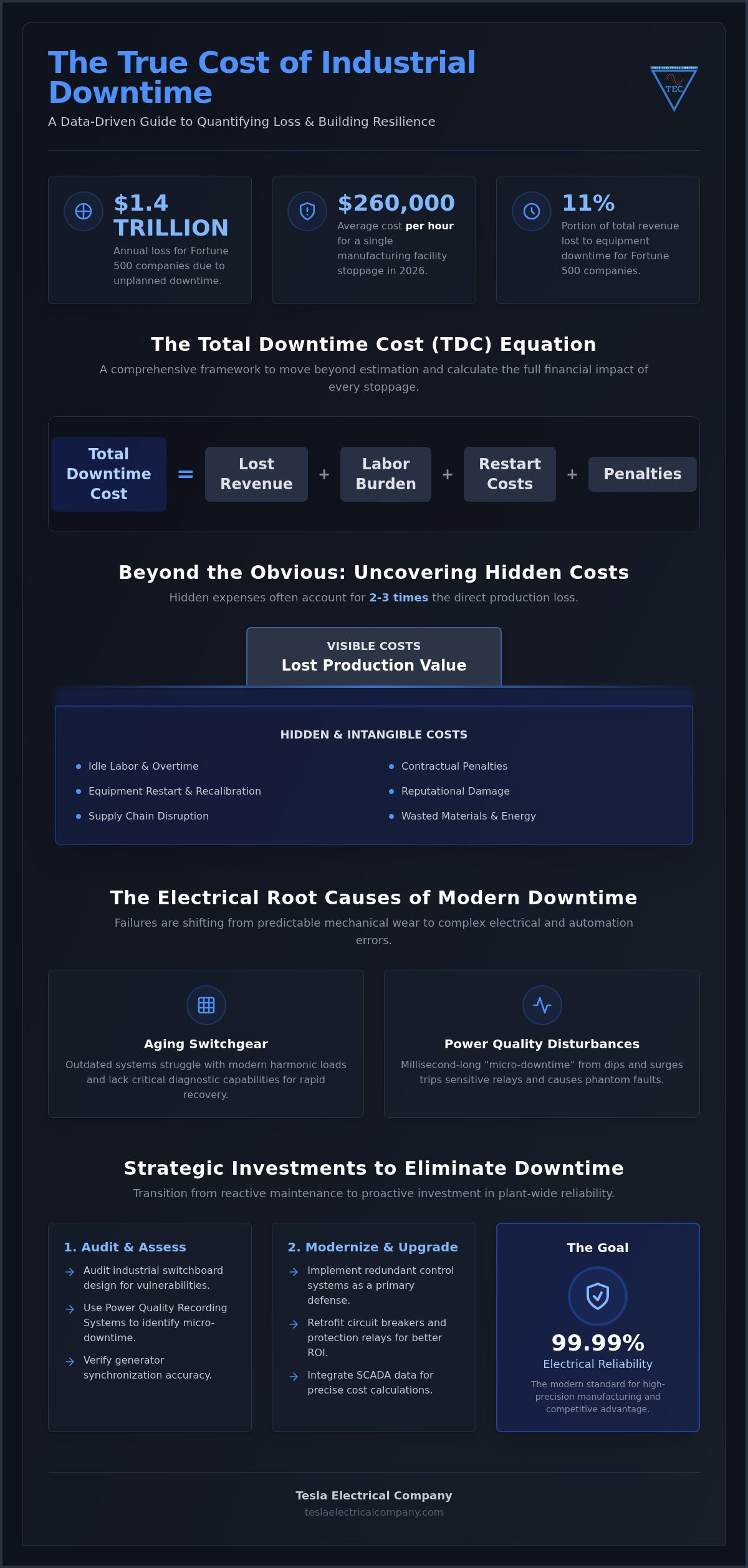
Fortune Global 500 companies lose a combined $1.4 trillion annually to unplanned equipment downtime, a figure representing nearly 11% of their total revenue. For a single manufacturing facility in 2026, the average cost of an unplanned stoppage has reached $260,000 per hour. While these figures are staggering, the primary challenge for engineering leadership isn’t just acknowledging the loss; it’s the precise process of calculating cost of industrial downtime to secure capital for modernization. You likely understand that a single tripped circuit or an aging switchgear failure ripples far beyond the immediate production halt.
It’s frustrating to watch micro-stoppages from aging electrical infrastructure erode your margins while you struggle to present a data-driven case for board-level approval. This guide provides the methodology you need to quantify every hidden expense, from downstream delays to long-term reputational damage. You’ll master a repeatable formula for financial impact and learn how to mitigate these risks through resilient electrical infrastructure. We will examine the technical justification for redundant systems and the strategic benefits of switchgear retrofits to ensure plant-wide reliability.
Key Takeaways
- Learn the Total Downtime Cost (TDC) equation to accurately account for labor burdens, restart expenses, and intangible penalties alongside lost revenue.
- Identify hidden electrical vulnerabilities within your facility by auditing industrial switchboard design and verifying generator synchronization accuracy.
- Establish a precise protocol for calculating cost of industrial downtime by integrating data from SCADA systems and power quality recording instruments.
- Evaluate the technical and financial advantages of implementing redundant control systems as a primary defense against unplanned stoppages.
- Compare the ROI of modernizing existing infrastructure through circuit breaker and protection relay retrofits versus the capital expenditure of full system replacement.
Defining the High Stakes of Industrial Downtime in 2026
Industrial downtime is the total cessation of value-added activity due to technical or systemic failure. While planned maintenance is a strategic necessity for equipment longevity, unplanned industrial downtime represents a failure of the facility’s protective and operational systems. In 2026, the benchmark for industrial competitiveness has shifted significantly. Modern standards now demand 99.99% electrical reliability to support high-precision manufacturing and automated logistics. Anything less creates a ripple effect where a single failed panel doesn’t just stop a motor; it halts the entire supply chain, resulting in missed delivery windows and heavy contractual penalties. For engineering leaders, calculating cost of industrial downtime is the first step toward reclaiming operational control and ensuring long-term stability.
The Evolution of Downtime Risks
The landscape of risk has undergone a fundamental transformation. Historically, downtime was often the result of predictable mechanical wear. Today, failures are increasingly rooted in complex electrical and automation errors. Aging switchgear, often overlooked during facility expansions, struggles to handle the harmonic loads of modern power electronics. These systems are the heart of your operation, yet many facilities rely on outdated industrial switchboard design that lacks the diagnostic capabilities required for rapid recovery. These legacy systems also fail to protect sensitive PLC and SCADA systems from subtle power quality disturbances. These disturbances trigger phantom faults that are notoriously difficult to troubleshoot and often lead to prolonged, unexplained stoppages.
Why Calculation is the Foundation of Resilience
Engineering decisions must be rooted in precise data, not “guestimation.” By quantifying the exact financial impact of every minute lost, you can transition from reactive maintenance to a strategy of proactive investment. This data is essential for calculating Overall Equipment Effectiveness (OEE), a core metric that exposes the true cost of availability losses. When you prioritize calculating cost of industrial downtime, you can present a data-driven justification for a redundant control system architecture. You’re no longer asking for a budget for simple repairs. Instead, you’re proposing a high-yield investment in plant-wide reliability. This psychological shift is vital for securing board-level approval for modernization projects that eliminate the root causes of failure before they manifest as a total system halt.
The Comprehensive Formula for Calculating Downtime Costs
To move beyond estimation, engineers must adopt a rigorous mathematical framework. The Total Downtime Cost (TDC) equation serves as the industry standard: TDC = (Lost Revenue + Labor Burden + Restart Costs + Penalties). While lost production is the most visible metric, a 2024 industry report on downtime costs reveals that hidden expenses often account for two to three times the direct production loss. Calculating cost of industrial downtime requires an audit of both tangible outflows and the subtle erosion of asset value. Precision is the only way to secure the budget needed for infrastructure upgrades.
Restart Costs are the energy and labor required to return a system to steady-state operation. This phase is often the most resource-intensive, involving equipment recalibration and the purging of stalled lines. Facilities frequently ignore “micro-downtime” because the events are so brief. These power dips and surges, lasting only milliseconds, can trip sensitive relays and cause PLC resets that result in hours of lost productivity. It’s essential to capture these events. Implementing a Power Quality and Disturbance Recording System allows teams to capture these disturbances and assign them a concrete dollar value.
Quantifying Tangible Financial Losses
- Lost Production Value: This is calculated by multiplying your units-per-hour throughput by the gross margin per unit. In heavy manufacturing, this often averages $260,000 per hour in 2026.
- Labor Burden: This includes the cost of idle staff and the premium paid for emergency maintenance overtime. As of May 2026, the average hourly earnings for manufacturing employees reached $36.68, making idle time a significant drain.
- Scrap and Rework: Sudden halts in thermal or chemical processes often lead to ruined batches. The cost of raw materials and the energy used to dispose of waste must be added to the TDC.
Evaluating Intangible and Long-term Impacts
Intangible costs are more difficult to track but equally damaging. Frequent unplanned restarts place immense mechanical and thermal stress on LV and MV switchboards, accelerating insulation breakdown and contact wear. This premature aging leads to a shorter asset lifecycle and higher capital expenditure over time. Additionally, missing delivery windows can trigger contractual penalties and damage long-term customer trust. Safety risks also rise during unplanned events, as technicians may rush to restore power under pressure, potentially violating ISO 45001 standards. If your facility struggles with recurring power instability, exploring specialized retrofit services for protection relays can offer a cost-effective path to stability.
Auditing the Electrical Root Causes of Unplanned Stoppages
Identifying the technical origin of a stoppage is as vital as calculating cost of industrial downtime. Data from 2026 indicates that 79% of maintenance teams saw unplanned downtime remain stagnant or increase over the previous year, often because they focused on symptoms rather than electrical root causes. Many failures trace back to fundamental flaws in industrial switchboard design, where inadequate cable management or poor thermal dissipation creates a high risk for catastrophic failure. By auditing these systems, engineers can pinpoint vulnerabilities before they manifest as expensive production halts.
Switchgear and Protection Relay Vulnerabilities
There’s a direct correlation between protection relay age and the frequency of nuisance tripping. As internal components degrade, their sensitivity shifts, leading to unnecessary circuit interruptions that halt production lines even when no genuine fault exists. A systematic switchgear condition assessment is essential for accurate cost forecasting and risk mitigation. Without this oversight, unmonitored LV distribution boards face a heightened risk of thermal failure. This is especially true in environments with high harmonic distortion, where heat buildup can compromise busbar integrity and lead to sudden, uncontained faults.
Synchronization and Load Sharing Risks
In facilities relying on multi-generator setups, improper synchronization is a primary driver of ‘black-start’ failures. When backup systems fail to align frequency and phase during a utility outage, the resulting voltage surges can damage sensitive electronics across the entire plant. Poor load sharing between units doesn’t just cause immediate trips; it leads to uneven engine wear and premature system failure. Modern Generator Synchronizing Control Panels eliminate these risks by ensuring seamless transitions and balanced load distribution. This level of control prevents a localized fault from cascading into a total facility blackout, which is a critical factor when calculating cost of industrial downtime in high-stakes environments.
Analyzing power quality reports helps identify the ‘silent killers’ like voltage unbalance and transient surges. These disturbances don’t always trip a breaker immediately but slowly degrade motor windings and control hardware over time. By auditing these specific electrical failure points, maintenance teams can transition from reactive firefighting to a state of predictive resilience, ultimately protecting the facility’s bottom line.
How to Execute a Downtime Cost Assessment: A Step-by-Step Protocol
Executing a formal assessment is the bridge between raw operational data and the executive-level justification for capital expenditure. The process requires a multidisciplinary approach, blending electrical engineering diagnostics with financial accounting. By following a structured protocol, you ensure that calculating cost of industrial downtime becomes a repeatable, objective exercise rather than a series of estimations. This methodology allows you to identify exactly where your infrastructure is failing and which investments will yield the highest return on investment (ROI).
- Step 1: Data Collection. Gather time-stamped logs from all automation hardware. This involves integrating SCADA logs with power quality meters to correlate electrical disturbances with production halts.
- Step 2: Baseline Establishment. Determine your standard operating revenue and OEE benchmarks. You must know what a “perfect” hour of production looks like to measure the depth of the loss.
- Step 3: Incident Analysis. Categorize every stoppage by duration and depth. A partial slowdown due to a VFD fault carries different financial weight than a total facility blackout.
- Step 4: Financial Calculation. Apply the TDC formula discussed in previous sections to your gathered data. Ensure you include the labor burden of both production staff and emergency repair teams.
- Step 5: Mitigation Planning. Use the resulting data to prioritize infrastructure upgrades. Focus on assets where the cost of a single failure exceeds the cost of a proactive retrofit.
Leveraging SCADA and Monitoring Data
Modern engineering demands empirical evidence. Utilizing SCADA and automation system solutions allows for real-time downtime logging, which eliminates the inaccuracies of manual reporting. These systems can be configured to automatically calculate Mean Time Between Failures (MTBF), providing a clear picture of asset reliability over time. Furthermore, interpreting power quality analysis reports is a critical step in the auditing process. These reports reveal the “invisible” transients and harmonics that often precede a major hardware failure, allowing you to intervene before a catastrophic stoppage occurs.
Identifying High-Risk Assets
Not all equipment is created equal in the eyes of the balance sheet. You should develop a Criticality Matrix that ranks every industrial electrical component based on its downtime cost per minute. For instance, a failure in the main distribution board is far more damaging than a fault in a standalone auxiliary pump. Evaluating the ROI of industrial VFD control panel design is often a high-priority task, as these components are frequently the root cause of motor-related stoppages. If your assessment reveals that aging motor controls are driving your TDC upward, modernization is the most logical path forward. For a detailed evaluation of your facility’s resilience, consider our SCADA & Automation Systems to streamline your data collection and reporting.
Strategic Investments to Eliminate Downtime Costs
Once the phase of calculating cost of industrial downtime is complete, the focus must shift toward high-impact mitigation. Sensors and software provide visibility, but they cannot prevent an electrical fault or a synchronization failure. True resilience requires a structural investment in redundant systems and modernized power distribution. For many facilities, the business case for installing automatic mains failure (AMF) panels and redundant control systems is clear; the cost of these systems is often recovered during the very first prevented outage. Professional automation creates a ‘self-healing’ industrial grid that can isolate faults and switch to backup power sources without human intervention.
Modernizing Legacy Electrical Infrastructure
Retrofitting protection relays is frequently the fastest and most cost-effective path to improved reliability. Rather than replacing entire LV/MV switchboards, which involves significant capital expenditure and prolonged shutdowns, retrofitting allows you to integrate modern diagnostic capabilities into existing frames. These upgrades ensure your infrastructure meets 2026 industrial automation standards, providing the precision required for high-speed production. In multi-generator environments, integrating Woodward or ComAp controls provides superior generator synchronization. These advanced controllers manage complex load sharing and phase matching with a level of accuracy that legacy systems simply cannot match, virtually eliminating the risk of synchronization-related blackouts.
Designing for Infinite Uptime
Achieving maximum availability requires a design philosophy centered on N+1 redundancy. In critical power control panels, having a secondary, synchronized backup ensures that a single component failure doesn’t lead to a facility-wide halt. This redundancy acts as the ultimate insurance policy for your production schedule. Additionally, the strategic use of VFD control panels reduces mechanical stress on motors, preventing the abrupt starts that often lead to unplanned failure. By implementing power quality correction through capacitor banks, you protect sensitive PLC electronics from the damaging effects of harmonic distortion and voltage drops. A comprehensive SCADA-driven maintenance strategy ties these hardware solutions together, providing a holistic view of plant health. When you prioritize these strategic investments, calculating cost of industrial downtime transitions from a post-mortem exercise into a roadmap for sustained engineering excellence.
Advancing Toward Industrial Resilience and Financial Stability
Transitioning from reactive maintenance to a strategy of proactive resilience requires a fundamental shift in how your facility views its electrical infrastructure. By mastering the methodology for calculating cost of industrial downtime, you’ve moved beyond surface-level estimation and into the realm of data-driven engineering. You now possess the framework to quantify the total financial impact of every stoppage, from direct revenue losses to the long-term degradation of your LV and MV switchboards.
The path forward involves eliminating the root causes of failure through strategic technical interventions. Whether it’s implementing redundant control systems or modernizing aging protection relays, the goal is to create a self-healing industrial environment that protects your margins. Tesla Electrical Company stands as your steady partner in this evolution. As specialists in Generator Synchronizing Panels, advanced SCADA and automation integration, and expert retrofit services for protection relays, we provide the technical rigor required for high-stakes operations. Secure your facility’s future with Tesla Electrical Company’s industrial automation solutions. Your facility’s reliability is a direct reflection of its infrastructure; it’s time to build for a future of uninterrupted excellence.
Frequently Asked Questions
What is the industry average cost of industrial downtime in 2026?
In 2026, the average cost of unplanned downtime across all manufacturing sectors is approximately $260,000 per hour. For high-stakes industries like automotive manufacturing, this figure can escalate to $2.3 million per hour. These numbers reflect the direct loss of production alongside the labor burdens and restart expenses that characterize modern industrial operations. Understanding these benchmarks is critical when calculating cost of industrial downtime for your specific facility.
How can SCADA systems help in calculating downtime costs?
SCADA and automation systems provide the granular data necessary for accurate financial modeling by logging every stoppage with millisecond precision. These systems eliminate the inaccuracies of manual reporting and allow for the automated calculation of Mean Time Between Failures (MTBF). By integrating SCADA logs with production throughput data, engineering teams can determine the exact revenue lost during each incident, transforming raw technical data into actionable financial insights for executive leadership.
Is it better to replace or retrofit aging switchgear to reduce downtime?
Retrofitting is often the superior strategy for reducing downtime because it allows for the modernization of protection relays and circuit breakers without the extensive lead times of a full replacement. While a total switchgear replacement may require weeks of planned outages, a targeted retrofit can be executed in phases. This approach enhances system reliability and diagnostic capabilities at a fraction of the capital expenditure; it effectively extends the lifecycle of your existing LV and MV switchboards.
What are the most common electrical causes of industrial downtime?
The most frequent electrical drivers of unplanned stoppages include aging protection relays that cause nuisance tripping and poorly maintained switchgear components. Additionally, improper generator synchronization in critical power environments often leads to catastrophic black-start failures. Other significant contributors include harmonic distortion and thermal stress within distribution boards. Addressing these root causes through systematic audits and modernized control panels is essential for maintaining the 99.99% reliability standards required in 2026.
How do power quality issues like voltage dips contribute to downtime costs?
Power quality issues like voltage dips and transient surges act as silent killers that degrade sensitive electronics over time. These events often cause immediate PLC resets or VFD faults, resulting in hours of “micro-downtime” that are frequently omitted from standard reports. By implementing a Power Quality and Disturbance Recording System, facilities can capture these millisecond events. This allows for a more comprehensive approach to calculating cost of industrial downtime by accounting for the cumulative impact of power instability.
Can redundant control systems pay for themselves through downtime prevention?
Redundant control systems typically pay for themselves by preventing a single facility-wide stoppage. In high-output environments where downtime costs hundreds of thousands of dollars per hour, the initial investment in N+1 redundancy represents a minor fraction of the potential loss. These systems act as a technical insurance policy, ensuring that a single component failure in a control panel does not halt your entire production line, thereby securing your facility’s long-term profitability.
What is the difference between tangible and intangible downtime costs?
Tangible costs include immediate financial outflows such as lost production revenue, idle labor wages, and the cost of scrapped raw materials. Intangible costs are more subtle but equally damaging, encompassing long-term reputational harm, contractual penalties for late deliveries, and the accelerated wear on electrical assets. A truly comprehensive assessment must account for both categories to reflect the total financial erosion caused by frequent restarts and unplanned system stress.
How do I justify the cost of a generator synchronizing panel to management?
You can justify the investment by highlighting the panel’s role in preventing catastrophic black-start failures during utility outages. A Generator Synchronizing Control Panel ensures seamless transitions and balanced load sharing, which protects engines from uneven wear and prevents voltage surges that damage plant-wide electronics. Presenting the cost of a single failed synchronization event versus the price of the panel provides a clear, data-driven argument that resonates with board-level decision-makers.
Disclaimer
Some content, images, text, or other materials on this website may have been created or assisted by artificial intelligence (AI).
While we review AI-generated content for accuracy and quality, we do not guarantee that all information is free from errors or omissions.
Content generated using AI is provided for informational purposes only and should not be solely relied upon without independent verification.