
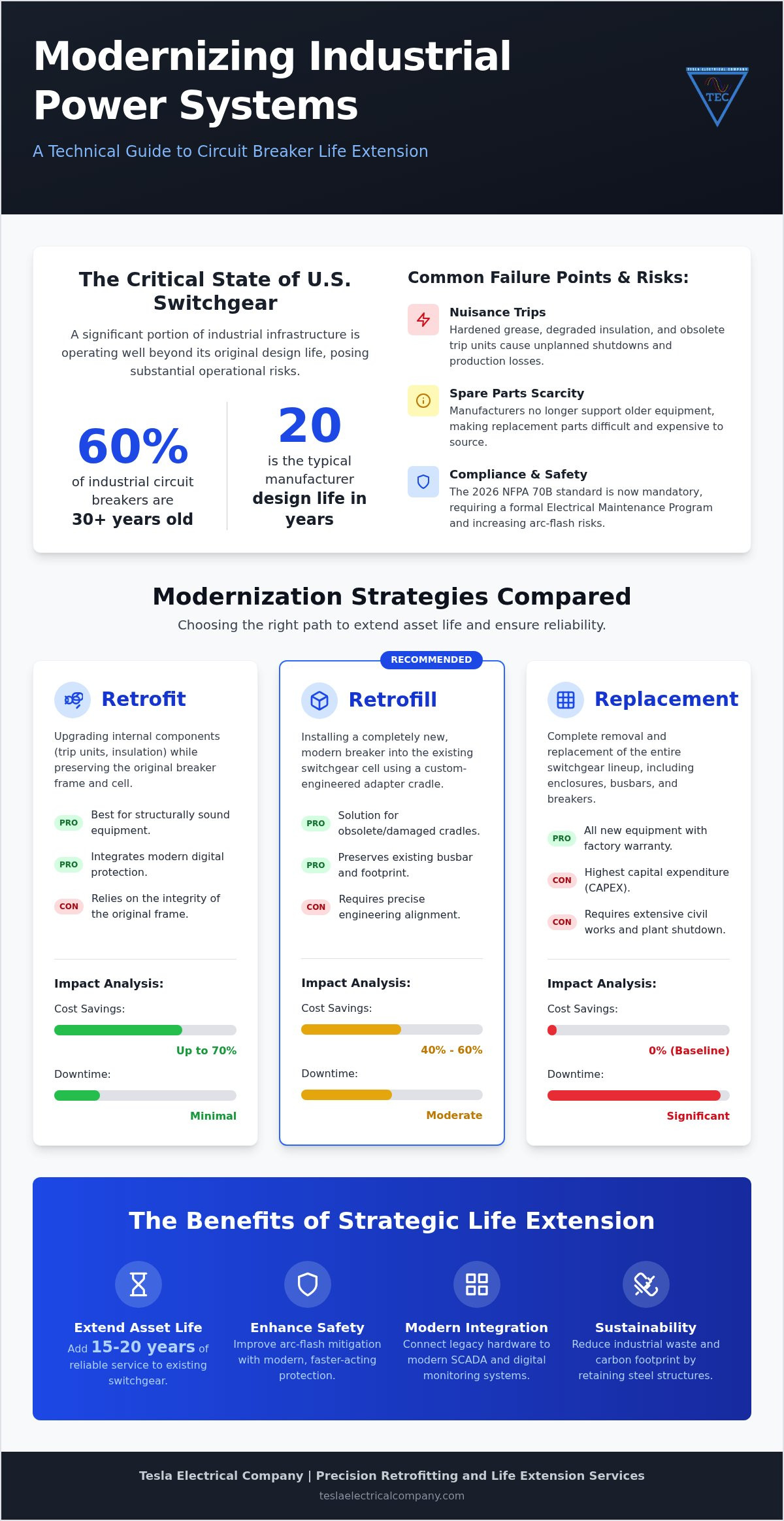
Sixty percent of industrial circuit breakers currently in operation are 30 years or older, a statistic that highlights a significant risk to global infrastructure reliability. You’re likely managing the persistent challenge of nuisance trips and the escalating difficulty of locating spare parts for equipment that manufacturers no longer support. In an environment where budget constraints often prevent a full switchgear overhaul, it’s clear that a more strategic approach to asset management is required to maintain operational continuity.
Implementing professional breaker life extension services offers a sophisticated alternative to the capital-intensive process of total equipment replacement. With the 2026 edition of NFPA 70B now a mandatory and enforceable standard, the transition from reactive maintenance to a formal Electrical Maintenance Program is essential for regulatory compliance. This engineering comparison examines the technical nuances of retrofit, retrofill, and replacement strategies to help you determine which path best maximizes your return on investment. We’ll explore how these specific interventions can extend asset life by 15 to 20 years, enhance arc-flash safety, and successfully integrate legacy hardware with modern SCADA and digital monitoring systems.
Key Takeaways
- Identify why the conventional 20-year design life for industrial assets is often exceeded and how systematic engineering can safely extend equipment utility.
- Distinguish between retrofit and retrofill architectures to select the optimal strategy for your breaker life extension services based on busbar alignment and cradle integrity.
- Discover how to integrate legacy circuit breakers with modern SCADA and automation systems to achieve real-time digital oversight and enhanced protection.
- Utilize a condition-based assessment framework to prioritize investments and navigate the challenges of sourcing parts for obsolete equipment.
- Learn how custom modernization projects, including generator synchronizing control panels, provide a total solution for industrial power reliability.
Understanding Breaker Life Extension in Industrial Infrastructure
Breaker life extension services are not merely maintenance routines; they represent a systematic engineering discipline designed to restore and elevate the performance of aging electrical infrastructure. While many manufacturers cite a 20-year design life, this figure is often a conservative estimate based on worst-case operational environments. In practice, the robust mechanical frames of industrial switchgear often outlive their internal components. By replacing specific high-wear parts and upgrading protection logic, engineering teams can bridge the gap between legacy hardware and modern digital standards.
Identifying critical failure points is the first step in this restoration process. Aging LV and MV units typically suffer from grease hardening in mechanical linkages, degradation of insulating materials, and the obsolescence of electronic trip units. A modern circuit breaker requires precise timing and contact pressure to ensure effective arc-flash mitigation. When these parameters drift, the risk to personnel increases. Modern life extension programs integrate advanced protection relays and disturbance recording systems, ensuring that equipment meets the mandatory 2026 NFPA 70B requirements for condition-based monitoring.
The Economic Case for Life Extension
Full switchgear replacement involves massive CAPEX, including the cost of new enclosures, busbar reconfiguration, and extensive civil works. Targeted modernization typically delivers cost savings of 40% to 70% compared to a complete replacement. This approach allows for phased upgrades during scheduled maintenance windows, which prevents the catastrophic production losses associated with total plant shutdowns. For assets reaching 30 years of service, the ROI of life extension is realized through the immediate elimination of nuisance trips and the avoidance of the massive costs associated with unplanned downtime.
Environmental and Sustainability Benefits
Retaining existing steel switchboard structures significantly reduces industrial waste and aligns with national circular economy objectives. Manufacturing new heavy electrical equipment carries a substantial carbon footprint due to raw material extraction and energy-intensive production processes. By utilizing breaker life extension services, facilities minimize their environmental impact while maintaining a high standard of operational reliability. This commitment to asset circularity ensures that robust hardware remains in service, reducing the demand for new raw materials and the energy required for their transport and installation.
Retrofit vs. Retrofill vs. Replacement: A Technical Comparison
Selecting the appropriate strategy for breaker life extension services requires a meticulous evaluation of the existing equipment’s physical state and the long-term availability of spare parts. Engineers must determine if the primary failure risks are confined to the breaker’s internal mechanisms or if they extend to the surrounding cell architecture. Precision in matching existing switchgear lineups is critical; even a minor discrepancy in busbar alignment can result in localized overheating or catastrophic equipment failure during a fault event.
The Retrofit Methodology
A technical retrofit involves a structured overhaul where the original breaker frame is preserved while the internal switching components are modernized. This process focuses on upgrading insulation systems and contact-breaking architecture to align with modern interrupting ratings. We typically integrate advanced solid-state trip units into legacy breaker bodies, providing superior protection curves and digital communication capabilities. For facilities managing specific equipment brands, our ABB Circuit Breaker Retrofit: 2026 Engineering Guide details the brand-specific nuances of this engineering process.
Retrofill: The Hybrid Solution
Retrofill serves as the preferred engineering path when the original cradle or racking mechanism has become obsolete or physically damaged. This strategy involves installing a completely new, modern breaker assembly into the existing switchgear cell using custom-engineered mounting kits. It preserves the integrity of the original busbar system while delivering the reliability of current-generation switching technology. This hybrid approach is a cornerstone of effective electrical equipment maintenance, allowing for technological advancement without the need for extensive civil modifications.
While total replacement is often considered the default for aging systems, it introduces significant infrastructure risks. A full lineup replacement necessitates lengthy plant shutdowns, complex cable re-terminations, and potentially disruptive civil works. The associated costs and operational risks often outweigh the benefits of new enclosures. Most industrial operators find that a targeted Retrofit of Circuit Breakers and Protection Relays achieves the desired reliability and safety outcomes with substantially less impact on the facility’s bottom line.
- Retrofit: Utilizes the existing frame; lowest capital expenditure; fastest installation; minimal operational downtime.
- Retrofill: Replaces both the breaker and the cradle; requires precision-engineered mounting kits; moderate downtime.
- Full Replacement: Highest cost; involves complete enclosure removal; requires major civil works; maximum downtime.
Beyond the Contact: Integrating Protection Relays and SCADA
A circuit breaker serves as the muscle of an electrical system, yet its performance is entirely dependent on the protective logic that dictates when to trip. Relying on legacy electromechanical relays during breaker life extension services creates a technical bottleneck that prevents the system from reaching its full safety potential. Modernizing these components ensures that the mechanical restoration of the breaker is matched by high-speed, programmable intelligence capable of responding to complex fault conditions in milliseconds.
Modernizing Protection Relay Systems
Replacing legacy electromechanical relays with digital, programmable units is essential for maintaining a rigorous Electrical Safety Program. These modern units offer superior fault detection speeds, which are vital for meeting 2026 arc-flash safety requirements. Digital relays provide precise coordination and the ability to record disturbances, allowing engineers to analyze fault data with high granularity. This transition is a core component of Architecting SCADA and Automation System Solutions for Modern Industrial Infrastructure, where protection and data acquisition converge to create a more resilient network.
Digital Integration and Remote Oversight
Bridging the digital divide requires more than just new hardware; it necessitates a cohesive communication architecture. By implementing communication modules, legacy breakers gain the ability to transmit real-time status updates to a centralized control room. Integrating these systems with SCADA and VFD control panels allows for intelligent load management and predictive maintenance scheduling. It’s a strategy that transforms a passive asset into an active data point within the industrial ecosystem. Digital relay integration prevents catastrophic industrial power failures by identifying micro-deviations in electrical performance before they escalate into permanent faults.
The implementation of a Power Quality and Disturbance Recording System ensures that every voltage dip or transient is captured for later review. This doesn’t just improve safety; it provides the diagnostic data needed to optimize system performance over time. PLC Control Systems for Process Control PID can also be synchronized with these protection layers to ensure that electrical events trigger appropriate process shutdowns, protecting both the machinery and the product. We prioritize the design of redundant systems to ensure that protection logic remains active even if a primary communication link fails, providing a steady hand for managing high-stakes industrial requirements.
Strategic Decision Framework: When to Invest in Life Extension
Engaging in breaker life extension services is a calculated engineering decision that requires a methodical audit of both mechanical and electrical health. It’s not enough to rely on the equipment’s age; instead, we analyze the current interrupting capacity requirements of the facility’s power grid. If the available fault current has increased due to utility upgrades or the addition of onsite renewables, legacy breakers may no longer possess the necessary ratings to clear a fault safely. We conduct a comprehensive switchgear condition assessment that evaluates the physical integrity of the switchboard and the health of the silver-plated busbar contacts. If the structural housing shows signs of heat stress or severe corrosion, the engineering justification for a retrofit must be weighed against the risks of frame failure. A complete electrical health review should also account for reactive power losses, as transformer overheating and voltage instability caused by poor power factor can accelerate the degradation of switchgear components; deploying industrial capacitor banks for power factor correction is a complementary strategy that reduces thermal stress on the very assets you are working to extend.
The Asset Criticality Matrix
Prioritizing modernization efforts involves mapping each breaker to an asset criticality matrix. This framework identifies units where a single failure would result in significant operational losses or safety breaches. Critical processes, such as those found in heavy industrial manufacturing or redundant systems, demand immediate intervention if legacy hardware exhibits mechanical sluggishness. We also identify un-serviceable units where fractured moldings or the total absence of specialized spare parts makes replacement the only responsible option. This systematic prioritization is a core element of our Comprehensive Switchgear Modernization Services: A Strategic Guide, ensuring that capital is deployed where it delivers the highest impact on reliability.
Regulatory and Safety Compliance Audit
The 2026 edition of NFPA 70B has fundamentally changed the landscape by transitioning from a recommended practice to a mandatory, enforceable standard. Facilities are now required to implement a formal Electrical Maintenance Program that emphasizes condition-based monitoring. Our audit process includes arc-flash studies to determine if legacy clearing times are sufficient to protect personnel. Many older breakers possess clearing speeds that result in dangerously high incident energy levels. Retrofitting these units with modern digital trip units can reduce these levels, ensuring compliance with national safety standards and protecting the workforce. To begin modernizing your infrastructure, schedule a technical assessment with our switchboard specialists today.
Tesla Electrical Company: Precision Retrofitting and Life Extension
Tesla Electrical Company manages the complexities of industrial modernization through a methodical, engineering-led process. Our breaker life extension services are executed with the precision required to maintain operational stability in high-stakes environments. We provide end-to-end oversight, transitioning from initial technical design to final implementation across national infrastructure. This comprehensive approach ensures that every retrofitted component aligns with the facility’s existing electrical architecture and future digital requirements. We maintain an extensive inventory of specialized spare parts, which enables us to provide a rapid response to industrial requirements and mitigate the risks associated with obsolete hardware.
Custom Engineering for Complex Infrastructure
Modernizing legacy systems often requires more than standard solutions. We specialize in designing bespoke retrofit kits tailored to unique or obsolete breaker models that no longer receive OEM support. This technical rigor is particularly critical when managing a Redundant System, where we ensure seamless load sharing and precise synchronization across multiple power sources. By integrating our Generator Synchronizing Control Panel with retrofitted breaker systems, we provide a steady hand for managing complex power transitions and ensuring system stability. Our design standards are strictly governed by the Principles of Industrial Switchboard Design and Engineering, ensuring that every modification enhances fault-clearing capabilities without compromising the switchgear’s structural integrity.
The Total Solution Advantage
Our identity as a total solution provider allows us to bridge the gap between mechanical hardware and digital oversight. By leveraging our deep-seated expertise in PLC Control Systems and VFD Control Panels, we enhance the functionality of retrofitted breakers with intelligent, programmable protection logic. This integration is further supported by sophisticated SCADA & Automation Systems, providing operators with real-time visibility and comprehensive disturbance recording. We don’t just restore equipment; we elevate it to meet 2026 industrial standards for efficiency and safety. This methodical approach ensures that your infrastructure remains resilient against the evolving demands of the national power grid and modern energy management requirements. To secure your facility’s operational future and maximize your ROI, consult our engineering team for a switchgear condition assessment to determine the most reliable path for your aging assets.
Securing Your Industrial Infrastructure for the Next Generation
The strategic modernization of aging power systems is no longer optional in an era of mandatory maintenance standards. We’ve examined how targeted engineering interventions restore robust legacy hardware while bridging the digital divide through SCADA and automation integration. Choosing between retrofit and retrofill strategies depends on your specific busbar and cradle integrity, yet the objective remains consistent: the restoration of reliability and the enhancement of personnel safety. Professional breaker life extension services represent a calculated investment that aligns your legacy hardware with the enforceable 2026 NFPA 70B requirements.
Tesla Electrical Company provides a steady hand in managing these complex transitions. We bring established expertise in LV and MV switchgear retrofitting, specializing in the design of redundant systems that ensure continuous uptime. Our authoritative engineering design for industrial automation transforms passive equipment into intelligent assets capable of real-time performance monitoring. Partner with Tesla Electrical Company for professional breaker life extension services to modernize your power distribution network with confidence. We’re committed to the long-term success of your facility through meticulous technical oversight and high standards of excellence.
Frequently Asked Questions
What are breaker life extension services?
Breaker life extension services are systematic engineering processes designed to restore and modernize aging electrical infrastructure. These services focus on upgrading protection logic and mechanical reliability to meet current industrial standards, effectively bridging the gap between legacy hardware and modern digital monitoring requirements. This includes the technical overhaul of internal components, such as contacts and insulation, while retaining the original switchgear housing and busbar structures.
How much longer will a retrofit extend the life of my circuit breaker?
A professionally executed retrofit typically extends the operational lifespan of a circuit breaker by 15 to 20 years. This extension is achieved by replacing high-wear internal mechanisms with modern components while maintaining the robust physical frame of the original equipment. By addressing mechanical fatigue and insulation degradation, facilities can defer the massive capital expenditure of a full switchgear replacement while ensuring long-term reliability and compliance.
Is a circuit breaker retrofit as reliable as a new unit?
Yes, a retrofitted unit provides reliability comparable to a new breaker because the critical switching and protection components are entirely modern. While the external frame remains, the internal heart of the breaker is replaced with current-generation technology. This process ensures that the equipment meets 2026 performance benchmarks for fault interruption and mechanical timing, often exceeding the original manufacturer’s specifications for durability and protection accuracy.
Can any circuit breaker be retrofitted regardless of its age?
Most industrial LV and MV circuit breakers are candidates for life extension, provided their primary structural frames and busbar connections remain physically sound. Age is less of a factor than the physical integrity of the non-replaceable housing. However, if a unit exhibits severe structural corrosion or fractured moldings, our engineering team may identify it as un-serviceable, recommending a retrofill or replacement as the only safe path forward for your facility.
What is the difference between breaker retrofit and retrofill?
A retrofit involves upgrading components within the original breaker frame, whereas a retrofill replaces the entire breaker and its cradle with a new assembly. Retrofill is the preferred solution when the original racking mechanism or cradle has become obsolete or damaged. Both methods are essential breaker life extension services that allow for the modernization of switching technology without requiring the removal of the entire switchgear lineup or busbar system.
How does breaker life extension improve arc-flash safety?
Life extension improves safety by replacing slow electromechanical relays with high-speed digital protection units. These modern relays significantly reduce fault-clearing times, which directly lowers the incident energy levels during an arc-flash event. By optimizing these clearing speeds, facilities can achieve compliance with 2026 safety standards and reduce the required Personal Protective Equipment categories for personnel working near the equipment, creating a much safer operational environment.
Will my SCADA system work with a retrofitted breaker?
Modern breaker life extension services specifically include the integration of digital communication modules that are compatible with current SCADA and automation systems. By replacing legacy trip units with programmable, network-capable versions, your retrofitted breaker can transmit real-time data regarding load status, trip history, and diagnostic health. This connectivity enables centralized oversight and predictive maintenance strategies that were impossible with the original legacy hardware, enhancing overall grid visibility.
What downtime should I expect during a breaker life extension project?
Downtime is significantly lower than that required for a full switchgear replacement, typically ranging from a few hours to a single shift per breaker. Because the existing enclosures and cabling remain in place, there’s no need for extensive civil works or cable re-terminations. We manage these projects through phased implementation during scheduled maintenance windows, ensuring that your facility maintains operational continuity without the need for total plant shutdowns.
Disclaimer
Some content, images, text, or other materials on this website may have been created or assisted by artificial intelligence (AI).
While we review AI-generated content for accuracy and quality, we do not guarantee that all information is free from errors or omissions.
Content generated using AI is provided for informational purposes only and should not be solely relied upon without independent verification.