
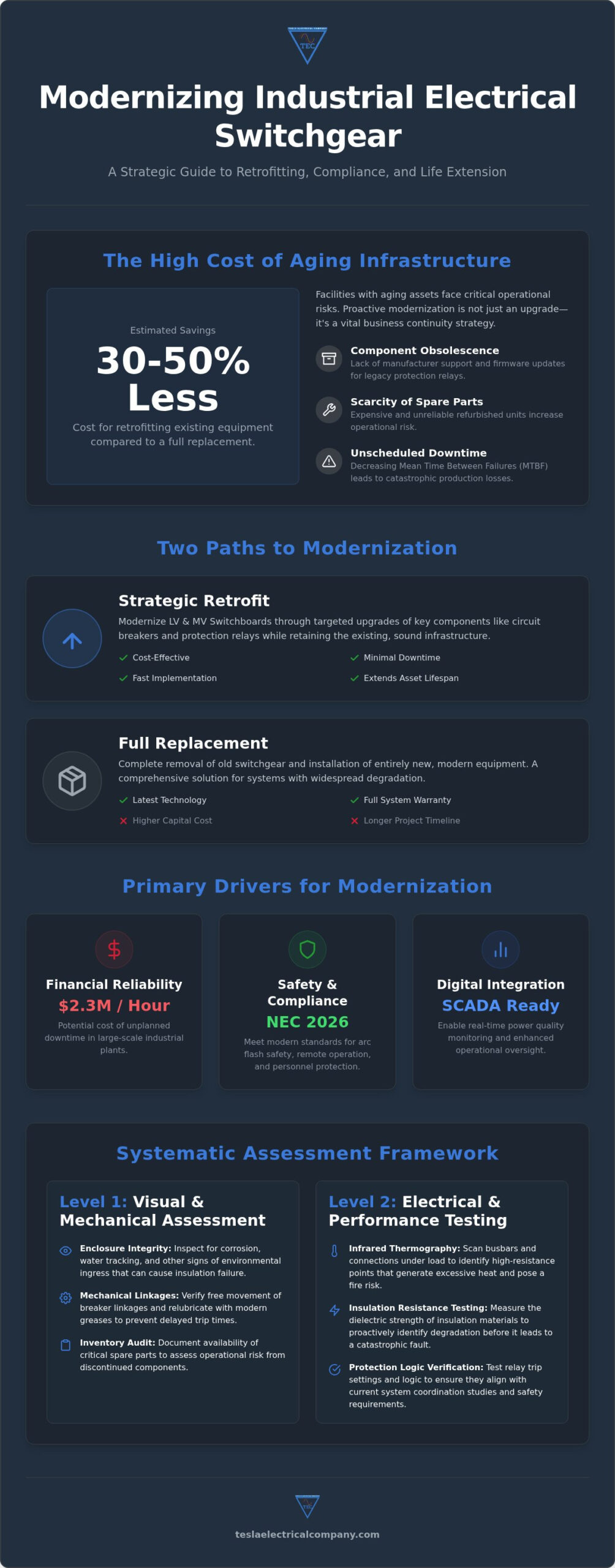
Retrofitting existing industrial infrastructure is estimated to cost 30% to 50% less than purchasing and installing entirely new equipment. If you’re managing a facility with aging assets, you’re likely familiar with the rising costs of rare spare parts and the persistent threat of unscheduled downtime. The process of upgrading old electrical switchgear has become a vital strategy for managers who must balance fiscal responsibility with the need to comply with the latest NEC 2026 safety standards.
We recognize that maintaining operational continuity is your primary objective. This article provides a comprehensive technical framework to help you evaluate your legacy systems and implement rigorous life-extension services. You’ll learn how to modernize your LV and MV Switchboards through targeted retrofits of circuit breakers and protection relays. We also preview the integration of advanced SCADA systems and power quality monitoring, ensuring your infrastructure remains reliable, safe, and fully integrated with modern digital monitoring platforms for long-term stability.
Key Takeaways
- Identify critical failure indicators in aging infrastructure, including the impact of component obsolescence and the increasing scarcity of essential spare parts.
- Follow a systematic framework for upgrading old electrical switchgear that prioritizes enclosure integrity and utilizes thermal analysis to mitigate high-resistance connections.
- Evaluate the strategic advantages of retrofitting circuit breakers and protection relays versus the full replacement of LV and MV Switchboards.
- Learn to integrate modern SCADA & Automation Systems into legacy panels to enable real-time power quality monitoring and enhanced operational oversight.
- Implement professional life-extension services to maximize the lifespan of existing assets while ensuring compliance with the latest industrial reliability standards.
Evaluating the State of Aging Industrial Switchgear
LV and MV Switchboards serve as the central nervous system of any industrial power distribution network. Their primary function is to isolate electrical equipment and clear faults downstream to prevent catastrophic damage. For those establishing a baseline for their facility, understanding What is Electrical Switchgear? provides insight into how these systems manage the protection and control of electrical power. As these systems age, the degradation of insulation materials and the mechanical wear of moving parts create hidden risks that can compromise the stability of your entire infrastructure.
Identifying the correct moment for upgrading old electrical switchgear often starts with recognizing the signs of component obsolescence. Protection relays that were state-of-the-art two decades ago now lack manufacturer support, making firmware updates and technical troubleshooting impossible. Finding genuine spare parts becomes an expensive search for refurbished units, which introduces significant reliability concerns. If your facility relies on legacy components that are no longer in production, you’re effectively operating on borrowed time.
The Cost of Maintenance vs. The Cost of Failure
Maintaining legacy hardware with non-OEM parts is a high-stakes gamble for any facility manager. While the initial repair might seem more budget-friendly than a retrofit, the long-term cost of ownership rises as system reliability drops. Unscheduled downtime in heavy industrial settings can be financially devastating. For instance, unplanned outages in large-scale automotive plants can cost as much as $2.3 million per hour in lost production and labor. Mean Time Between Failures (MTBF) is the average time a system operates before experiencing a failure that requires repair or replacement. When MTBF begins to decrease, the cumulative expense of emergency maintenance quickly outpaces the investment required for a systematic upgrade.
Regulatory and Safety Drivers for Modernization
Safety standards have evolved significantly, frequently leaving legacy equipment as a major liability. The 2026 NEC now mandates specific arc flash marking on all non-dwelling unit service and feeder equipment. Older switchgear often lacks the internal arc-resistant construction or the high-speed protection relays necessary to reduce incident energy during a fault. Transitioning to modern systems allows for remote operation, removing personnel from the immediate vicinity of the gear during switching events. Upgrading old electrical switchgear isn’t just about reliability; it’s a critical step in ensuring your facility complies with modern safety mandates and protects your personnel from preventable hazards.
The Technical Checklist for Industrial Switchgear Maintenance
A systematic diagnostic approach is the foundational step for any modernization strategy. Before committing to a specific path for upgrading old electrical switchgear, facility managers must execute a rigorous technical assessment of their existing assets. This process identifies immediate safety hazards while establishing the baseline data required for future life-extension projects. Regular maintenance isn’t just a cleaning exercise; it’s a data-gathering mission that informs your long-term capital expenditure decisions.
Level 1: Routine Visual and Mechanical Assessment
The integrity of LV and MV Switchboards begins with the physical enclosure. Technicians must inspect for signs of environmental ingress, such as corrosion or water tracking, which can lead to catastrophic insulation failure. Mechanical linkages in aging circuit breakers are particularly vulnerable. Over time, original factory lubricants harden, significantly increasing the friction within the racking mechanism. This mechanical resistance can delay trip times, pushing the equipment outside its engineered safety tolerances.
- Corrosion and Tracking: Identify moisture entry points and salt-air degradation in the enclosure.
- Mechanical Linkages: Verify that circuit breaker linkages move freely and are properly lubricated with modern, high-stability greases.
- Inventory Audit: Document the availability of critical spare parts. If your facility relies on discontinued components, your operational risk profile is unacceptably high.
Level 2: Electrical and Performance Testing
Visual inspections cannot reveal the internal health of busbars or the accuracy of protection logic. Infrared thermography is essential for identifying high-resistance connections that generate excessive heat under load. Insulation resistance testing, or Megger testing, provides a quantitative look at the health of busbars and cable terminations. This data is critical when evaluating whether the existing structure can support a digital retrofit or if a full replacement is necessary.
Advanced testing includes primary and secondary injection to verify that protection relays respond correctly to fault conditions. Contact resistance testing ensures that power transfer across breaker contacts remains efficient. Referencing a Switchgear Modernization Case Study published by IEEE illustrates how these diagnostic steps justify the transition from legacy systems to modern, digital-ready platforms. When upgrading old electrical switchgear, these tests provide the technical proof that the modernization will actually improve system reliability. For a specialized audit of your infrastructure, consulting with the engineering team at Tesla Electrical Company can help align your maintenance schedule with the latest 2026 industrial standards.
Finally, utilizing a power quality and disturbance recording system during the testing phase allows you to identify transient issues that standard meters might miss. These disturbances often signal early-stage component failure within the switchgear or downstream loads.
Modernization Strategies: Retrofit vs. Full Replacement
Deciding between a targeted retrofit and a complete system replacement is a pivotal moment in the life cycle of industrial power infrastructure. Upgrading old electrical switchgear through retrofitting involves the methodical replacement of aging circuit breakers and protection relays while retaining the existing cubicles and busbar structures. This strategy is designed to extend the operational life of assets that remain structurally sound but possess obsolete internal switching technology. By focusing on critical components, facility managers can achieve modern performance levels while avoiding the prohibitive costs and logistical complexity of a total overhaul.
A cost-benefit analysis typically reveals that retrofitting is 30% to 50% more cost-effective than purchasing and installing new equipment. Beyond the direct CAPEX savings, retrofitting eliminates the need for extensive civil works and the time-consuming process of rerouting primary power cables. In facilities where space is at a premium, maintaining the original footprint is often the only viable way to modernize without triggering a massive facility redesign.
The Advantages of Circuit Breaker Retrofitting
Retrofitting allows a facility to maintain its original industrial switchboard design while significantly improving electrical performance and safety. Modern vacuum or SF6 technology can be integrated into legacy enclosures using custom-engineered mounting kits. This process provides the high-speed clearing times required by current standards without disturbing the surrounding infrastructure. Because the busbar connections and external cabling remain intact, site disruption is minimized, allowing for shorter, more predictable maintenance windows. This approach bridges the gap between legacy reliability and modern technical requirements.
When Full Switchgear Replacement is Unavoidable
There are specific technical thresholds where a full replacement becomes a necessity. If your facility expansion requires a load capacity that exceeds the original busbar ratings, or if the physical enclosure shows signs of advanced structural corrosion, a new installation is the only responsible path. When evaluating medium voltage switchgear suppliers, it’s essential to prioritize those who offer end-to-end integration with modern low voltage distribution boards. A full replacement provides a “clean slate” for power distribution, ensuring that every component, from the enclosure to the smallest protection relay, meets the most stringent 2026 industrial reliability and safety benchmarks.
Integrating SCADA and Automation into Legacy Systems
Modern industrial operations no longer view switchgear as isolated mechanical assets. The process of upgrading old electrical switchgear today involves a strategic transition from “dumb” hardware to data-rich, networked infrastructure. By implementing comprehensive SCADA and automation system solutions, facility managers gain granular visibility into their power distribution network. This digital layer allows for the collection of real-time performance data, which is essential for predictive maintenance and long-term reliability. With the Bureau of Labor Statistics reporting switchgear price index increases of up to 17.5% through April 2026, extracting maximum value from existing assets through automation is a financially prudent alternative to full procurement.
Steps for Digitalizing Old Switchgear
The digitalization process begins with the installation of smart metering and power quality recording equipment directly into existing panels. These devices capture critical data points, including voltage, current, power factor, and total harmonic distortion. To facilitate communication, legacy protection relays are replaced with modern units supporting protocols such as IEC 61850 or Modbus TCP/IP. Industrial gateways then aggregate this information, feeding it into PLC and SCADA platforms. This architecture enables remote monitoring; operators can oversee hazardous zones from a safe distance, which significantly reduces the need for manual intervention. It’s a systematic approach to safety that aligns with the latest industrial standards.
- Data Point Identification: Prioritize the monitoring of harmonics and power factor to prevent equipment overheating and utility penalties.
- Protocol Migration: Ensure all new components support open standards like MQTT or OPC-UA for future-proof interoperability.
- Software Lifecycle Management: Plan for concurrent OS and SCADA migrations, especially as extended support for legacy databases like SQL Server 2016 concludes on July 14, 2026.
Enhancing Reliability with Redundant Control Systems
High-stakes industrial environments require architecting redundancy into every critical power path. Modernized switchgear often serves as the hub for various specialized systems, including VFD control panels and capacitor banks, which must interface seamlessly with the central automation platform. For facilities relying on onsite power, the real-time monitoring of generator synchronizing control panels ensures critical power resilience during grid transitions. Utilizing a power quality and disturbance recording system allows engineers to diagnose intermittent faults and transients before they escalate into full-scale outages. This systematic oversight transforms aging assets into a proactive component of the facility’s digital ecosystem. To modernize your facility’s automation architecture, explore the SCADA & Automation Systems provided by Tesla Electrical Company.
Life Extension Services with Tesla Electrical Company
Tesla Electrical Company provides a structured, authoritative approach to industrial infrastructure modernization. We understand that the process of upgrading old electrical switchgear is rarely binary; it requires a deep technical understanding of the existing system’s architecture. Our expertise focuses on the design and supply of high-performance LV and MV Switchboards, ensuring that your facility operates with the highest standards of reliability and safety. By prioritizing life-extension services, we help facility managers avoid the excessive capital expenditure of full system overhauls while significantly enhancing electrical performance.
Our Systematic Retrofit and Modernization Process
Our modernization framework transitions projects from initial technical design through to final on-site execution. This “total solution” provider mindset ensures that every component is engineered for compatibility and performance. We specialize in the Retrofit of Circuit Breakers and Protection Relays, utilizing custom mounting kits to integrate modern vacuum or SF6 technology into your legacy cubicles. This process includes:
- Rigorous engineering of custom electrical switchboards for specific industrial requirements.
- Seamless integration between existing power quality systems and new digital protection logic.
- Precision calibration of protection settings to ensure compliance with 2026 safety standards.
Partnering for Industrial Resilience
Managing complex electrical projects requires the steady hand of an experienced partner. Our engineering-first approach focuses on system longevity, providing comprehensive design and supply of a Redundant System for high-stakes industrial environments. This ensures that critical power paths remain energized, often integrated with a Generator Synchronizing Control Panel to maintain stability during grid transitions. We also implement systematic spare parts management, securing the necessary components to guarantee continued operation for decades.
The goal of modernization is to transform aging hardware into a resilient, data-rich asset. Tesla Electrical Company offers the human-centric expertise and technical rigor needed to manage the nuances of upgrading old electrical switchgear without compromising production. For a detailed evaluation of your facility’s current state, contact us for a comprehensive switchgear health assessment and modernization roadmap. This proactive oversight is the most effective way to ensure your Power Quality and Disturbance Recording System provides the actionable insights required for modern industrial excellence.
Securing the Future of Industrial Power Infrastructure
Modernizing industrial infrastructure requires a precise balance between capital efficiency and operational reliability. By prioritizing the systematic process of upgrading old electrical switchgear, facility managers can achieve modern safety compliance while avoiding the massive disruption associated with total system replacement. This strategic life-extension approach ensures that your LV and MV Switchboards remain robust assets within an increasingly data-driven industrial landscape. Integrating modern protection relays and thermal analysis into your maintenance routine provides the technical foundation needed for long-term stability.
Tesla Electrical Company brings decades of established expertise to every modernization project, from the initial design of a Generator Synchronizing Control Panel to comprehensive SCADA and automation integration. We provide the end-to-end oversight and “total solution” engineering necessary to transform legacy systems into resilient, high-performance networks. Our commitment to high standards of excellence ensures that your facility remains safe, compliant, and efficient as industrial requirements evolve.
To begin your journey toward enhanced reliability, Consult with Tesla Electrical Company for Switchgear Modernization Services today. We look forward to partnering with you to establish a more stable and secure power distribution environment for your facility.
Frequently Asked Questions
How long does a typical industrial switchgear system last before needing an upgrade?
Industrial switchgear systems generally possess a design life of 20 to 30 years. While the structural enclosures often remain viable for longer periods, the internal switching components and protection logic typically reach technical obsolescence after two decades. Environmental factors such as humidity and salt air can accelerate this timeline. Once OEM spare parts become unavailable, the risk of extended downtime makes a modernization project a logistical necessity for the facility.
What are the primary signs that old electrical switchgear requires a retrofit?
Primary indicators include frequent nuisance tripping, visible corrosion on the enclosure, and increased mechanical resistance during breaker racking. If your maintenance team struggles to source genuine spare parts or if thermal imaging reveals persistent hotspots at busbar connections, the system is likely nearing end-of-life. These physical symptoms often coincide with a decrease in the Mean Time Between Failures, signaling that the reliability of your power distribution is compromised.
Is retrofitting circuit breakers more cost-effective than full switchgear replacement?
Retrofitting is significantly more cost-effective, typically requiring 30% to 50% less capital expenditure than a total replacement. This strategy avoids the high costs associated with civil works, structural modifications, and the complex rerouting of primary power cables. By utilizing the existing footprint and busbar structure, facility managers can achieve modern performance levels and enhanced safety while preserving a substantial portion of their original infrastructure investment.
Can I integrate my old electrical switchgear into a modern SCADA system?
Yes, legacy systems can be successfully integrated into a modern SCADA & Automation environment through the installation of smart meters and digital gateways. The process of upgrading old electrical switchgear involves replacing analog protection relays with modern units that support communication protocols like IEC 61850 or Modbus TCP/IP. This digital layer provides real-time visibility into power quality and equipment health, transforming “dumb” hardware into a data-rich industrial asset.
What safety standards should I consider when upgrading industrial switchgear?
Compliance with the NEC 2026 is the most critical consideration, particularly Section 110.16(B) regarding mandatory arc flash labeling for service and feeder equipment. You should also ensure your modernized system aligns with NFPA 70E requirements for electrical safety in the workplace. Upgrading to modern protection relays helps meet these standards by providing faster fault clearing times and enabling remote switching operations, which keeps personnel outside of hazardous arc flash boundaries.
How does upgrading protection relays improve industrial plant safety?
Modern protection relays improve safety by significantly reducing arc flash incident energy through high-speed fault detection. They also support advanced logic that allows for remote monitoring and control, removing operators from the immediate vicinity of the switchgear during high-risk switching events. These digital units provide precise trip settings that remain within engineered tolerances, ensuring that faults are isolated quickly before they can cause catastrophic damage or personnel injury.
What is the expected downtime for a circuit breaker retrofit project?
The downtime for a circuit breaker retrofit is typically limited to a few hours per unit. Because the existing LV and MV Switchboards remain in place, the installation involves a “plug-and-play” process using custom-engineered mounting kits. This is a massive improvement over full system replacements, which can take weeks of scheduled outages. The methodical nature of retrofitting allows for phased upgrades during standard maintenance windows, ensuring minimal disruption to production schedules.
Why is power factor correction important when modernizing old switchgear?
Power factor correction is essential for optimizing the efficiency of your electrical network and avoiding utility penalties. Integrating modern Capacitor Banks during a switchgear upgrade reduces the reactive power demand on your transformers and aging busbars. This process stabilizes the voltage across your facility and frees up system capacity for future load expansion. It’s a vital component of a total power quality solution that ensures long-term industrial resilience.
Disclaimer
Some content, images, text, or other materials on this website may have been created or assisted by artificial intelligence (AI).
While we review AI-generated content for accuracy and quality, we do not guarantee that all information is free from errors or omissions.
Content generated using AI is provided for informational purposes only and should not be solely relied upon without independent verification.