
The true strength of an industrial power grid isn’t found in the size of its engines, but in the precision of the logic that governs them. For many facility managers, the stress of managing mismatched genset brands or facing unexpected downtime during a control upgrade is a constant reality. It’s difficult to maintain a stable, synchronized grid when your existing infrastructure lacks the transparency needed for real-time power quality metrics. You likely recognize that manual intervention is no longer a sustainable strategy for modern industrial demands.
By mastering the technical complexities of Woodward generator control, you can transform these disparate assets into a unified, resilient system. This article provides a comprehensive look at how professional integration ensures industrial power reliability. We will examine the transition from legacy hardware to advanced controllers, the mechanics of automated load sharing, and the role of custom-engineered switchboards in protecting your power quality. Discover how a methodical approach to control logic secures your facility’s energy future and extends the operational lifespan of your existing generator assets.
Key Takeaways
- Learn why Woodward generator control serves as the critical logic core for managing complex power architectures and ensuring seamless transitions between diverse energy sources.
- Understand the advanced paralleling capabilities of the easYgen-3000XT series, which offers integrated protection for engines, generators, and the utility grid.
- Discover the precise mechanics behind automatic synchronization and how proportional load sharing prevents instability within grids containing mismatched generator brands.
- Evaluate the technical methodology for retrofitting legacy switchboards with modern controllers to extend the operational lifespan of your existing power infrastructure.
- Explore how the integration of SCADA and Power Quality Recording systems provides the deep visibility required for comprehensive oversight of industrial automation.
Understanding Woodward Generator Control in Industrial Infrastructure
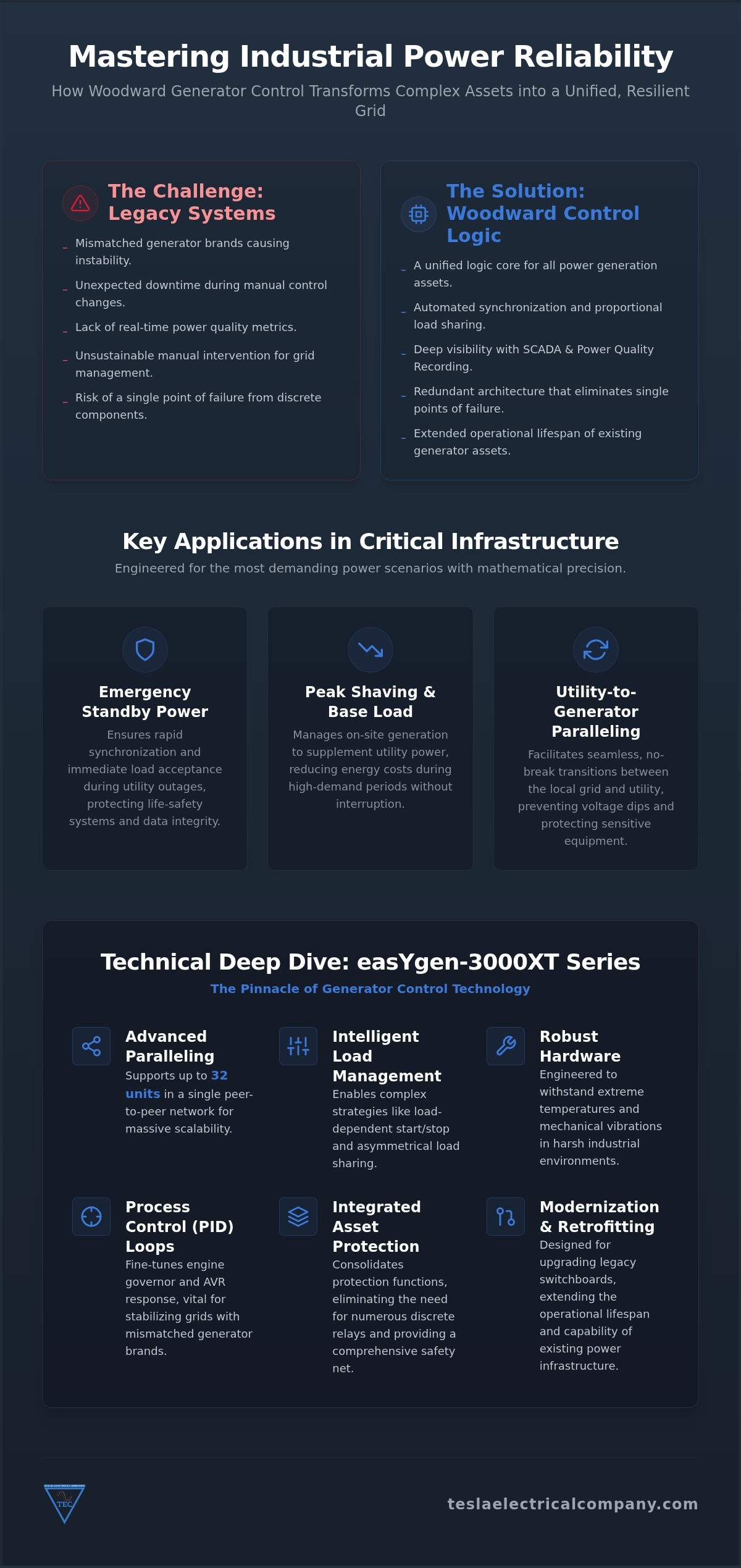
Woodward generator control systems represent the definitive standard for managing complex power generation assets. In modern industrial settings, these controllers function as the central logic core, orchestrating the performance of prime movers to ensure a stable and synchronized supply. While basic governors once focused solely on engine speed, contemporary systems provide comprehensive oversight of the entire electrical distribution network. This shift toward integrated power management allows for the precise coordination of multiple generator sets, regardless of manufacturer, into a cohesive and resilient grid. Tesla Electrical Company leverages this technology as the brain of their custom-manufactured synchronizing panels, ensuring every component operates within rigorous technical tolerances.
The Evolution of Power Management
The transition from analog synchronization to digital microgrid management has fundamentally changed how facilities operate. Legacy systems often relied on discrete components for voltage regulation and load sharing, which increased the risk of a single point of failure. Modern Woodward easYgen controllers consolidate these functions into a unified digital platform. This standardization reduces operational complexity and enhances system visibility across the entire plant. By implementing distributed logic, engineers can design redundant architectures where the loss of one controller doesn’t compromise the integrity of the entire power system. The easYgen series serves as a versatile solution for diverse prime movers, including diesel, gas, and steam turbines, providing a consistent control interface across varied asset types.
Key Applications for Woodward Systems
Critical infrastructure requires a level of reliability that only a robust Woodward generator control strategy can provide. Facilities such as data centers, hospitals, and heavy industrial plants depend on Woodward’s ability to manage high-availability requirements without interruption. These systems are engineered to handle the most demanding power scenarios with precision. The following applications highlight why this technology is essential for modern infrastructure:
- Emergency standby power: Ensuring rapid synchronization and immediate load acceptance during utility outages to protect life-safety systems and data integrity.
- Peak shaving and base load: Managing base load operations to reduce energy costs during high-demand periods by supplementing utility power with on-site generation.
- Utility-to-generator paralleling: Facilitating seamless transitions between the local grid and the utility provider, which prevents voltage dips and protects sensitive electronic equipment.
By centralizing these functions, Woodward controls mitigate the risks associated with manual synchronization. This automated approach ensures that every power transition is executed with mathematical accuracy, preserving the lifespan of circuit breakers and protection relays within the LV and MV switchboards manufactured by Tesla Electrical Company. It’s a methodical way to secure long-term stability for your facility’s energy future.
Technical Capabilities of the easYgen-3000XT Series
The easYgen-3000XT series represents the pinnacle of Woodward generator control technology, offering a sophisticated paralleling architecture that supports up to 32 units in a single peer-to-peer network. This advanced logic allows for complex power management strategies, such as load-dependent start/stop and asymmetrical load sharing. Beyond software intelligence, the hardware is engineered for the most demanding industrial environments. It features a robust housing capable of withstanding extreme temperatures and mechanical vibrations. This durability ensures that the logic core remains operational even when housed in outdoor enclosures or near heavy machinery. Precise process control is achieved through configurable PID loops. These loops allow engineers to fine-tune the response of the engine’s governor and the generator’s automatic voltage regulator (AVR). When integrating mismatched brands, these PIDs are vital for achieving a stable state without oscillations.
Integrated Asset Protection
The easYgen-3000XT consolidation of protection functions eliminates the need for numerous discrete relays. It provides a comprehensive safety net for the entire power system. This level of oversight is why Tesla Electrical Company incorporates these controllers into their generator synchronizing control panels to provide clients with a total solution. The system monitors the following parameters:
- Generator protection: The system monitors for over/under voltage, frequency deviations, and reverse power conditions to prevent alternator damage.
- Engine monitoring: Integrated analog and digital inputs track oil pressure, coolant temperature, and overspeed parameters to ensure mechanical longevity.
- Mains protection: For utility-parallel applications, the controller utilizes phase shift and rate of change of frequency (ROCOF) detection to identify grid instability and disconnect safely. When combined with automatic mains failure panels, this detection capability enables a fully automated and seamless response to utility outages.
Configuration and Emulation Tools
Commissioning complex systems often presents significant risks. Woodward addresses this through specialized configuration software that allows for rapid parameter adjustment and logic mapping. A standout feature of the 3000XT series is its on-board emulation capability. This allows technicians to simulate the entire sequence of operations before the generators are even started. It verifies the logic, ensures the protection settings are correct, and reduces the time required for live testing. Additionally, integrated communication protocols like Modbus TCP/RTU and Ethernet/IP facilitate remote monitoring. This connectivity allows facility managers to access real-time power metrics and disturbance logs through secure industrial cloud interfaces, ensuring total visibility into system performance.
Architecting Advanced Synchronization and Load Sharing Logic
Designing a power grid that withstands unforeseen disruptions requires more than just high-quality hardware. It demands a sophisticated logic layer capable of making split-second decisions. Implementing a robust Woodward generator control strategy allows for the orchestration of complex bus-tie architectures where multiple sources must converge without conflict. The mechanics of automatic synchronization involve the precise matching of voltage, frequency, and phase angle before a circuit breaker closes. This process must be flawless to prevent massive mechanical stress on the engine and alternator. Once synchronized, the system transitions into load sharing logic. Proportional sharing ensures each unit contributes based on its specific capacity, while isochronous sharing maintains a constant frequency across the entire bus regardless of demand fluctuations.
Redundant System Architecture
In high-stakes environments, a Redundant System is not a luxury but a necessity. Woodward controllers utilize a peer-to-peer communication network that eliminates the need for a central master PLC, which often represents a single point of failure. This architecture allows for N+1 or N+N redundancy, where the “master” responsibilities automatically shift to the next available controller if a unit goes offline. During a utility failure, this logic ensures that the most critical power paths are prioritized and energized within seconds. It’s a methodical approach to fail-safe synchronization that protects your facility’s operational integrity.
Automated load shedding is another critical feature of this redundant architecture. If the total load exceeds the available capacity of the running generators, the Woodward logic identifies and disconnects non-essential circuits. This prevents a total system collapse and keeps life-safety systems or data centers operational. The precision of this shedding logic is customizable, allowing engineers to define multiple priority levels based on the facility’s specific requirements.
Tie Breaker and Utility Feed Management
Managing multiple utility feeds alongside on-site generation requires complex interlocking logic to prevent back-feeding and ensure safety. Woodward controls facilitate this through integrated logic for automatic transfer switching (ATS) and tie-breaker coordination. The system can manage “long-time” paralleling with the utility for peak shaving, where the generator supplements the grid during high-tariff periods. This sequencing is not just about reliability; it’s about operational efficiency. Intelligent genset sequencing ensures that only the necessary number of units are running to meet the current load, which significantly optimizes fuel consumption and reduces wear on your assets. By coordinating these feeds through a centralized logic core, you achieve a level of grid stability that manual systems simply cannot match.
Retrofitting Legacy Switchboards with Modern Woodward Controllers
Maintaining legacy infrastructure often presents a choice between total replacement and targeted modernization. For many industrial facilities, the existing LV or MV switchboard remains structurally sound, yet the control logic has become obsolete. Retrofitting these systems with modern Woodward generator control technology offers a cost-effective path to achieving contemporary reliability without the capital expenditure of a full switchboard overhaul. This process involves integrating high-speed digital processing into an environment that may still rely on analog governor systems or older mechanical protection. Tesla Electrical Company specializes in this delicate synchronization, ensuring that new digital logic communicates seamlessly with legacy prime movers.
The Retrofit Assessment Process
The success of any modernization project depends on a rigorous evaluation of the current hardware state. This phase includes a detailed inspection of existing protection relays and the mechanical health of circuit breakers to determine if they can handle the increased precision of a digital controller. Mapping input/output (I/O) requirements is equally critical; engineers must identify every sensor, solenoid, and auxiliary contact to ensure total system integration. A comprehensive retrofit audit serves as a mandatory first step for ensuring long-term system longevity and operational reliability. By identifying potential failure points early, we prevent unexpected complications during the commissioning phase.
Execution and Commissioning
The physical execution of a retrofit requires meticulous craftsmanship and technical oversight. It begins with precise panel cutouts and the management of complex wiring looms to accommodate the new Woodward hardware. Beyond the physical installation, the calibration of Automatic Voltage Regulators (AVR) is essential for maintaining a stable output during load transitions. Tesla Electrical Company provides specialized retrofit of circuit breakers and protection relays to ensure the entire electrical path is as resilient as the new control logic.
The final stage involves Site Acceptance Testing (SAT), where the system is subjected to real-world load scenarios. This performance verification ensures that the automated load sharing and shedding logic functions correctly within the specific constraints of the legacy equipment. To minimize downtime, Tesla Electrical Company employs a methodical approach involving pre-manufactured sub-panels and modular wiring. This strategy allows much of the work to be completed before the generators are taken offline, reducing the critical path of the outage from days to hours. This transition ensures your facility gains the benefits of modern automation while preserving the value of your existing generator assets.
Comprehensive Industrial Automation: The Tesla Electrical Advantage
While the controller serves as the logic core, its true value is realized when integrated into a broader automation ecosystem. A Woodward generator control system shouldn’t operate in isolation; it must communicate effectively with the entire facility’s infrastructure. Tesla Electrical Company specializes in bridge-building between these sophisticated controllers and comprehensive industrial frameworks. By housing these units within custom-manufactured generator synchronizing control panels, we ensure that every signal is processed with absolute precision. This holistic approach transforms a standalone asset into a data-rich component of your facility’s energy strategy. It allows for a level of oversight that protects both the equipment and the operational continuity of the plant.
SCADA and Data Acquisition
Modern industrial operations require real-time visualization to maintain peak efficiency. Integrating Woodward controls into a SCADA and automation system allows facility managers to monitor performance metrics from a centralized interface. This connectivity is achieved through standardized industrial protocols, including Modbus TCP, CANbus, and Ethernet integration. The data harvested through these channels provides more than just a snapshot of current status; it offers a historical record essential for predictive maintenance. By analyzing trends in fuel consumption, load patterns, and engine response times, engineers can identify potential issues before they escalate into system failures. This proactive oversight is augmented by the inclusion of a Power Quality and Disturbance Recording System, which captures high-resolution data during transient events to facilitate deep-root cause analysis.
The Total Solution Provider
Tesla Electrical Company maintains a position as a premier partner for complex power systems by offering an end-to-end service model. Our expertise extends beyond simple installation to include the design and manufacturing of LV and MV switchboards that serve as the foundation for resilient grids. We understand that industrial reliability is built on a commitment to engineering rigor and professional authority. This dedication ensures that every system we commission meets the highest standards of excellence and safety. To support the long-term health of your infrastructure, we provide specialized technical support and maintain a robust inventory of spare parts for all integrated components.
Choosing a partner who understands the intricate relationship between control logic and electrical distribution is vital for any critical facility. Whether you’re designing a new redundant system or modernizing an existing plant, our team provides the steady hand required to manage high-stakes technical requirements. We invite you to consult with our engineers on your Woodward control integration to discover how a methodical, total-solution approach can secure your facility’s power future.
Securing Your Facility’s Energy Future Through Precision Logic
Transitioning to a resilient power ecosystem requires a methodical approach to control logic and hardware integration. You’ve seen how the easYgen series provides the sophisticated paralleling architecture needed for complex industrial grids. By implementing automated synchronization and intelligent load sharing, you eliminate the risks associated with manual operation and mismatched equipment. Modernizing your facility with Woodward generator control doesn’t just improve visibility; it fundamentally transforms your existing assets into a unified, high-performance system.
Tesla Electrical Company acts as a dependable partner for facilities requiring absolute power reliability. Our expert engineers specialize in the design of Generator Synchronizing Control Panels and focus on critical power redundant systems. With global coverage for industrial automation and retrofitting, we provide the steady hand needed for complex system transitions. Partner with Tesla Electrical Company for Your Woodward Control Retrofit to integrate world-class logic into your infrastructure. Achieving a stable, synchronized grid is a strategic investment in your facility’s long-term resilience.
Frequently Asked Questions
What is the primary difference between Woodward easYgen-3000 and 3000XT series?
The 3000XT series is the advanced successor to the standard 3000 series, offering significantly expanded processing power and hardware flexibility. While both series handle complex paralleling, the XT version introduces enhanced communication protocols and a higher count of configurable inputs and outputs. This allows for more intricate logic in a Redundant System. The XT hardware also features an improved display and a wider operating temperature range for challenging industrial environments.
Can Woodward controllers be used with generators from different manufacturers in the same grid?
Woodward controllers are brand-agnostic and function as a universal logic layer for diverse engine and alternator combinations. They utilize standardized signals to interface with various electronic governors and automatic voltage regulators regardless of the manufacturer. This capability allows facility managers to synchronize mismatched gensets into a single, cohesive power grid. It provides the flexibility required when expanding or retrofitting existing industrial power infrastructure with new assets.
How does Woodward generator control improve fuel efficiency in industrial applications?
A robust Woodward generator control strategy optimizes fuel consumption through intelligent load-dependent sequencing. The system automatically calculates the total load demand and starts or stops generators to ensure each unit operates within its most efficient fuel-to-power ratio. By preventing engines from running at low-load conditions, the controller reduces wet stacking and minimizes unnecessary fuel burn. This methodical management extends the operational lifespan of the equipment while lowering overall energy expenditures.
Is it possible to monitor Woodward generator controls remotely via a mobile device?
Remote monitoring is achieved through the integration of secure industrial gateways and cloud-based interfaces. These systems translate controller data into mobile-friendly dashboards, allowing for real-time oversight from any location. Users can view critical metrics, such as voltage stability and engine health, and receive immediate alerts for disturbance events. This level of visibility is essential for maintaining high-stakes technical requirements in facilities where immediate response times are critical for operational continuity.
What technical support is required for Woodward control system commissioning?
Successful commissioning requires expert engineering support to handle complex logic mapping and precise PID loop tuning. A qualified technician must configure the controller to match the specific response characteristics of the engine and alternator. This process includes performing Site Acceptance Testing (SAT) to verify that the protection settings and synchronization logic function correctly under real-world load conditions. Professional oversight ensures that the final system meets the rigorous standards of industrial reliability.
How do Woodward controllers handle load shedding during a partial system failure?
The controller manages partial system failures by executing priority-based load shedding logic. When a generator goes offline, the system immediately identifies the remaining capacity and disconnects non-essential circuits to prevent a total grid collapse. This automated response occurs in milliseconds, ensuring that life-safety systems and critical data centers remain energized. Facility managers can define these shedding levels during the initial design phase to match their specific operational requirements and safety protocols.
What are the environmental limits for installing Woodward industrial controllers?
Woodward industrial controllers are engineered to operate in extreme environments with a typical temperature range of -20°C to +70°C. The hardware is ruggedized to withstand high levels of mechanical vibration and humidity, making it suitable for both indoor switchrooms and outdoor enclosures. For coastal or highly corrosive areas, these units are often housed within custom-manufactured panels that provide additional ingress protection. This durability ensures the logic core remains stable regardless of external conditions.
Can Woodward controls be integrated with existing SCADA systems using Modbus TCP/IP?
Woodward generator control systems provide native support for Modbus TCP/IP, allowing for seamless integration with existing SCADA and automation frameworks. This protocol enables the high-speed transfer of performance data and alarm logs to a centralized monitoring station. By utilizing standardized Ethernet connectivity, facilities can achieve deep visibility into their power distribution network without requiring proprietary hardware. This open communication architecture facilitates the comprehensive oversight needed for modern industrial automation and data acquisition.
Disclaimer
Some content, images, text, or other materials on this website may have been created or assisted by artificial intelligence (AI).
While we review AI-generated content for accuracy and quality, we do not guarantee that all information is free from errors or omissions.
Content generated using AI is provided for informational purposes only and should not be solely relied upon without independent verification.