
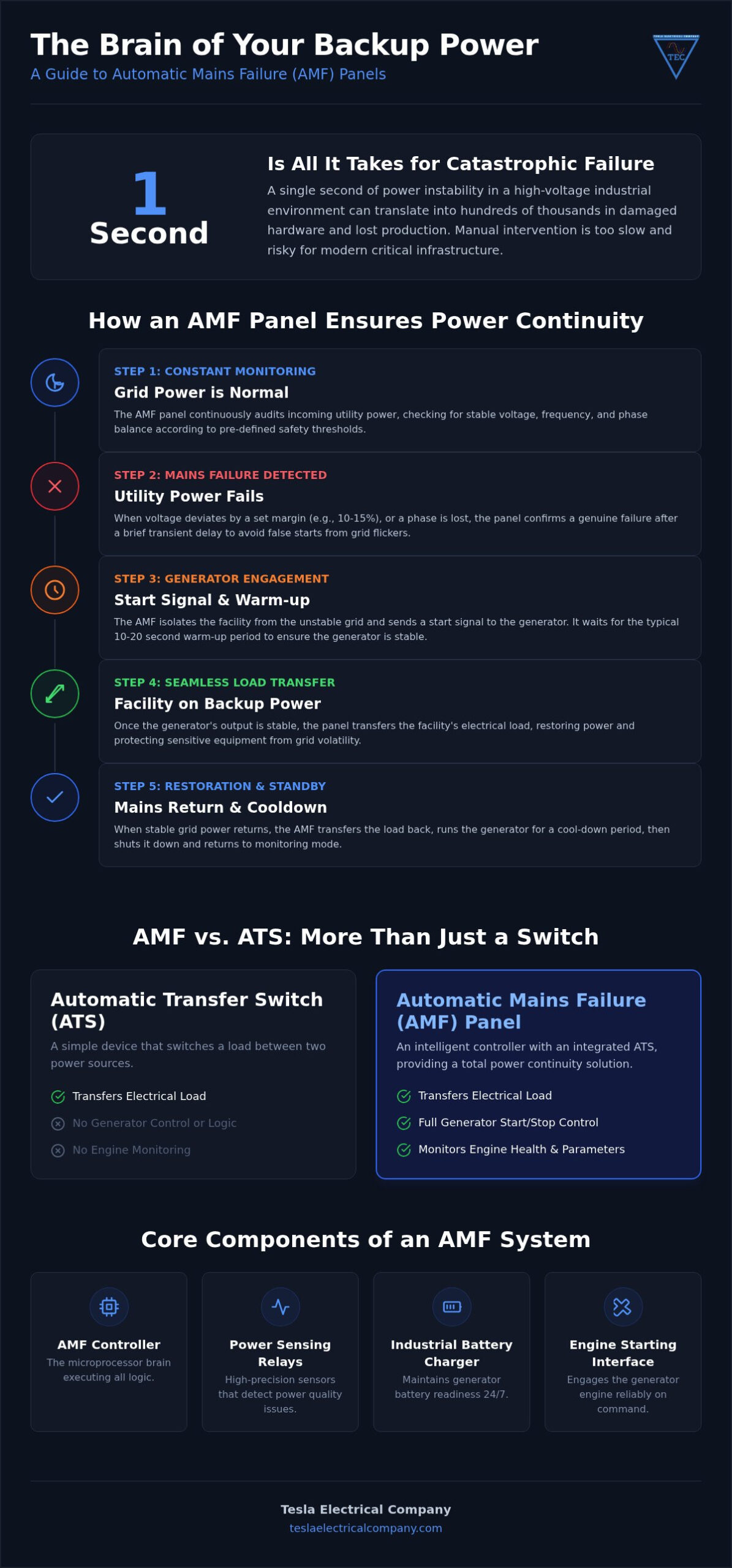
A single second of power instability in a high-voltage industrial environment can translate into hundreds of thousands of dirhams in damaged hardware and lost production time. You likely understand that relying on manual intervention during a utility outage is a risk your facility cannot afford, especially in unmanned or critical infrastructure where precision is paramount. Automatic mains failure panels act as the sophisticated brain of your backup strategy, executing seamless transitions that protect sensitive equipment from the volatile surges often associated with grid failure.
This guide explores the systematic logic behind these controllers to help you safeguard your operations against unexpected downtime. You will discover how automatic mains failure panels integrate with generator synchronizing systems to provide a total solution for power continuity. We will also clarify the common confusion between AMF and ATS terminology while reviewing the latest 2026 NEC requirements for arc flash labeling and energy management. By understanding these technical specifications and the importance of protection relay retrofits, you can ensure your facility maintains the high standards of excellence required in the modern industrial landscape.
Key Takeaways
- Learn how AMF panels function as intelligent interfaces that monitor utility stability and initiate standby protocols to prevent industrial downtime.
- Understand the sequential logic and sensing thresholds required to manage the critical warm-up period for industrial generators.
- Distinguish between standard transfer switches and automatic mains failure panels to ensure your facility has full control over engine parameters.
- Identify essential technical specifications, including the role of protection relay retrofits in maintaining the integrity of aging electrical infrastructure.
- Discover how to integrate AMF logic into plant-wide SCADA systems and redundant power strategies for total operational oversight.
Understanding Automatic Mains Failure Panels in Industrial Infrastructure
In the context of high-stakes industrial operations, automatic mains failure panels serve as the primary defensive interface between the utility grid and your facility’s standby power assets. These systems are far more than simple mechanical switches. They are sophisticated, microprocessor-based command centers that continuously audit the quality of incoming electricity. An AMF panel monitors critical parameters such as phase balance, voltage stability, and frequency consistency. When these metrics deviate from pre-defined safety thresholds, the panel initiates a systematic protocol to isolate the facility and engage secondary power sources. This intelligence ensures that your infrastructure remains resilient even when the national grid face’s instability.
Relying on manual intervention is no longer a viable strategy for modern industrial uptime. In a typical UAE industrial facility, a manual transition can take several minutes to execute. This delay is unacceptable for processes governed by sensitive electronics. An AMF panel serves as a specialized Automatic Transfer Switch (ATS) that includes dedicated logic for engine management. It is typically integrated directly into the main LV distribution switchboard, acting as the gatekeeper for all downstream loads. This positioning allows for a coordinated response that protects the entire electrical architecture from the volatile surges often seen during a utility collapse.
The Critical Need for Automated Power Resilience
Power interruptions don’t just stop production; they can cause catastrophic failures in logic-heavy systems. Industrial PLC and SCADA stability depends on a clean, consistent voltage profile. Even a brief brownout can trigger a system-wide reboot or lead to data corruption in process control PID loops. Automated power resilience is also a safety requirement. In large scale facilities, the immediate restoration of lighting and ventilation systems is essential to maintain a secure environment for the workforce. By utilizing automatic mains failure panels, operators ensure that transitions occur within a controlled window, typically bridging the gap before a generator reaches its standard 10 to 20 second warm-up period.
Core Components of an Industrial AMF System
The efficacy of an AMF system depends on the synergy of its internal components. The AMF controller acts as the central brain, executing complex logic sequences and monitoring engine health during the run cycle. This is supported by high-precision power sensing relays that detect phase loss or under-voltage conditions with millisecond accuracy. To ensure the standby system is always ready, these panels include integrated industrial battery chargers and engine starting interfaces. These components maintain the generator’s readiness, ensuring that when the “start” command is issued, the system responds without hesitation. For aging infrastructure, a protection relay retrofit is often recommended to bring these core components up to modern 2026 NEC safety standards.
The Operational Logic: How AMF Panels Ensure Power Continuity
The intelligence of automatic mains failure panels lies in their ability to distinguish between a transient grid flicker and a genuine utility collapse. These systems operate on a microprocessor-driven logic that prioritizes load safety above all else. Sensing thresholds are typically configured to trigger a response when the utility voltage deviates by 10% to 15% from the nominal rating or when a phase imbalance is detected. By implementing a short “mains transient” delay, the panel avoids unnecessary engine starts caused by momentary dips that don’t require standby intervention. This precision ensures that your facility only transitions to secondary power when it’s absolutely necessary for operational stability.
Once the failure condition is confirmed, the panel moves into an active command phase. This sequence is highly structured to prevent mechanical stress on the generator and electrical stress on the downstream infrastructure. If your current system feels sluggish or fails to meet modern response times, you might consider how protection relay retrofits can enhance the sensing accuracy of your existing installation. A well-calibrated AMF logic ensures that the transition is both predictable and safe, maintaining the integrity of your industrial processes.
Step-by-Step Sequence of an AMF Operation
A successful power transfer follows a rigorous sequential logic designed to protect the generator’s alternator and the facility’s switchgear. The process begins with the mains monitoring phase, where the controller identifies under-voltage or over-voltage conditions. Upon confirmation, the controller initiates the engine cranking sequence. The generator is then allowed a warm-up period, typically 10 to 20 seconds, to reach thermal stability and rated frequency before it accepts the load. Only after these parameters are verified does the panel open the mains breaker and close the generator breaker, ensuring a clean handover of power. Throughout the run-time, the system continuously monitors oil pressure, coolant temperature, and electrical output to prevent engine damage.
Mains Restoration and System Normalization
The logic for returning to utility power is as critical as the initial failure response. When the grid stabilizes, the AMF panel enters a “mains return” timing phase. It verifies that the utility power is healthy and consistent for a set duration, often several minutes, to ensure the grid isn’t “hunting” or prone to immediate re-failure. Once stability is confirmed, the panel executes a re-transfer back to the mains. This is followed by a vital “Cool Down” period. During this phase, the generator runs off-load for a specified time to allow the turbocharger and engine components to dissipate heat gradually. This prevents thermal shock and significantly extends the operational lifespan of the standby asset.
AMF vs. ATS: Distinguishing Between Automatic Transfer and Failure Logic
Terminology in the power distribution sector often overlaps, leading to critical misunderstandings during the specification phase. Within this lexicon, the distinction between an Automatic Transfer Switch (ATS) and automatic mains failure panels is frequently blurred. While both systems facilitate the transition between power sources, their functional scope differs significantly. It’s accurate to state that every AMF panel incorporates the hardware of an ATS, yet a standard ATS lacks the autonomous intelligence required to manage a standby generator’s lifecycle. Understanding this hierarchy is essential for engineers designing resilient industrial infrastructure.
The choice between these two systems depends entirely on the nature of the secondary power source. If a facility relies on a dual-utility feed where both sources are maintained by the grid, a standard switch may suffice. However, when the contingency plan involves a local generator, the switch alone is insufficient. The AMF panel provides the “failure” logic that bridges the gap between a dead grid and a running engine, a capability that standard transfer hardware cannot replicate on its own.
Defining the Automatic Transfer Switch (ATS)
The fundamental role of a standard ATS is to toggle a load between two available, energized sources. This is typically applied in facilities with dual utility feeds or where a large-scale UPS system provides the secondary source. A basic ATS doesn’t possess the capability to issue a “start” command to a combustion engine. Instead, it waits for the secondary source to reach a stable state before executing the transfer. This lack of autonomous engine control makes a standalone ATS insufficient for facilities that rely on diesel or gas generators as their primary contingency.
Why AMF is the Standard for Generator Backup
In contrast, automatic mains failure panels act as a comprehensive management system. They don’t just switch the load; they actively supervise the generator from the moment a grid instability is detected. This integrated approach offers advanced diagnostic capabilities that a standard switch cannot provide. For maintenance teams, the AMF panel serves as a data hub, logging faults and run-time statistics that are vital for predictive maintenance. Key features include:
- Autonomous engine cranking and monitoring of starting batteries.
- Real-time oversight of engine parameters such as oil pressure and coolant temperature.
- Execution of the cooling cycle logic to prevent thermal stress on the alternator.
- Integration of protection relays to isolate faults before they reach the main switchboard.
From a financial perspective, the investment in integrated AMF logic is justified by the reduction in system complexity. By housing the transfer hardware and the generator control logic in a single enclosure, facilities reduce their footprint and simplify the wiring architecture. For UAE industrial operators, where the cost of a single hour of downtime can exceed tens of thousands of dirhams, the comprehensive oversight provided by an AMF system represents a necessary standard for operational excellence.
Essential Specifications for High-Performance AMF Control Systems
Reliability in industrial power distribution is a product of rigorous engineering and high-specification components. While light commercial units might suffice for basic backup, industrial-grade automatic mains failure panels must adhere to more stringent standards, such as IEC-61439, to handle the high fault levels found in manufacturing and processing plants. A high-performance system doesn’t just switch power; it provides a comprehensive diagnostic overview of the entire electrical infrastructure. Modern microprocessor-based controllers, such as those running current version 26.03 firmware, allow for sophisticated load-shedding and remote monitoring that traditional analog systems simply cannot match.
The shift from analog metering to high-resolution Human Machine Interface (HMI) panels has transformed how maintenance teams interact with their power systems. These digital interfaces provide real-time visualization of phase voltages, currents, and power factors. This clarity is essential when managing complex transitions in high-voltage environments. If you’re looking to upgrade your facility’s resilience, you can review our high-performance LV and MV switchboard specifications to see how these components integrate into a total solution.
Advanced Protection and Monitoring Features
The inclusion of sophisticated power system protection relays is the most critical specification for any industrial AMF panel. These relays provide a layer of defense that standard circuit breakers cannot offer, detecting subtle faults like negative phase sequence or restricted earth faults before they cause permanent damage to the generator’s alternator. In alignment with the 2026 NEC mandates, modern panels now incorporate expanded arc flash labeling and integrated disturbance recording. This allows engineers to perform a granular post-outage analysis by reviewing the exact sequence of events leading up to a trip, ensuring that any underlying issues are addressed before the system is reset.
Hardware Durability and Maintenance Access
Hardware durability is a non-negotiable requirement, particularly in the United Arab Emirates, where ambient temperatures can frequently exceed 50°C. Industrial automatic mains failure panels require robust thermal management systems, including filtered ventilation or active cooling, to prevent the derating of sensitive electronic components. The physical architecture should prioritize serviceability, utilizing modular components and providing clear access to all internal wiring. High-quality vacuum circuit breakers and silver-alloy contactors are standard in these high-performance environments, as they offer the mechanical endurance needed for thousands of switching cycles without failure. This focus on hardware integrity ensures that the system remains a dependable partner throughout its decades-long operational life.
Integrating AMF Panels into Comprehensive Power Automation Strategies
The true value of automatic mains failure panels is realized when they transition from standalone protective devices into integrated nodes of a broader industrial ecosystem. In complex facilities, a single AMF unit often functions as a foundational component of a Redundant System, ensuring that no single point of failure can compromise the power architecture. This integration allows for a sophisticated interplay between the utility grid, standby assets, and the facility’s critical loads. By centralizing the transition logic, operators gain a holistic view of their power health, moving beyond reactive switching to proactive energy management.
In multi-generator environments, the logic within AMF panels must coordinate seamlessly with generator synchronizing control panels. This synergy is essential for facilities that require load-sharing capabilities or N+1 redundancy. While the AMF logic manages the initial utility failure and engine start protocols, the synchronizing system handles the complex task of matching frequency and phase angles across multiple sets. This tiered approach to automation ensures that even the most demanding industrial processes remain energized without the risk of voltage instability during the transition period.
SCADA and Remote Connectivity
Modern industrial automation demands real-time visibility into every facet of the electrical network. Integrating automatic mains failure panels into plant-wide SCADA systems via Modbus or Ethernet protocols provides maintenance teams with unparalleled operational data. This connectivity facilitates remote start and stop capabilities, allowing for controlled testing and emergency overrides from a centralized control room. Beyond simple status reporting, these systems integrate power quality data and disturbance recording into industrial energy management platforms. This level of transparency is vital for post-outage analysis and for identifying subtle inefficiencies in the power distribution chain before they escalate into costly equipment failures.
The Role of Tesla Electrical Company in Power Resilience
Tesla Electrical Company approaches power resilience as a total solution provider, specializing in the design and execution of custom AMF and synchronizing architectures. Our expertise extends to the systematic integration of SCADA and PLC Control Systems, ensuring that your power logic is perfectly aligned with your process requirements. We recognize that many facilities operate with aging infrastructure; therefore, we prioritize the retrofit of circuit breakers and protection relays to bring legacy systems up to modern 2026 NEC safety standards. By focusing on high-precision engineering and modular serviceability, we ensure that the national industrial infrastructure remains resilient against grid volatility. Our commitment is to provide the steady hand and technical rigor necessary to safeguard your high-stakes technical requirements through every utility cycle.
Strengthening Your Infrastructure for Long-Term Power Resilience
Implementing robust automatic mains failure panels is a foundational step in building a resilient industrial infrastructure. These systems provide the critical logic required to manage the gap between utility failure and generator stability with millisecond precision. By distinguishing between simple transfer switching and comprehensive failure management, you ensure your facility is protected against the thermal stress and data corruption associated with grid instability. This technical oversight is no longer optional; it’s a requirement for modern operational excellence.
Modern power automation relies on the seamless integration of these panels into plant-wide SCADA and PLC networks. Tesla Electrical Company stands as a seasoned partner in this space, offering deep expertise in LV and MV switchboard design alongside advanced synchronization solutions. Our capability extends to comprehensive retrofit support and the provision of high-quality spare parts to keep your legacy systems running at peak efficiency. We invite you to consult with our engineers for custom AMF and synchronizing solutions tailored to your facility’s unique requirements. Together, we can ensure your operations remain secure and uninterrupted through every utility cycle.
Frequently Asked Questions
What is the main difference between an AMF panel and an ATS?
An Automatic Transfer Switch (ATS) simply toggles between two available live sources without controlling the power source itself. In contrast, automatic mains failure panels incorporate autonomous engine control logic to manage the entire generator lifecycle. This includes initiating the start command, monitoring engine vitals during the run cycle, and executing the cooling sequence. A standard ATS is insufficient for facilities that rely on local combustion engines for standby power.
Can an AMF panel be retrofitted to an existing manual generator?
Retrofitting is entirely possible if the existing generator is equipped with an electric start system and a compatible governor. The process involves integrating an industrial AMF controller and upgrading the sensing hardware within the LV switchboard. We often recommend a protection relay retrofit during this transition to ensure the aging infrastructure meets current 2026 NEC safety requirements. This upgrade transforms a manual asset into a reliable, automated component of your power strategy.
How long does it take for an AMF panel to restore power?
The transition typically requires 10 to 20 seconds to complete. This window accounts for the initial failure detection delay, the engine cranking cycle, and the mandatory warm-up period required for the generator to reach rated frequency. While the transition isn’t instantaneous like a UPS, the AMF logic ensures the handover occurs only when the standby source is electrically stable. This protects your downstream industrial machinery from the risks of frequency fluctuations.
What maintenance is required for an industrial AMF control panel?
Maintenance focuses on the integrity of the control logic and the readiness of the starting system. Technicians must regularly inspect the industrial battery chargers, test the sensing relay calibration, and verify the physical condition of the contactors or breakers. Modern systems also require periodic firmware updates to maintain compatibility with plant-wide SCADA networks. Consistent maintenance prevents the fail-to-start scenarios that often plague neglected standby systems in harsh industrial environments.
Is an AMF panel necessary if I already have a UPS system?
A UPS and an AMF panel serve complementary but distinct roles in a redundant power system. A UPS provides immediate, millisecond-level bridge power to prevent data loss or PLC reboots during the initial outage. However, automatic mains failure panels are essential for long-term continuity. They engage the generator to take over the load once the UPS batteries are depleted, ensuring your facility can operate indefinitely until the utility grid is restored.
What happens if the generator fails to start during a mains failure?
If the engine fails to engage after the programmed number of cranking attempts, the controller will lock out and issue a critical alarm. This status is displayed on the HMI and can be transmitted to a centralized control room via Ethernet or Modbus protocols. In a redundant system, the logic may then attempt to start a secondary standby set. This failure highlights the importance of regular load testing and the availability of genuine spare parts.
Can AMF panels handle multiple generator sets?
These panels are frequently designed to handle multiple generator sets through integration with a generator synchronizing control panel. In this configuration, the AMF logic detects the mains failure and issues a collective start command. The synchronizing system then manages the complex task of matching the frequency and phase angles of each set before closing them onto a common busbar. This architecture provides necessary N+1 redundancy for critical industrial loads.
Disclaimer
Some content, images, text, or other materials on this website may have been created or assisted by artificial intelligence (AI).
While we review AI-generated content for accuracy and quality, we do not guarantee that all information is free from errors or omissions.
Content generated using AI is provided for informational purposes only and should not be solely relied upon without independent verification.