
Industrial energy savings aren’t won at the light switch; they’re won at the switchboard through rigorous infrastructure management. For many facility managers, the monthly utility statement is a source of persistent frustration, often inflated by reactive power penalties and peak demand surcharges that seem impossible to control. When a single cent per kilowatt-hour can translate into millions in annual expenditure for large-scale operations, understanding how to reduce factory electricity bill costs becomes a matter of operational survival rather than mere budgeting. We recognise the pressure of maintaining high-stakes technical requirements while utility costs continue to climb.
This strategic guide provides a comprehensive engineering framework to eliminate industrial energy waste and secure a measurable ROI on your electrical upgrades. You’ll discover how advanced Capacitor Banks for power factor correction, VFD Control Panels, and synchronising systems can stabilise power quality and protect sensitive equipment from costly downtime. We’ll examine the precise methodologies required to meet national grid standards and transform your electrical infrastructure into a high-performance asset. By shifting from passive monitoring to active infrastructure optimisation, you can eliminate penalties and extend the longevity of your entire system.
Key Takeaways
- Understand the critical distinction between active and reactive power to eliminate high penalties associated with a poor Power Factor on the national grid.
- Discover how to reduce factory electricity bill costs by conducting technical audits using power quality and disturbance recording systems to establish baseline consumption data.
- Implement advanced Capacitor Banks and VFD Control Panels to automate power factor correction and ensure motors operate at peak efficiency relative to actual load requirements.
- Leverage generator synchronising control panels and switchgear retrofitting as cost-effective alternatives to full replacements for managing peak demand loads.
- Establish a resilient energy strategy by integrating real-time monitoring into your SCADA architecture and committing to rigorous preventative maintenance for electrical infrastructure.
Analysing the Components of an Industrial Electricity Bill
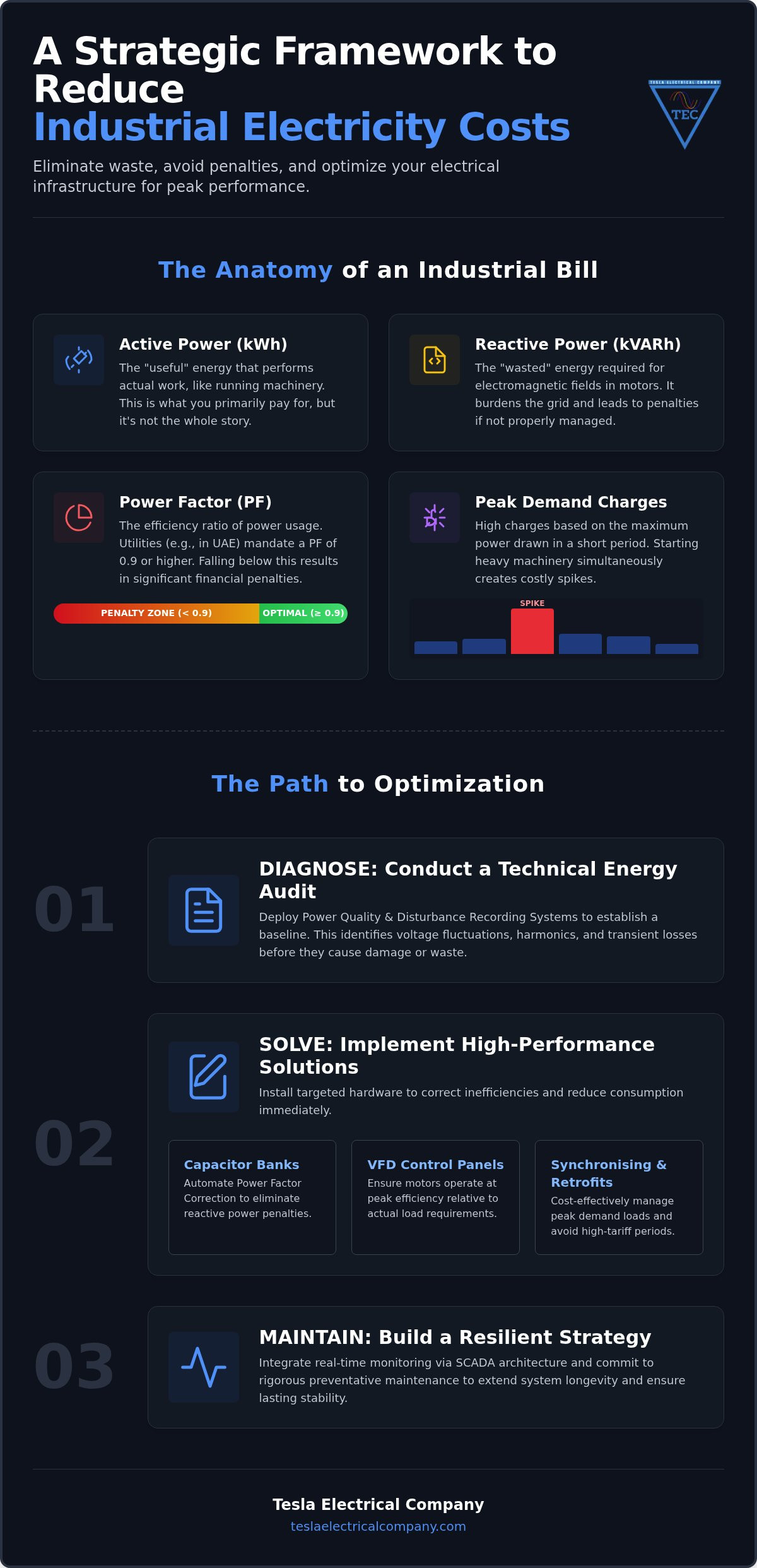
Industrial utility statements are far more complex than residential invoices. They reflect the sophisticated interplay between electrical infrastructure and operational demand. To understand how to reduce factory electricity bill totals, one must first deconstruct the bill into its technical components. Most industrial consumers focus solely on active power, measured in kilowatt-hours (kWh), which represents the energy converted into useful work. However, the national grid also monitors reactive power, measured in kilovolt-ampere reactive hours (kVARh). This is the energy required to maintain electromagnetic fields in motors and transformers. While it doesn’t perform work, it places a significant burden on the utility’s distribution network.
Poor power quality introduces hidden costs that often go unnoticed. Harmonics, which are distortions in the voltage or current waveform, can lead to overheating in conductors and premature failure of sensitive electronics. These disturbances force equipment to work harder, increasing consumption and maintenance requirements. Adhering to fundamental energy efficiency principles requires a systematic approach to identifying these inefficiencies. Key indicators of poor power quality include:
- Excessive heat in transformers and cables
- Nuisance tripping of circuit breakers
- Flickering lights or equipment resets
Addressing these issues ensures that every kilowatt delivered contributes directly to production and system stability.
The High Cost of Low Power Factor
Power Factor (PF) is the efficiency ratio of electrical power usage, representing the difference between the power delivered to the site and the power actually used to run equipment. Utility providers in the UAE typically mandate a Power Factor of 0.9 or higher to maintain grid stability. If your facility operates below this threshold, you’ll face substantial financial penalties. Reactive Power is the “unused” energy that creates no physical output but still incurs measurable costs on your monthly statement. Maintaining a high PF ensures your LV and MV switchboards operate within their designed capacity.
Peak Demand and Time-of-Use Charges
Peak demand represents the highest amount of power your factory draws during a specific interval. Starting heavy machinery simultaneously creates expensive demand spikes that set the “maximum demand” charge for the entire billing cycle. Implementing strategic load shifting or switchgear modernization services can help mitigate these costs. By staggering the activation of high-draw assets, you avoid high-tariff periods and reduce the peak load profile. This methodical approach is a cornerstone of any strategy focused on how to reduce factory electricity bill expenses.
Step-by-Step: Conducting an Industrial Energy Audit
Establishing a technical baseline is the foundational step in understanding how to reduce factory electricity bill costs. Without precise data, any corrective measures are merely speculative and may fail to address the root causes of inefficiency. A professional audit begins with the deployment of a Power Quality and Disturbance Recording System to capture high-resolution data on voltage fluctuations, sags, and swells. This systematic approach reveals exactly where energy is dissipated as heat before it ever reaches your production machinery. By identifying these transient losses, engineers can develop a targeted roadmap for infrastructure optimisation.
Data Collection with SCADA and Monitoring
Real-time oversight is indispensable for modern industrial facilities seeking to maintain high standards of excellence. By implementing SCADA and automation system solutions, facility managers gain immediate visibility into the performance of individual assets across the plant floor. This level of granularity allows for the identification of high-consumption motors or inefficient process loops that deviate from standard operating parameters. Historical data analysis, which aligns with NIST’s tips for reducing energy costs, helps in spotting seasonal trends and transient energy losses that occur during specific shift changes or production cycles. Reliable data ensures that every investment in new hardware is backed by a clear, data-driven business case.
Identifying Infrastructure Inefficiencies
An audit must extend beyond software analytics to the physical state of the electrical distribution network. Legacy LV and MV switchboards often suffer from increased contact resistance in aging circuit breakers, which leads to significant heat loss and reduced system efficiency. We also examine the balance of loads across the three-phase system. Imbalanced phases increase neutral current and cause unnecessary stress on transformers, leading to premature insulation failure. Furthermore, high levels of harmonic distortion, often caused by non-linear loads like older rectifiers, are a critical factor that leads to transformer overheating and wasted energy.
Effective auditing also involves evaluating whether existing protection relays are causing nuisance trips that disrupt production. Retrofitting these components can improve both safety and reliability. If your current monitoring setup lacks the precision to identify these “hidden” costs, our specialists can deploy a Power Quality and Disturbance Recording System to pinpoint your exact savings potential. This methodical evaluation ensures that your facility moves from reactive maintenance to a proactive energy management strategy that delivers long-term stability.
Technical Solutions for Immediate Consumption Reduction
Meaningful progress in how to reduce factory electricity bill totals requires a shift from behavioural changes to robust engineering interventions. While operational discipline is valuable, the most substantial savings are achieved through the installation of specialised hardware designed to optimise electrical throughput. By addressing inefficiencies at the component level, industrial facilities can secure immediate and permanent reductions in energy waste. This methodical approach focuses on correcting the underlying electrical characteristics that lead to utility penalties and excessive consumption.
Capacitor Banks: Eliminating Reactive Power Penalties
The installation of automatic Capacitor Banks is the most effective method for achieving rapid ROI in industrial settings. These units provide local reactive power support, ensuring that the facility maintains an optimal power factor near 1.0. By compensating for the inductive loads inherent in large motors and transformers, capacitor banks reduce the total current drawn from the national grid. This technical correction allows facilities to meet the UAE’s stringent 0.9 power factor requirement without altering production schedules. Integrating these units into existing LV switchboards provides a direct financial benefit by eliminating the reactive power surcharges that frequently inflate industrial utility statements.
Calculating the ROI of Power Factor Correction (PFC) is straightforward when based on avoided utility penalties. In many high-capacity plants, the capital expenditure for a capacitor bank system is recovered within 12 to 18 months through penalty savings alone. Beyond the financial incentives, PFC reduces the thermal stress on cables and switchgear, which improves overall system reliability and prevents nuisance tripping during peak operational periods.
VFDs and Motor Control Optimisation
Motors often represent the largest portion of industrial energy consumption, particularly those driving fans, pumps, and compressors. Implementing a specialised industrial VFD control panel design allows for precise speed regulation, matching motor output to the actual process load. This is critical for centrifugal applications where the affinity laws dictate that a small reduction in motor speed leads to an exponential reduction in energy use. For example, reducing a fan’s speed by 20% can result in nearly 50% energy savings, providing a powerful tool for any facility manager focused on how to reduce factory electricity bill expenses. VFDs also prevent expensive peak demand spikes by providing a controlled, ramped acceleration during motor startup.
To further refine consumption, we recommend the use of soft starters and automated sequencing for non-variable loads. These systems mitigate high inrush currents that strain the electrical infrastructure. Additionally, mitigating harmonics through active or passive filtering improves the efficiency of transformers and motors, preventing the energy dissipation that occurs when non-linear loads distort the power supply. These integrated technical solutions transform the electrical network from a passive cost centre into a high-efficiency asset.
Optimising Power Supply with Synchronisation and Retrofits
Achieving a sustainable reduction in energy expenditure requires more than just efficient end-use equipment. It demands a sophisticated approach to how power is distributed and managed at the source. Many facilities overlook the inherent inefficiencies within their backup and primary supply systems, leading to wasted capacity and unnecessary costs. Understanding how to reduce factory electricity bill totals involves a rigorous evaluation of your power supply architecture, ensuring that every kilowatt generated or drawn from the grid is utilised with maximum precision. A systematic focus on synchronisation and strategic retrofitting provides the technical foundation for this level of oversight.
Efficient Load Management via Synchronisation
Operating a single, large generator at a low load percentage is one of the most common sources of industrial energy waste. By utilising a Generator Synchronising Control Panel, facilities can manage multiple smaller units to match the actual demand of the plant. This modular approach ensures that generators operate within their optimal efficiency range, significantly reducing fuel consumption and maintenance requirements. Automated load sharing and load shedding protocols further protect critical infrastructure during peak periods, preventing expensive system-wide failures. This integrated strategy allows for seamless transitions between mains and backup power, maintaining system resilience without sacrificing efficiency.
Retrofitting vs. Replacement for Efficiency
Full system replacements are often unnecessary when strategic upgrades can deliver comparable efficiency gains. Our switchgear modernisation services focus on retrofitting aging circuit breakers and protection relays to improve conductivity and reduce heat loss. As components age, contact resistance increases, which dissipates energy as heat rather than delivering it to production assets. By updating these critical elements, facilities can incorporate modern energy-monitoring features that provide real-time data on consumption patterns. This technical evolution is a cost-effective method for those determining how to reduce factory electricity bill costs while extending the operational life of existing LV and MV switchboards.
Beyond primary hardware, addressing “vampire” loads in idle industrial automation systems is essential for long-term savings. Even when production lines are stationary, PLC control systems and SCADA networks continue to draw power. Implementing a redundant control system architecture ensures that while safety and monitoring remain active, unnecessary peripheral systems are powered down during non-operational hours. This methodical oversight ensures that your facility maintains high standards of reliability while minimising baseline energy consumption.
If your current infrastructure is struggling with load imbalances or aging components, our engineering team is ready to optimise your industrial power infrastructure through specialised retrofitting and synchronisation solutions.
Building a Long-Term Industrial Energy Strategy
Achieving permanent reductions in utility expenditure requires a transition from isolated technical fixes to a comprehensive, long-term energy strategy. While hardware installations like capacitor banks provide immediate relief, their efficacy depends on consistent oversight and integration into the facility’s broader operational framework. A systematic approach ensures that initial gains are not eroded by equipment degradation or shifting production demands. For those committed to how to reduce factory electricity bill costs permanently, the focus must shift toward data-driven maintenance and professional partnership.
Continuous Improvement through SCADA
Modern efficiency is governed by real-time data. Integrating energy management directly into the core SCADA architecture allows facility managers to move beyond monthly bill analysis to minute-by-minute oversight. Automated alerts can be configured to trigger when the power factor drops below the UAE’s 0.9 threshold or when harmonic spikes are detected. This proactive visibility ensures that technical issues are addressed before they result in utility penalties or equipment failure. The historical data gathered through these systems provides the necessary evidence to justify future infrastructure investments based on measurable ROI metrics, ensuring that every upgrade is a calculated step toward total system optimisation.
The Total Solution Approach
Reliability and efficiency are inseparable. A holistic approach to industrial switchboard design ensures that the distribution network is engineered for low impedance and minimal thermal loss from the outset. Selecting high-performance components, such as specialised VFDs and redundant control systems, is vital for maintaining high standards of excellence. However, hardware alone is insufficient. Long-term success requires a commitment to preventative maintenance and staff development to ensure the infrastructure continues to perform as designed.
- Establish a rigorous maintenance schedule for capacitor banks to verify that individual steps haven’t degraded.
- Monitor VFD cooling systems and filters to prevent heat-related efficiency losses in motor control centres.
- Train internal engineering teams on interpreting power quality analysis reports to identify emerging inefficiencies.
Partnering with a specialised engineering firm provides the total solution oversight necessary to manage complex projects from design to final execution. This relationship allows your facility to leverage deep industry expertise while focusing on core production goals. The path from the initial energy audit to infrastructure modernisation is a continuous cycle of measurement, optimisation, and maintenance. By adopting this methodical roadmap, you secure a stable, high-performance electrical environment that effectively addresses the challenge of how to reduce factory electricity bill expenditure for the long term.
Securing Your Industrial Energy Future
Transitioning from passive utility monitoring to active electrical infrastructure management is the only definitive way to secure long-term operational stability. By addressing Power Factor inefficiencies and peak demand spikes through specialised hardware, you move beyond superficial savings to fundamental system optimisation. We’ve established that understanding how to reduce factory electricity bill costs requires a methodical approach, starting with precise baseline data and concluding with high-performance engineering retrofits.
Tesla Electrical Company provides the seasoned authority and technical hardware necessary to execute these complex strategies. Our team delivers specialised design for Generator Synchronising Control Panels, full-spectrum SCADA and automation expertise, and proven Power Quality and Disturbance Recording solutions. We invite you to Contact Tesla Electrical Company for a Technical Infrastructure Audit to identify your facility’s exact savings potential. Achieving a high-efficiency electrical environment is a rigorous process, but with the right technical partner, it remains an achievable and highly rewarding objective for any industrial enterprise.
Frequently Asked Questions
What is the most effective way to reduce factory electricity bills quickly?
The most immediate method to achieve measurable savings is the installation of automatic Capacitor Banks for Power Factor Correction. This technical intervention addresses the reactive power penalties often imposed by the national grid. By optimising the efficiency ratio of your electrical usage, you don’t need to alter production cycles to see a difference. This approach is highly effective for those determining how to reduce factory electricity bill costs because it targets billing penalties directly.
How does a low power factor affect my industrial electricity bill?
A low power factor indicates that your facility is drawing more current than is strictly necessary to perform useful work. In the UAE, industrial consumers are typically required to maintain a power factor of 0.9 or higher. Falling below this threshold triggers significant financial penalties on your monthly utility statement. It’s a charge that compensates the utility provider for the additional burden placed on the distribution network by your facility’s reactive power demand.
Can VFD control panels really save money on energy?
VFD control panels deliver substantial energy savings by matching motor speed to the actual process requirements rather than running at a constant maximum. This is particularly effective for centrifugal loads like fans and pumps, where a modest reduction in speed results in an exponential decrease in power consumption. Additionally, VFDs mitigate peak demand spikes during motor startup, which reduces the maximum demand charges that often inflate an industrial utility bill.
What is the difference between active and reactive power in industrial billing?
Active power, measured in kilowatt-hours (kWh), is the energy that performs actual work, such as turning a motor. Reactive power, measured in kilovolt-ampere reactive hours (kVARh), is the non-working energy required to maintain magnetic fields in inductive equipment. While reactive power doesn’t contribute to production output, utility providers monitor it closely. High reactive power usage lowers your overall efficiency and leads to the power factor penalties discussed earlier.
Is it better to retrofit old switchgear or replace it entirely for energy efficiency?
Retrofitting is often a more cost-effective alternative to full replacement for improving energy efficiency. By performing a retrofit of circuit breakers and protection relays, you can reduce heat loss caused by aging components and high contact resistance. This process allows for the integration of modern energy-monitoring features into existing LV and MV switchboards. It extends the operational life of your assets while providing the data necessary to refine your long-term energy strategy.
How do capacitor banks help in reducing electricity costs?
Capacitor banks reduce electricity costs by providing local reactive power support, which offloads this demand from the national grid. When installed at the main switchboard, these units ensure the facility’s power factor remains near 1.0. This technical correction eliminates the reactive power penalties that account for a large portion of industrial energy waste. By reducing the total current flow, capacitor banks also lower thermal stress on cables and transformers, improving system longevity.
What role does SCADA play in factory energy management?
SCADA systems provide the real-time visibility required to identify and eliminate energy waste across the plant floor. By integrating energy management into your core SCADA architecture, you can monitor consumption patterns of individual assets and set automated alerts for efficiency drops. This data-driven oversight allows facility managers to implement precise load-shifting strategies. It’s essential for anyone researching how to reduce factory electricity bill totals through permanent infrastructure optimisation.
How can generator synchronisation improve my plant’s energy efficiency?
Generator synchronisation improves efficiency by allowing multiple smaller units to share the load, ensuring each operates within its most efficient fuel-consumption range. Using a Generator Synchronising Control Panel prevents the waste associated with running a single large generator at a low load percentage. This modular approach provides the flexibility to activate only the necessary capacity for the current demand. It also ensures seamless transitions between power sources, maintaining resilience while minimising fuel and energy waste.
Disclaimer
Some content, images, text, or other materials on this website may have been created or assisted by artificial intelligence (AI).
While we review AI-generated content for accuracy and quality, we do not guarantee that all information is free from errors or omissions.
Content generated using AI is provided for informational purposes only and should not be solely relied upon without independent verification.