
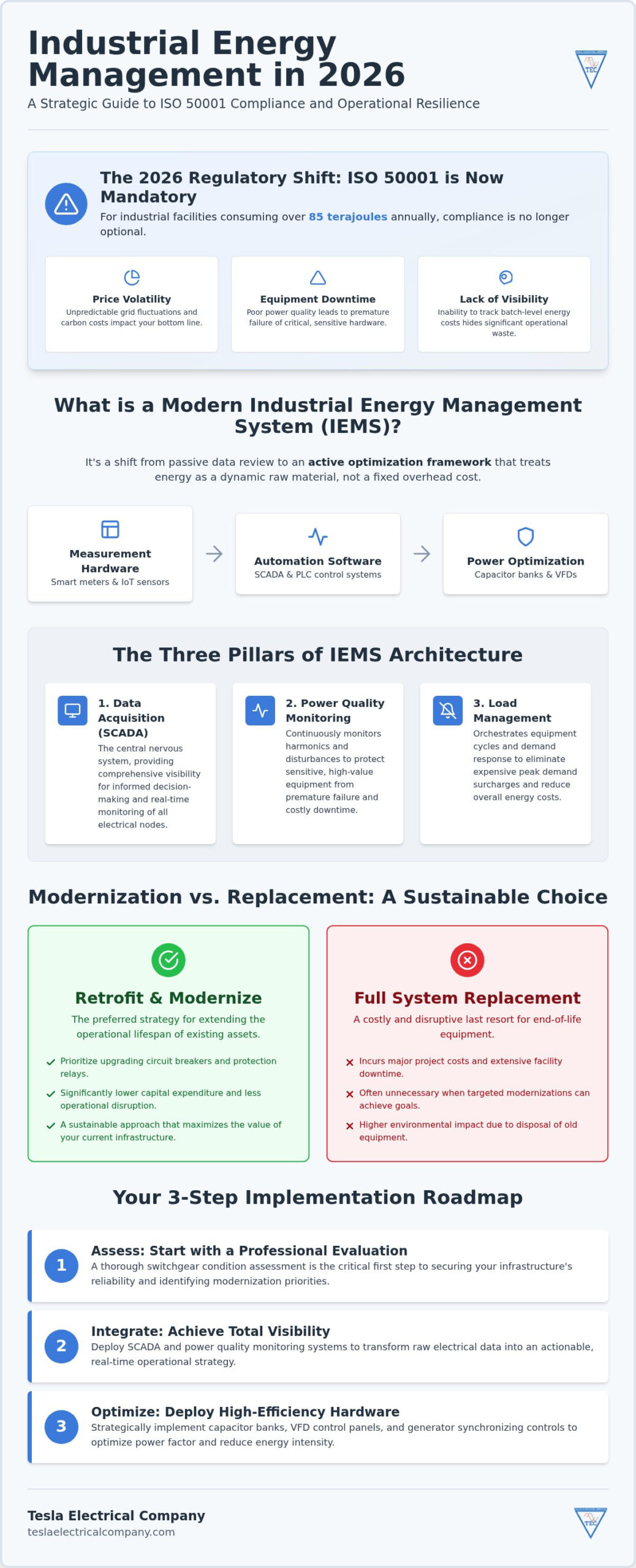
In 2026, any industrial facility consuming more than 85 terajoules annually now faces a mandatory requirement to implement an ISO 50001 compliant energy management system. This is no longer a voluntary sustainability goal; it’s a strict regulatory baseline that determines your operational viability and long-term stability. You’ve likely felt the mounting pressure of energy price volatility and the costly frustration of equipment downtime caused by poor power quality. It’s difficult to optimize your bottom line when you lack granular visibility into batch-level energy costs or when legacy hardware fails to meet modern efficiency standards.
This article demonstrates how integrating advanced industrial energy management systems with strategic hardware retrofits and redundant automation creates a resilient, high-efficiency infrastructure. You’ll learn to navigate the new 2026 NEC Article 130 requirements and utilize Power Control Systems evaluated under UL 3141 to maximize your existing electrical assets. We provide a methodical overview of how power quality monitoring and SCADA integration drive a measurable reduction in energy intensity while extending the lifespan of your critical power distribution equipment.
Key Takeaways
- Understand how modern industrial energy management systems have evolved into active optimization frameworks that unify measurement hardware with automation software.
- Identify hidden operational waste and prevent costly downtime by integrating SCADA systems with comprehensive power quality and disturbance recording.
- Optimize your facility’s power factor and energy intensity through the strategic use of capacitor banks and generator synchronizing control panels.
- Extend the operational lifespan of existing assets by prioritizing the retrofit of circuit breakers and protection relays over full system replacement.
- Follow a structured implementation roadmap that begins with a professional switchgear condition assessment to secure your infrastructure’s reliability.
What is an Industrial Energy Management System (IEMS) in 2026?
In the current industrial climate, energy management has transitioned from a back-office accounting task to a frontline operational necessity. Industrial energy management systems in 2026 are defined by the seamless integration of measurement hardware, automation software, and power optimization equipment. This framework provides the technical rigor required to stabilize a facility’s electrical environment while driving down operational costs. IEMS is a systematic approach to optimizing energy procurement and consumption through technical infrastructure.
The industrial landscape has moved decisively past passive monitoring, where managers simply reviewed historical utility data to identify waste. Modern systems focus on active optimization. This involves utilizing automated controls to respond to grid conditions and internal demand fluctuations in milliseconds. By treating energy as a dynamic raw material rather than a fixed overhead cost, facilities can maintain a superior level of fiscal and operational control. A complete IEMS architecture rests on three specific pillars:
- Data Acquisition (SCADA): This serves as the central nervous system, providing the comprehensive visibility needed for informed decision-making.
- Power Quality: This involves the continuous monitoring of harmonics and disturbances to protect sensitive equipment from premature failure.
- Load Management: This pillar orchestrates equipment cycles and demand response to eliminate expensive peak surcharges.
The Drivers of Industrial Energy Volatility
The integration of decentralized renewable energy sources has created a more volatile grid environment. Frequent fluctuations in supply lead to unpredictable price spikes that can disrupt even the most disciplined production schedules. Simultaneously, rising carbon-related costs are directly impacting manufacturing margins, making high-level efficiency a competitive requirement. Real-time data acquisition is no longer optional; it’s the only reliable method for forecasting operational expenses and maintaining long-term profitability in an uncertain market.
Key Components of a Modern IEMS Architecture
A robust energy strategy requires a methodical layering of technology. We categorize the essential components of a 2026 architecture into three distinct levels:
- Field Level: Smart meters and machine-level IoT sensors that capture granular consumption data at the source.
- Control Level: Centralized PLC and SCADA systems that process field data to execute automated efficiency protocols.
- Hardware Level: Physical efficiency tools, such as VFD Control Panels and Capacitor Banks, which optimize the power factor and reduce thermal stress across the distribution network.
Integrating SCADA and Power Quality Monitoring for Total Visibility
SCADA acts as the central intelligence layer for modern industrial energy management systems. It provides the necessary oversight to transform raw electrical data into actionable operational strategy. By adopting a comprehensive Energy Management System (EMS), facilities can ensure that every kilowatt is accounted for, from the main intake to the individual machine level. High-fidelity data is the cornerstone of accurate energy reporting, especially when meeting the rigorous audit requirements mandated by 2026 regulations.
SCADA: Supervisory Control and Data Acquisition
A well-engineered SCADA platform integrates directly with your existing LV and MV switchboards to facilitate real-time monitoring of every electrical node. This connectivity allows for the immediate identification of inefficiencies that would otherwise remain hidden in monthly utility bills. For those designing these environments, our guide on SCADA and automation system solutions details the specific principles required for industrial-grade reliability. Within this architecture, PLC control systems manage process control PID for energy-heavy machinery, ensuring that motors and thermal loads operate only within their most efficient parameters.
Addressing the ‘Silent’ Energy Wasters: Power Quality
While total consumption is a primary metric, the quality of that power is often where the most significant waste occurs. Voltage dips, swells, and harmonics don’t just damage sensitive electronics; they create parasitic loads that inflate energy intensity. A dedicated Power Quality and Disturbance Recording System captures these transient events with microsecond precision. This level of detail is critical for diagnosing the root cause of efficiency drops, such as a failing motor or a poorly tuned capacitor bank. These disturbances often signal deeper infrastructure issues that, if left unaddressed, lead to catastrophic equipment failure.
To maintain total visibility even during grid instability, we utilize a Redundant System to prevent data loss. If a primary controller fails, the secondary unit takes over without a gap in recording, preserving the audit trail required for compliance. If you’re designing a new facility or upgrading an existing plant, integrating robust SCADA and automation system solutions is the most effective way to secure total visibility and long-term electrical health. This high-precision monitoring ensures that your infrastructure remains stable and your assets reach their full operational lifespan.
Optimizing the Power Path: Hardware’s Critical Role in Energy Efficiency
Software intelligence is only as effective as the hardware that executes its commands. Within the framework of industrial energy management systems, the physical power path determines the ultimate energy intensity of a facility. While software provides the data, hardware level optimization directly modifies how electricity is consumed and distributed across the plant floor. This technical approach aligns with the IEA Energy Efficiency Policy Toolkit, which emphasizes combining management practices with high efficiency technology to reach national sustainability targets.
Maintaining a stable, efficient on-site power source requires a Generator Synchronizing Control Panel to ensure multiple units operate in perfect phase. Without precise synchronization, parallel generation systems suffer from circulating currents and load imbalances that lead to fuel waste and increased mechanical stress. This hardware layer is essential for facilities operating microgrids or those requiring seamless transition between grid and backup power.
Capacitor Banks and Power Factor Correction
Reactive power is a silent drain on industrial budgets and system capacity. By installing industrial capacitor banks, facilities can correct their power factor at the source. This ensures that the current drawn from the grid is utilized for productive work rather than being lost to magnetic field maintenance in inductive loads. A corrected power factor doesn’t just eliminate utility penalties; it also reduces the thermal load on cables and transformers, which allows for additional equipment capacity without requiring a full switchgear replacement. We design these banks specifically for high harmonic industrial environments to prevent resonance issues that can compromise system stability.
Variable Frequency Drives (VFDs) for Load Optimization
Motor driven systems account for approximately 60% of total industrial energy consumption. Traditional fixed speed motors are inherently wasteful because they run at full capacity regardless of the actual process demand. Integrating a VFD Control Panel allows for precise speed modulation, matching motor output to real time requirements. Referencing our industrial vfd control panel design guide helps engineers select the correct drive topology for their specific torque and load profiles. Beyond immediate energy savings, VFDs provide controlled acceleration, which reduces mechanical wear and significantly extends the operational life of your electrical assets.
Traditional hardware configurations rely on worst case scenario sizing, leading to oversized equipment that operates at poor efficiency. Optimized configurations utilize modular capacitor banks and VFD driven loads to ensure every component operates within its peak efficiency curve. This shift from static to dynamic hardware response is what separates a modern 2026 facility from a legacy operation.
Modernization vs. Replacement: The Sustainability of Retrofitting
Retrofitting has emerged as a core component of 2026 industrial energy management systems. It represents a strategic decision to embed modern intelligence into proven, heavy-duty frames that still possess decades of structural integrity. This approach allows facilities to comply with evolving efficiency standards without the prohibitive costs and operational downtime associated with total infrastructure replacement. By focusing on the modernization of existing assets, companies can achieve high-level performance while significantly reducing their environmental footprint.
The financial logic for this strategy is undeniable. Retrofitting circuit breakers can reduce capital expenditure by up to 40% while achieving modern efficiency standards. Beyond the immediate CAPEX savings, upgrading protection relays and circuit breakers improves overall system reliability. Modernized components offer faster clearing times and more accurate sensing, which directly mitigates the risk of catastrophic failures and protects your facility’s long-term electrical health.
Circuit Breaker Retrofit and Life Extension
The technical process of an ABB circuit breaker retrofit involves replacing aging trip units and mechanisms with modern equivalents while retaining the original switchgear housing. This ensures seamless compatibility between legacy frames and modern vacuum interrupters, which provide superior arc quenching and lower maintenance requirements. Many engineers find that breaker life extension services are superior to full replacement because they target the specific points of failure while maintaining the existing footprint of the MV and LV switchboards. This methodical preservation of infrastructure is essential for meeting aggressive energy goals without disrupting established production lines.
Upgrading Protection Relays for Intelligent Load Shedding
Protection relays are no longer just safety devices; they’re critical nodes in a data-driven energy strategy. Modern relays enable granular control over non-critical loads, allowing for automated load shedding during peak pricing intervals. This intelligence is particularly vital during generator synchronization, where maintaining grid stability requires precise coordination of all electrical assets. By integrating these new relays into existing SCADA frameworks, you create a unified environment that manages both safety and efficiency from a single interface. This level of oversight ensures that your facility responds dynamically to grid conditions while protecting the lifespan of your critical distribution equipment.
If you’re ready to modernize your existing infrastructure, explore our breaker life extension services to see how we can optimize your current assets for the 2026 energy landscape.
Implementing a Resilient Energy Management Framework
Transitioning to sophisticated industrial energy management systems requires a methodical progression rather than a fragmented software deployment. The most common point of failure in energy initiatives is the attempt to layer high-level analytics over unstable legacy hardware. A successful implementation roadmap begins with a switchgear condition assessment to establish a baseline of infrastructure health. This technical evaluation ensures that your LV and MV switchboards can handle the high-speed data acquisition and automated switching required for active optimization.
Operational continuity is secured through the deployment of a Redundant System. These configurations ensure that if a primary controller or communication node fails, the energy management protocols remain active without interruption. Without this redundancy, a minor hardware fault can lead to data gaps that invalidate energy audits or cause critical power imbalances. Tesla Electrical Company acts as the technical partner for these end-to-end optimizations, providing the engineering rigor needed to bridge the gap between physical distribution and digital oversight.
The Role of Generator Synchronization in Energy Strategy
Managing peak demand requires more than just load shedding; it involves the efficient orchestration of on-site power generation. A Generator Synchronizing Control Panel allows for precise load sharing between multiple units, enabling a facility to “peak shave” during high-tariff periods. This synchronization ensures seamless transitions between the utility grid and backup power, preventing the production dips and equipment resets that often follow power quality events. Safely synchronizing multiple power sources requires advanced PLC control systems and high-precision protection relays to manage phase angles and voltage levels in real time.
Next Steps for National Industrial Facilities
For facilities looking to secure their energy future, the progression should follow a structured three-tier approach:
- Phase 1: Power Quality Audit. Conduct a comprehensive assessment of harmonics and transients to identify immediate energy waste and equipment risks.
- Phase 2: Targeted Retrofits. Prioritize the modernization of aging circuit breakers and protection relays to improve monitoring and control capabilities without full replacement costs.
- Phase 3: SCADA Integration. Develop a long-term roadmap for integrating all electrical assets into a unified SCADA and automation framework for total visibility.
This methodical approach guarantees that your investment in industrial energy management systems delivers measurable reductions in energy intensity while protecting the integrity of your electrical infrastructure. By aligning your hardware capabilities with modern software intelligence, you create a facility that’s both efficient and exceptionally resilient.
Securing Your Industrial Energy Future
Transitioning to a high-efficiency facility in 2026 requires a methodical approach that unifies software intelligence with robust electrical hardware. We’ve explored how the integration of SCADA and power quality monitoring provides the necessary visibility to eliminate hidden waste and ensure regulatory compliance. By prioritizing strategic retrofits and optimizing your power path through advanced capacitor banks and VFDs, you can significantly extend the lifespan of your critical assets while reducing energy intensity. The successful implementation of industrial energy management systems is the only reliable way to maintain stability in an increasingly volatile energy market.
Tesla Electrical Company offers the technical rigor and decades of engineering expertise required to execute these complex infrastructure optimizations. As specialists in LV/MV switchgear and generator synchronizing panels, we provide end-to-end solutions that include a dedicated inventory of spare parts to ensure system longevity. Partner with Tesla Electrical Company for Comprehensive Industrial Energy Solutions and secure a resilient, high-performance electrical environment. Taking these steps today ensures your operations remain compliant and cost-effective for the long term.
Frequently Asked Questions
What are the primary benefits of an industrial energy management system?
The primary benefits include enhanced operational visibility, strict regulatory compliance with national efficiency standards, and improved cost predictability. By implementing industrial energy management systems, facilities gain the ability to monitor consumption at a granular level, allowing for the identification of specific inefficiencies. This systematic approach reduces carbon footprints and protects sensitive equipment from power quality issues, ultimately securing long-term profitability and infrastructure stability.
How much can an IEMS realistically reduce industrial energy costs?
Realistic cost reductions depend on the facility’s baseline efficiency and the level of automation integrated into the system. Savings are primarily achieved through the elimination of reactive power penalties, reduced peak demand surcharges, and optimized motor performance. By utilizing real-time data to orchestrate equipment cycles, businesses can avoid expensive energy spikes. These systems ensure that energy is treated as a controllable production cost rather than a fixed overhead expense.
Is it better to replace old switchgear or invest in retrofitting for energy efficiency?
Retrofitting is often the superior choice for facilities looking to improve efficiency without the capital expenditure of total replacement. Upgrading existing MV and LV switchboards with modern circuit breakers and protection relays provides current-generation monitoring capabilities while preserving proven structural components. This strategy reduces downtime and minimizes environmental impact. It allows for the seamless integration of digital oversight into legacy frames, extending the operational lifespan of your critical electrical assets.
How do VFD control panels contribute to energy management?
VFD control panels contribute to energy management by matching motor speed to actual process demand, eliminating the waste associated with fixed-speed operation. Since motor-driven systems represent a significant portion of industrial energy consumption, precise speed modulation is a high-impact efficiency strategy. These panels also reduce mechanical stress through controlled acceleration and deceleration. This technical oversight lowers energy intensity while protecting the motors from premature wear and thermal damage.
What is the role of power factor correction in reducing electricity bills?
Power factor correction, achieved through the installation of capacitor banks, eliminates the reactive power charges often levied by utility providers. It improves the overall capacity of your electrical system by ensuring that the current drawn is used for productive work. This reduces the thermal load on transformers and cabling, which prevents energy loss through heat. Maintaining a high power factor is essential for maximizing the efficiency of your facility’s power distribution network.
Can a SCADA system be integrated with legacy electrical panels?
SCADA and automation systems can be integrated with legacy electrical panels through the installation of modern protection relays and machine-level sensors. This integration provides the digital oversight required for industrial energy management systems without requiring a complete infrastructure overhaul. By adding communication-capable components to existing switchgear, facilities can capture real-time data and execute automated control protocols. This methodical modernization ensures that older assets can participate in a data-driven energy strategy.
What happens if an industrial facility ignores power quality disturbances?
Ignoring power quality disturbances leads to frequent equipment downtime, increased energy waste, and the premature failure of sensitive electronics. Voltage dips, swells, and harmonics create parasitic loads that inflate electricity bills without contributing to production. Over time, these disturbances degrade the insulation of motors and transformers. Utilizing a Power Quality and Disturbance Recording System is the only reliable way to identify these silent wasters and protect your facility’s long-term operational integrity.
How does generator synchronization impact energy management during peak hours?
Generator synchronization allows for efficient load sharing between multiple power sources, which is critical for managing peak demand during high-tariff periods. By utilizing a Generator Synchronizing Control Panel, a facility can seamlessly transition between the grid and on-site generation without interrupting production. This capability enables peak shaving strategies that significantly lower utility costs. It also ensures grid stability during critical power events, providing a resilient foundation for your overall energy management framework.
Disclaimer
Some content, images, text, or other materials on this website may have been created or assisted by artificial intelligence (AI).
While we review AI-generated content for accuracy and quality, we do not guarantee that all information is free from errors or omissions.
Content generated using AI is provided for informational purposes only and should not be solely relied upon without independent verification.