
Your facility’s electrical infrastructure is only as resilient as its weakest link, and more often than not, that link is an improperly engineered distribution assembly. You recognize that unplanned downtime remains the most significant threat to operational profitability in the UAE industrial sector. Whether you are dealing with the complexity of integrating legacy low voltage distribution boards with modern SCADA systems or struggling to meet the latest national utility standards, the pressure to maintain a continuous power supply is immense. Systems that lack the necessary rigor in their design don’t just risk equipment failure; they jeopardize the safety and stability of your entire operation.
This comprehensive guide ensures you can master the technical complexities of power distribution, from hierarchical architecture to lifecycle modernization. We provide a methodical breakdown of IEC 61439-1:2020 compliance, the shift toward “limited energy” terminology in the 2026 NEC, and the strategic implementation of redundant systems. You’ll gain the engineering insights required to transform your power distribution from a potential point of failure into a robust, intelligent asset that supports your long-term infrastructure goals and meets the highest standards of excellence.
Key Takeaways
- Understand the hierarchical structure of industrial power distribution, distinguishing between Main Distribution Boards (MDB) and Sub-Main Distribution Boards (SMDB) to optimize load management.
- Identify critical engineering specifications for low voltage distribution boards, including busbar conductivity and enclosure IP ratings, to ensure resilience in harsh industrial environments.
- Learn how to transition from legacy hardware to intelligent, SCADA-integrated hubs using modern communication protocols like Modbus and Ethernet/IP.
- Evaluate the economic advantages of retrofitting aging circuit breakers with modern equivalents to extend system longevity without the capital expenditure of full replacement.
- Align your infrastructure with the latest 2026 international standards and UAE utility requirements to mitigate the risk of unplanned downtime.
Fundamentals of Low Voltage Distribution Boards in Industrial Infrastructure
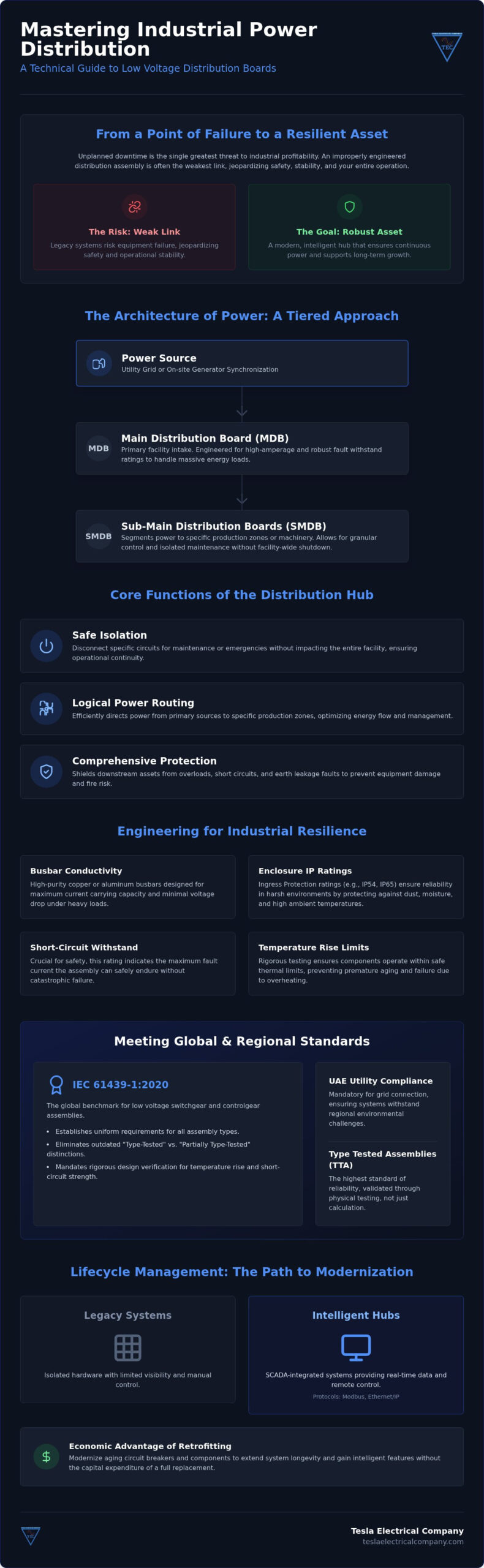
Industrial power systems rely on low voltage distribution boards as the primary nervous system for energy management. These assemblies serve as the central nodes for routing electrical power up to 1000V AC, acting as the critical interface between primary power sources and downstream machinery. Unlike commercial panels, industrial units manage significantly higher fault levels due to the proximity of high-capacity transformers and heavy inductive loads found in manufacturing environments. If you’re seeking a foundational definition, What is a Distribution Board? explains how these systems divide an electrical power feed into subsidiary circuits while providing a protective fuse or circuit breaker for each. In a heavy infrastructure context, this functionality is amplified to handle the rigorous demands of continuous industrial cycles.
Key Functions of the Distribution Hub
The role of a distribution hub extends far beyond simple circuit housing. It provides a methodical framework for managing electrical energy through three primary functions:
- Safe Isolation: You can disconnect specific circuits for maintenance or emergency shutdown without compromising the entire facility’s power supply. This is vital for operational continuity.
- Logical Power Routing: The system ensures power flows efficiently from primary sources, such as utility grids or generator synchronizing control panels, to specific production zones.
- Comprehensive Protection: These boards shield your downstream assets from overloads, short circuits, and earth leakage faults. This prevents catastrophic equipment damage and reduces the risk of fire.
Safety Standards and Compliance in 2026
Compliance in the current 2026 landscape requires strict adherence to international and local frameworks. The IEC 61439-1:2020 standard remains the global benchmark, establishing uniform requirements for all assemblies. This standard has eliminated the old distinctions between Type-Tested and Partially Type-Tested Assemblies, requiring rigorous verification of temperature rise limits and short-circuit withstand strength for every design.
For operations within the UAE, meeting national utility technical specifications is mandatory for any industrial grid connection. These regulations ensure that low voltage distribution boards can withstand the region’s specific environmental challenges, such as high ambient temperatures, while maintaining the fault level ratings necessary for heavy industry. Utilizing Type Tested Assemblies (TTA) provides the highest level of industrial reliability, ensuring that the switchboard’s design has been validated through physical testing rather than just theoretical calculation. This commitment to proven engineering is what separates a standard enclosure from a high-performance industrial asset. For facilities requiring tailored solutions, custom electrical switchboards bridge the gap between heavy power distribution and intelligent automation while maintaining full compliance with evolving international safety standards.
The Architecture of Power: Hierarchical Distribution Board Types
Industrial electrical systems require a tiered approach to ensure both safety and operational flexibility. At the foundation of this hierarchy are low voltage distribution boards designed to manage varying levels of current and fault intensity. This structured arrangement allows for granular control over a facility’s power flow, ensuring that a fault in one localized production line doesn’t paralyze the entire plant. By segmenting the distribution, engineers can isolate specific zones for maintenance while the rest of the infrastructure remains energized.
Main Distribution Boards (MDB) for Industrial Intake
The Main Distribution Board serves as the primary intake point where utility power or onsite generation enters the facility. Engineering these units requires a focus on high-amperage intake and robust busbar fault withstand ratings to handle the massive energy loads typical of UAE industrial sites. In critical infrastructure, MDBs often integrate with generator synchronizing control panels to manage the seamless transition between grid power and backup sources. The selection of Air Circuit Breakers (ACBs) is paramount at this level, as they provide the heavy-duty protection and high breaking capacity necessary for the system’s primary feeder.
Sub-Distribution and Load Management
Sub-Main Distribution Boards (SMDB) act as the intermediary layer, bridging the distance between the central plant room and specific production zones. These units are engineered for localized load control and increasingly incorporate advanced energy monitoring hardware to track consumption in real time. While MDBs utilize ACBs, SMDBs typically rely on Molded Case Circuit Breakers (MCCBs) for efficient sub-main protection. This layer is where you optimize cable management and busway systems to ensure plant-wide distribution remains efficient and accessible. Designing these systems with a custom redundant system architecture can further protect mission-critical loads from unforeseen interruptions.
The hierarchy concludes with Final Distribution Boards, which manage direct circuits for motors, lighting, and auxiliary equipment. For sensitive industrial applications, dual-feed configurations are often employed at this final stage to provide a secondary power path. This methodical design philosophy ensures that every component, from the largest breaker to the smallest terminal, is part of a cohesive and resilient energy network. This level of architectural precision is what transforms standard electrical equipment into a high-performance industrial asset capable of supporting continuous, 24-hour operations across the national infrastructure.
Core Components and Engineering Specifications for Reliability
The internal engineering of low voltage distribution boards determines their long term stability and fault resilience. Selecting the right materials and components isn’t merely a matter of cost; it’s a critical decision that affects the thermal performance and safety of the entire facility. In heavy industrial applications, the busbar system serves as the primary conductor. While aluminum offers weight advantages, high purity copper remains the industry standard for UAE infrastructure due to its superior conductivity and lower thermal expansion. These busbars must be sized to handle continuous full-load currents while maintaining enough mechanical strength to withstand the electromagnetic forces generated during a short circuit event.
Reliability also depends on the enclosure’s ability to protect sensitive internals from external stressors. Determining the correct Ingress Protection (IP) and Impact Protection (IK) ratings is essential for harsh environments where dust and humidity are prevalent. For power quality management, integrating capacitor banks directly into the distribution assembly allows for real-time power factor correction. This reduces energy waste and prevents utility penalties, which is vital for maintaining lean operational costs in large scale manufacturing plants.
Switchgear and Circuit Protection Selection
Modern protection has evolved from basic thermal-magnetic breakers to sophisticated electronic trip units. These units allow for precise fault coordination, ensuring that only the breaker closest to a fault trips, thereby preventing unnecessary plant-wide blackouts. In high-disturbance industrial zones, the inclusion of surge protection devices (SPD) is mandatory to shield PLC control systems from transient overvoltages. Every component selection must be backed by rigorous fault level calculations to ensure the breaking capacity exceeds the potential short-circuit current of the installation.
Thermal Management and Environmental Resilience
Heat is the primary enemy of electrical longevity, especially when ambient temperatures in the UAE can exceed 50°C. Engineers must calculate heat dissipation requirements based on the total power loss of all internal components. While passive ventilation may suffice for some sub-panels, active cooling solutions, such as filtered fan systems or heat exchangers, are often required for high-density low voltage distribution boards. Material selection also plays a role in longevity; using thermoset plastics and corrosion-resistant coatings ensures the assembly remains operational in chemically aggressive or coastal industrial zones. This methodical approach to environmental resilience prevents the premature aging of insulation and contact surfaces.
Integrating Automation and SCADA with LV Distribution
The digital transformation of industrial infrastructure has shifted the role of low voltage distribution boards from passive enclosures to intelligent, communicative hubs. Modern assemblies no longer simply house breakers; they function as critical data nodes that provide granular visibility into your facility’s electrical health. This transition enables you to move beyond reactive maintenance toward a model of predictive oversight. By integrating real-time data acquisition, you can monitor energy consumption, Total Harmonic Distortion (THD), and the precise operational status of every circuit breaker within the network.
The backbone of this intelligence lies in the adoption of robust communication protocols. Utilizing Modbus TCP, Profibus, or Ethernet/IP allows your distribution hardware to speak the same language as your supervisory systems. This connectivity is essential for executing complex remote control capabilities, such as automated load shedding or sequence-of-event recording. In the event of a fault, having a networked system means you can pinpoint the exact failure point from a central control room, significantly reducing the duration of unplanned downtime across your UAE operations.
Designing for SCADA Connectivity
Successful integration requires a methodical approach to hardware selection. You must specify power meters and smart trip units that are natively compatible with your SCADA and automation system solutions. This architecture ensures that every data point, from current peaks to voltage sags, is accurately captured and logged. As these systems become increasingly networked, cybersecurity becomes a critical engineering requirement. Implementing hardware firewalls and secure gateways within the distribution board protects your infrastructure from unauthorized access while maintaining high-speed digital communication.
VFD Integration and Motor Control
Coordinating low voltage distribution boards with industrial VFD control panels requires specialized engineering to manage the unique electrical signatures of high-frequency drives. These drives introduce non-linear loads that can cause harmonic interference, potentially damaging sensitive electronics. We implement harmonic mitigation strategies, such as active filters and specialized busbar shielding, to maintain power quality. Furthermore, the heat generated by power electronics necessitates rigorous thermal planning. Our team specializes in designing integrated SCADA & Automation Systems that harmonize distribution and motor control into a single, resilient infrastructure solution.
Lifecycle Management: Modernization and Retrofitting of LV Systems
Aging electrical infrastructure presents a significant operational risk that requires a methodical management strategy. For industrial facilities across the UAE, the decision between full system replacement and strategic retrofitting often determines the long term viability of the plant. Maintaining low voltage distribution boards for over two decades is entirely achievable through a structured modernization program. Retrofitting focuses on upgrading the internal active components while retaining the existing structural enclosure and busbar system. This approach significantly reduces capital expenditure and minimizes the disruption associated with a complete overhaul of the electrical room.
Upgrading aging Air Circuit Breakers (ACBs) with modern equivalents is a cornerstone of this process. Modern breakers offer enhanced breaking capacities and integrated digital trip units that provide superior fault coordination. Similarly, transitioning from legacy electromechanical or early electronic relays to modern digital protection relays allows for advanced logic and seamless integration into SCADA networks. These upgrades don’t just restore safety; they enhance the intelligence of the entire distribution network, providing a level of oversight that was previously unattainable with older hardware. When non-standard components or legacy integration challenges demand a more tailored solution, specifying custom electrical switchboards engineered for industrial resilience ensures that retrofitting efforts align with both current fault level requirements and future automation goals.
The Retrofit Process: A Systematic Approach
The execution of a successful modernization project begins with a comprehensive site audit and health check of the existing industrial switchgear. We evaluate the mechanical integrity of the busbars and the condition of the insulation before proposing a solution. Custom engineering is often required to design cradle adaptors that allow new breakers to fit perfectly into legacy compartments without extensive busbar modifications. Once installed, the retrofitted protection systems undergo rigorous testing and commissioning to verify that the timing and trip curves align with the facility’s current fault level requirements.
Spare Parts Strategy and Preventive Maintenance
Ensuring the longevity of your infrastructure requires a proactive stance on maintenance and inventory management. You must maintain a critical inventory of spare parts, including contact kits and charging motors, to minimize industrial downtime during a component failure. Our preventive protocols utilize thermal imaging and ultrasonic testing to detect early signs of overheating or partial discharge before they escalate into faults. Periodic protection relay testing and calibration, conducted every two to three years, ensure that the system remains responsive to transient disturbances. This disciplined approach to lifecycle management transforms aging low voltage distribution boards into reliable, high-performance nodes within your industrial network.
Securing the Future of Your Industrial Power Network
The reliability of your facility depends on a methodical approach to electrical architecture. You’ve seen how a structured hierarchy and precise component selection form the foundation of a resilient system. Transitioning from legacy hardware to intelligent, SCADA-integrated hubs transforms your energy infrastructure into a strategic asset capable of real-time optimization. The strategic modernization of existing low voltage distribution boards through circuit breaker retrofitting offers a high-performance alternative to full system replacement. This approach extends the lifecycle of your critical assets while maintaining strict compliance with national UAE utility standards.
As infrastructure requirements evolve, having a steady hand to manage these technical complexities is paramount. We invite you to Partner with Tesla Electrical Company for Your Industrial Power Infrastructure to leverage our expert engineering of LV and MV switchboards. Our team provides specialized retrofit services for breaker life extension and end-to-end SCADA and automation integration. It’s time to ensure your operations remain robust, efficient, and ready for the demands of 2026 and beyond.
Frequently Asked Questions
What is the difference between an LV distribution board and a switchboard?
Switchboards are primary intake assemblies for high-current loads, while low voltage distribution boards serve as secondary units for final circuit management. Switchboards typically house larger Air Circuit Breakers (ACBs) for main feeders. In contrast, distribution boards utilize Molded Case Circuit Breakers (MCCBs) and Miniature Circuit Breakers (MCBs) to route power to specific machinery and lighting. The distinction lies in the amperage capacity and the hierarchical position within the facility’s electrical network.
How do I determine the required fault level rating for my industrial LVDB?
Determining the required fault level rating involves conducting a short-circuit study that accounts for the transformer’s kVA rating and the impedance of the supply cables. In many UAE industrial zones, low voltage distribution boards must be engineered to withstand fault levels between 50kA and 65kA for one second. This ensures the busbars and breakers don’t sustain mechanical or thermal damage during a catastrophic short-circuit event upstream of your equipment.
Is it possible to integrate a legacy distribution board into a new SCADA system?
You can integrate legacy hardware into a modern SCADA system by retrofitting digital power meters and communicative trip units. These components act as a bridge, converting analog signals into digital protocols like Modbus TCP or Ethernet/IP. This upgrade allows your existing distribution boards to provide real-time data on energy consumption and breaker status. It’s a cost-effective way to achieve smart monitoring without the capital expense of a total system replacement.
What are the benefits of using electronic trip units over thermal-magnetic ones?
Electronic trip units provide significantly greater precision and flexibility compared to traditional thermal-magnetic versions. They offer adjustable settings for long-time, short-time, and instantaneous protection, allowing for superior fault coordination in complex industrial environments. Additionally, electronic units can store event logs and communicate directly with supervisory systems. This digital visibility helps you identify the root cause of a trip quickly, whereas thermal-magnetic units offer no data regarding the fault’s nature.
How often should industrial low voltage distribution boards undergo maintenance?
Industrial assemblies should undergo a comprehensive preventive maintenance check at least once every twelve months. This protocol includes thermal imaging to detect hotspots and ultrasonic testing for partial discharge. Every two to three years, you should schedule more intensive service, such as protection relay calibration and mechanical testing of the circuit breakers. Regular maintenance is the only way to ensure the 20-plus year longevity required for heavy infrastructure assets.
What is the role of a capacitor bank within an LV distribution system?
A capacitor bank functions as a reactive power source within the distribution system to improve the power factor. By compensating for inductive loads from motors and transformers, it reduces the total current drawn from the grid. This optimization increases the available capacity of your distribution assemblies and prevents costly utility penalties. It’s a critical component for maintaining high electrical efficiency and reducing thermal stress on your conductors and switchgear.
Can circuit breaker retrofitting be performed without a total plant shutdown?
You can perform circuit breaker retrofitting with minimal disruption by utilizing a phased outage strategy. This involves upgrading individual feeders while the rest of the switchboard remains operational, or using temporary bypass systems to maintain critical loads. Modern cradle adaptors allow for the rapid replacement of aging breakers, often reducing the necessary downtime to just a few hours. This systematic approach ensures your facility stays productive while the infrastructure is modernized.
How do high UAE ambient temperatures affect the design of LV distribution boards?
High ambient temperatures in the UAE, which often exceed 50°C, require the intentional de-rating of electrical components to prevent overheating. Engineers must specify larger busbar cross-sections and implement active cooling solutions, such as filtered fan systems, to maintain safe internal temperatures. Enclosures must also be designed with sufficient surface area for heat dissipation. Ignoring these environmental factors can lead to premature insulation failure and frequent nuisance tripping of your protection devices.
Disclaimer
Some content, images, text, or other materials on this website may have been created or assisted by artificial intelligence (AI).
While we review AI-generated content for accuracy and quality, we do not guarantee that all information is free from errors or omissions.
Content generated using AI is provided for informational purposes only and should not be solely relied upon without independent verification.
One Response