
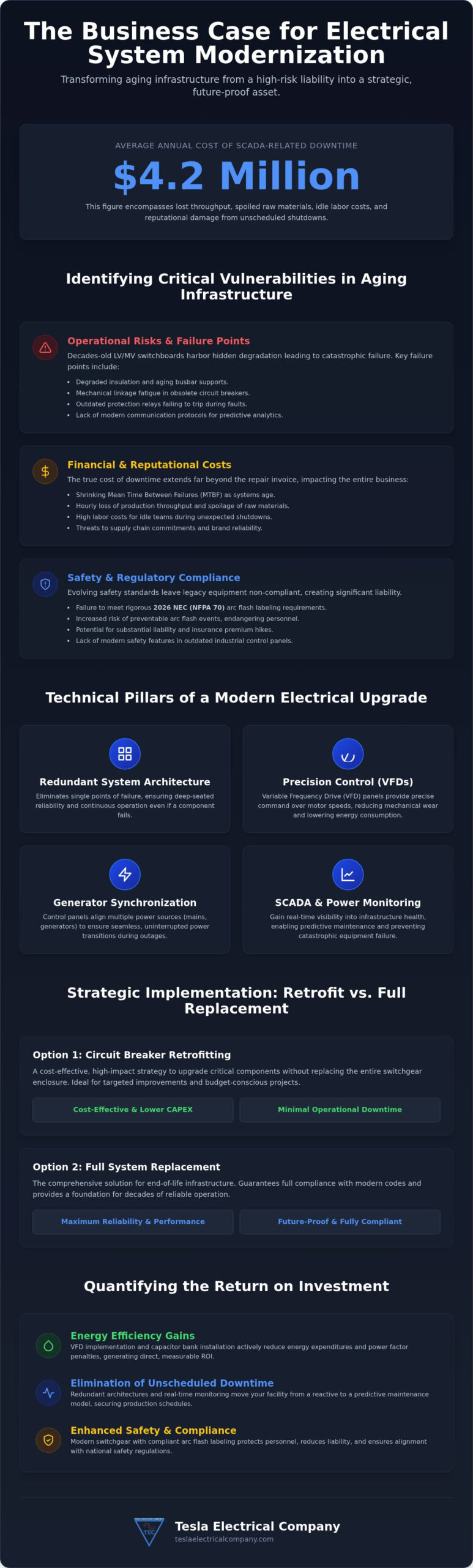
The average annual cost of SCADA-related downtime has reached $4.2 million, yet many industrial facilities continue to rely on legacy infrastructure that was never designed for the demands of 2026. You likely recognize that patching obsolete circuit breakers and managing fluctuating power quality is no longer a sustainable strategy for long-term operational stability. Developing a robust business case for electrical system upgrade projects is the only way to bridge the gap between aging hardware and the digital precision required by modern automation. It’s about transforming a perceived maintenance expense into a strategic asset that secures your facility’s future.
We understand that securing CAPEX approval requires more than just technical justification; it demands a clear demonstration of financial rigor and risk mitigation. This article provides a comprehensive framework to quantify your return on investment, address the 2026 NEC arc flash labeling requirements, and integrate advanced SCADA platforms. We’ll examine how to leverage redundant system architectures and retrofit services to eliminate the threat of unscheduled downtime while optimizing your energy expenditures through precise power quality monitoring and disturbance recording.
Key Takeaways
- Identify the hidden operational risks and failure points within legacy LV and MV switchboards that contribute to costly, unscheduled downtime.
- Develop a robust business case for electrical system upgrade by quantifying energy efficiency gains from VFD implementation and capacitor bank installation.
- Evaluate the financial and technical advantages of circuit breaker retrofitting as a cost-effective alternative to full enclosure replacement.
- Strengthen facility resilience through redundant control system architectures and synchronized generator panels that ensure seamless power transitions.
- Leverage modern SCADA integration and power quality recording to gain real-time visibility into infrastructure health and prevent catastrophic equipment failure.
Assessing the Operational Risks of Aging Electrical Infrastructure
Relying on decades-old infrastructure creates a precarious foundation for modern production. While the process of electrification has historically focused on expanding capacity, current industrial priorities must shift toward reliability and precision. Legacy LV and MV switchboards often harbor hidden degradation that doesn’t appear on a standard maintenance checklist. Components such as insulation, busbar supports, and mechanical linkages in circuit breakers face cumulative stress that eventually leads to catastrophic failure. These components are the primary failure points that turn a routine operation into an emergency shutdown.
Building a robust business case for electrical system upgrade projects starts with identifying these vulnerabilities before they manifest as smoke and fire. Aging protection relays are particularly problematic; if they fail to trip during a fault, the resulting damage to downstream motors and transformers can be irreversible. These outdated systems also lack the high-speed communication protocols needed for modern SCADA and automation. Without digital connectivity, your facility remains locked in a reactive maintenance cycle, unable to adopt the predictive analytics that define industry leaders in 2026.
The True Cost of Unscheduled Downtime
In heavy industry, the financial impact of an electrical failure extends far beyond the repair invoice. You must account for the hourly loss of throughput, spoiled raw materials, and the labor costs of idle teams. Mean Time Between Failures (MTBF) serves as a critical metric here, representing the predicted elapsed time between inherent failures of a mechanical or electrical system during normal operation. As systems age, this window shrinks, directly threatening supply chain commitments and your brand’s reputation for reliability. With SCADA-related downtime costs averaging $4.2 million annually across the sector, the price of inaction is often higher than the cost of modernization.
Safety and Regulatory Compliance Hazards
Safety standards have evolved significantly, leaving legacy equipment in a state of non-compliance. The 2026 NEC (NFPA 70) updates now demand more rigorous arc flash labeling and detailed hazard assessments for all industrial control panels and switchgear. Operating obsolete assets without these protections increases your liability and can lead to substantial insurance premium hikes. Modernizing your switchgear ensures alignment with national safety regulations, protecting your personnel and your capital investment from the legal and physical consequences of a preventable arc flash event.
Technical Pillars of a Modern Industrial Electrical Upgrade
Constructing a robust business case for electrical system upgrade projects requires a shift from passive distribution to active, intelligent power management. Modern industrial environments demand more than just basic connectivity; they require a digital foundation capable of supporting high-stakes automation. This modernization is anchored in four technical pillars: synchronization, redundancy, precision control, and advanced protection. By integrating these elements, facilities transition from aging, reactive hardware to a proactive infrastructure designed for the rigorous standards of 2026.
The heart of this transformation lies in the deployment of sophisticated LV and MV switchboards that provide the structural integrity and busbar capacity necessary for heavy industrial loads. When these are paired with a VFD control panel, operators gain precise command over motor speeds and process variables. This level of control reduces mechanical wear and significantly lowers energy consumption. To ensure these systems never falter, a redundant system architecture is employed to eliminate single points of failure, providing the deep-seated reliability that seasoned industry leaders expect.
Generator Synchronization and Load Sharing
Generator synchronizing control panels are essential for facilities where even a momentary power loss results in significant production deficits. These panels manage the complex task of aligning the voltage, frequency, and phase angle of multiple power sources to ensure a seamless transition during a mains failure. By mastering generator load sharing systems for reliability, your facility can automatically distribute demand across several generator sets. This automation prevents engine overloads and optimizes fuel efficiency, ensuring that your backup power remains as stable as the primary grid.
Advanced Protection and Monitoring
Upgrading to modern digital protection relays is a critical step in isolating faults before they cause catastrophic equipment damage. Unlike legacy electromagnetic relays, these digital units offer high-speed fault detection and comprehensive event logging. Integrating a power quality and disturbance recording system provides the diagnostic data needed to identify harmonics or voltage sags that threaten sensitive electronics. This technical oversight is further enhanced through PLC and SCADA integration, which centralizes control and offers real-time visibility into system health. For organizations seeking a total solution provider to manage these complex installations, focusing on these technical pillars ensures a resilient and future-ready infrastructure.
Quantifying the Business Case: ROI and Energy Savings
A compelling business case for electrical system upgrade projects relies on shifting the narrative from capital expenditure to long-term operational savings. While the initial investment in modern infrastructure is substantial, the financial return is driven by measurable improvements in energy efficiency and a significant reduction in the Total Cost of Ownership (TCO). By replacing inefficient legacy components with intelligent power management solutions, facilities can capture immediate utility savings and protect expensive downstream machinery from the hidden costs of poor power quality.
Modernization also addresses the rising costs of industrial components. With copper prices increasing approximately 45% year-over-year as of September 2026, and the producer price index for transformers rising 4.6% in a single month, protecting existing assets has never been more financially critical. An upgraded system doesn’t just distribute power; it serves as a defensive layer that extends the operational lifespan of your most valuable production equipment.
Power Factor Correction and Capacitor Banks
Many industrial facilities pay significant monthly penalties for low power factor, a result of the reactive power required by inductive loads like motors and transformers. These utility surcharges represent pure waste that can be eliminated through the installation of custom capacitor banks. By correcting the power factor at the source, these systems reduce the total current drawn from the grid, which in turn lowers the heat generated in cables and transformers. This reduction in thermal stress slows the degradation of insulation and prevents premature equipment failure. Calculating the payback period for a capacitor bank installation often reveals a full return on investment within 12 to 24 months, depending on the severity of the utility penalties and the scale of the facility’s inductive load.
Energy Optimization with VFD Control Panels
The transition from traditional across-the-line starting to Variable Frequency Drive (VFD) control represents one of the most impactful energy-saving opportunities in heavy industry. Traditional starting methods subject motors to high inrush currents and mechanical shocks, leading to significant energy spikes and accelerated wear. In contrast, VFDs allow for precise control over motor speed, matching energy consumption exactly to the process requirements. For engineers and facility managers, understanding Industrial VFD Control Panel Design: The Ultimate Engineering Buying Guide is essential for selecting systems that maximize these returns. Beyond energy savings, the “soft start” capability of a VFD reduces mechanical stress on couplings, belts, and bearings, further lowering maintenance requirements and contributing to a healthier bottom line.
Strategic Implementation: Retrofitting vs. Full Replacement
Choosing between a full system replacement and a targeted retrofit is a critical engineering decision that shapes the financial profile of your modernization project. Evaluating the structural integrity of existing switchgear enclosures is the first step in this process. If the steel housing and busbar systems remain sound, a complete overhaul may be an unnecessary expense. This technical distinction is a cornerstone of a logical business case for electrical system upgrade planning, as it allows for capital preservation while still achieving the safety and reliability standards required in 2026.
When enclosures are severely corroded or cannot accommodate the physical clearances required by the 2026 NEC updates, a full replacement becomes the only viable engineering path. However, for many facilities, the most efficient route involves a hybrid approach. This strategy prioritizes the replacement of active components while utilizing the existing structural foundation, effectively minimizing both material waste and the downtime associated with extensive civil works.
The Case for Circuit Breaker and Relay Retrofits
Retrofitting focuses on replacing aging moving parts, specifically circuit breakers and protection relays, with modern equivalents while retaining the original switchboard enclosure. This method allows you to maintain existing footprints, which is essential in space-constrained electrical rooms. Modern trip units offer superior accuracy and digital communication protocols that legacy hardware simply cannot match. By choosing this path, you achieve the technical benefits of a new system at a fraction of the cost of a full switchboard overhaul. For a detailed breakdown of these strategies, review our Comprehensive Switchgear Modernization Services: A Strategic Guide to Industrial Asset Life Extension.
Phased Modernization and Spare Parts Management
A phased modernization strategy allows for multi-year infrastructure upgrades that align with your facility’s scheduled maintenance windows. This roadmap ensures that critical failure points are addressed first, spreading the capital requirement over several budget cycles. During this transition, managing a dedicated inventory of specialized spare parts is vital. As components become obsolete, finding replacements for circuit breakers or protection relays becomes increasingly difficult and expensive. Professional engineering oversight during a phased rollout ensures that new redundant system architectures and PLC controls integrate flawlessly with remaining legacy hardware. It’s a methodical way to build resilience without a single, massive operational disruption.
If you are ready to evaluate your facility’s modernization options, contact our team for a professional switchgear assessment and retrofit consultation.
Executing the Upgrade: Engineering Excellence and SCADA Integration
Execution is the final hurdle in the modernization journey. A successful business case for electrical system upgrade culminates in the precise integration of physical hardware and sophisticated control software. Custom-designed electrical switchboards are not merely enclosures; they are the central nervous system of your industrial automation. These units are tailored to specific process control PIDs, ensuring that the physical footprint matches the operational logic of your plant. Selecting a partner with comprehensive manufacturing and design capabilities ensures that every component is engineered to work in unison, avoiding the integration conflicts that often plague multi-vendor projects.
Post-commissioning, the focus shifts to long-term stability and system optimization. A power quality and disturbance recording system allows engineers to analyze transient events that could indicate burgeoning component failures, providing a layer of protection that legacy systems simply cannot offer. This systematic oversight ensures that your investment remains resilient against the power fluctuations common in heavy industrial environments.
Integrating SCADA and Automation Systems
Modern industrial facilities generate vast amounts of raw electrical data, yet much of it remains siloed. The challenge lies in transforming this information into actionable operational insights. By architecting SCADA and automation system solutions for modern industrial infrastructure, your team gains real-time visibility into the health of LV/MV distribution and generator sets. Centralized control allows for immediate responses to power disturbances, ensuring that the facility maintains peak performance without constant human intervention. This digital layer is the bridge between physical infrastructure and the data-driven decision-making required in 2026.
The Tesla Electrical Company Advantage
Tesla Electrical Company operates as a total solution provider, managing complex projects from initial conceptual design through to final execution. Our engineering philosophy is rooted in a human-centric approach, valuing the specialized skill of our team as much as the technical output they produce. We provide the steady hand necessary for high-stakes modernization, offering a level of systematic oversight that ensures every redundant system and PLC control is installed to the highest industry standards. Our commitment extends beyond the initial installation; we provide rigorous support to ensure your system remains optimized for years to come. To begin your modernization journey, consult with our engineering team for a comprehensive system audit.
Securing the Future of Industrial Power Infrastructure
Modernizing your electrical infrastructure is no longer a matter of simple maintenance; it’s a strategic imperative for operational resilience. By quantifying the risks of aging switchgear and the energy savings provided by VFDs and capacitor banks, you can build a formidable business case for electrical system upgrade initiatives. This approach ensures that your facility remains compliant with the 2026 NEC standards while leveraging the full potential of digital automation. Transitioning from legacy hardware to a unified industrial platform provides the transparency needed to mitigate unscheduled downtime and optimize production throughput.
As specialists in generator synchronizing and SCADA automation, Tesla Electrical Company offers the technical depth required to manage these high-stakes transitions. We provide dedicated retrofit services for asset life extension and maintain national coverage for critical industrial infrastructure projects. Our team acts as a steady hand, guiding your project from conceptual design through to final execution with professional rigor. We invite you to Request a Technical Consultation for Your Industrial Electrical Upgrade to begin architecting a more reliable, future-ready power system. Investing in your infrastructure today secures your operational excellence for years to come.
Frequently Asked Questions
What are the first signs that an industrial electrical system needs an upgrade?
The primary indicators include frequent unscheduled tripping, difficulty sourcing spare parts for obsolete breakers, and excessive heat generation at busbar connections. If your protection relays can’t communicate with modern monitoring software, it’s a clear sign of technological obsolescence. These physical and digital symptoms directly impact your business case for electrical system upgrade by increasing the probability of catastrophic failure and long-term production losses.
How much downtime should we expect during a switchboard retrofit?
Downtime for a switchboard retrofit is significantly lower than a full replacement because the existing enclosure remains in place. A phased modernization strategy allows for individual sections to be upgraded during scheduled maintenance windows. This approach often reduces total shutdown time by a substantial margin. It ensures that critical circuits are restored quickly while modernizing internal components to current safety and performance standards.
Can we integrate new VFD panels into our existing SCADA system?
Yes, modern VFD control panels are designed for seamless integration with existing SCADA and automation systems through standard industrial protocols like Modbus or OPC UA. Our engineering team utilizes PLC control systems to bridge the gap between legacy software and new hardware. This integration provides centralized visibility into motor performance and energy consumption. It allows for data-driven adjustments that improve overall equipment effectiveness across the facility.
What is the typical ROI period for a power factor correction project?
Most industrial facilities see a full return on investment for power factor correction within 12 to 24 months. This rapid payback is achieved by eliminating reactive power surcharges from utility providers and reducing thermal stress on transformers. By installing custom capacitor banks, you optimize the electrical capacity of your existing infrastructure. This prevents the need for expensive upstream equipment upgrades while lowering monthly energy expenditures.
Is it better to replace or retrofit circuit breakers in an aging MV switchboard?
Retrofitting circuit breakers is the superior engineering choice if the original MV switchgear enclosure maintains structural integrity. This process involves installing modern vacuum or SF6 breakers into the existing cubicle, providing the same reliability as new equipment at a lower capital cost. Full replacement is only necessary when the busbar capacity is insufficient or the physical housing has suffered severe environmental degradation or corrosion.
How does a generator synchronizing panel improve business continuity?
A generator synchronizing control panel ensures that backup power sources align perfectly with the phase and frequency of the grid before a transfer occurs. This synchronization prevents the voltage spikes and mechanical shocks that trigger secondary equipment failures during a mains outage. By automating load sharing across multiple generator sets, these panels maintain stable power for critical processes. They effectively eliminate the risk of total facility blackouts.
What role does power quality monitoring play in a business case?
Power quality monitoring provides the empirical data required to justify a business case for electrical system upgrade. By using a disturbance recording system, you can identify hidden harmonics and voltage sags that cause premature motor failure. This visibility transforms anecdotal evidence of system instability into quantifiable risk metrics. It allows management to prioritize investments based on actual infrastructure performance rather than speculative maintenance schedules.
Do modern electrical upgrades help with industrial sustainability goals?
Modern electrical upgrades are fundamental to achieving industrial sustainability goals. High-efficiency VFD control panels and capacitor banks directly reduce total energy consumption and carbon emissions by optimizing how power is utilized. Retrofitting existing assets also extends their operational life. This minimizes the environmental impact associated with manufacturing and transporting entirely new switchgear enclosures. It’s a responsible approach to resource management in heavy industrial environments.
Disclaimer
Some content, images, text, or other materials on this website may have been created or assisted by artificial intelligence (AI).
While we review AI-generated content for accuracy and quality, we do not guarantee that all information is free from errors or omissions.
Content generated using AI is provided for informational purposes only and should not be solely relied upon without independent verification.