
For industrial facilities, power is not a utility; it is the lifeblood of production, safety, and profitability. When a single generator is insufficient, a multi-generator system becomes essential, but bringing multiple powerful engines online together is a high-stakes engineering challenge. An industrial generator synchronizing control panel is the critical brain of this operation, designed to ensure multiple generator sets operate in perfect harmony as a single, unified power source. This guide explores the technical principles, control strategies, and modernization solutions that define reliable power synchronization in today’s demanding industrial environments.
Mastering multi-generator synchronization is about more than just hardware; it is an engineering discipline. It involves a deep understanding of electrical parameters, advanced automation, and strategic retrofitting to guarantee unwavering power stability. From the precision of phase angle alignment to the integration with facility-wide SCADA systems, the reliability of the panel is determined by the logic and redundancy engineered into its core.
The Science of Stability: Defining Industrial Generator Synchronization
An industrial generator synchronizing control panel is the centralized command system that manages the interconnection of two or more generator sets to a common busbar. Its primary function is to precisely match the electrical characteristics of an incoming generator with the existing power system before closing the breaker. This process prevents catastrophic mechanical stress, severe electrical surges, and damage to both the generators and downstream equipment. In the industrial sector, the move away from high-risk manual synchronization towards fully automated, PLC-based systems is driven by the need for unparalleled reliability, safety, and operational efficiency, integrating the panel as a core component of the facility’s LV/MV switchboard infrastructure.
The Four Pillars of Perfect Synchronization
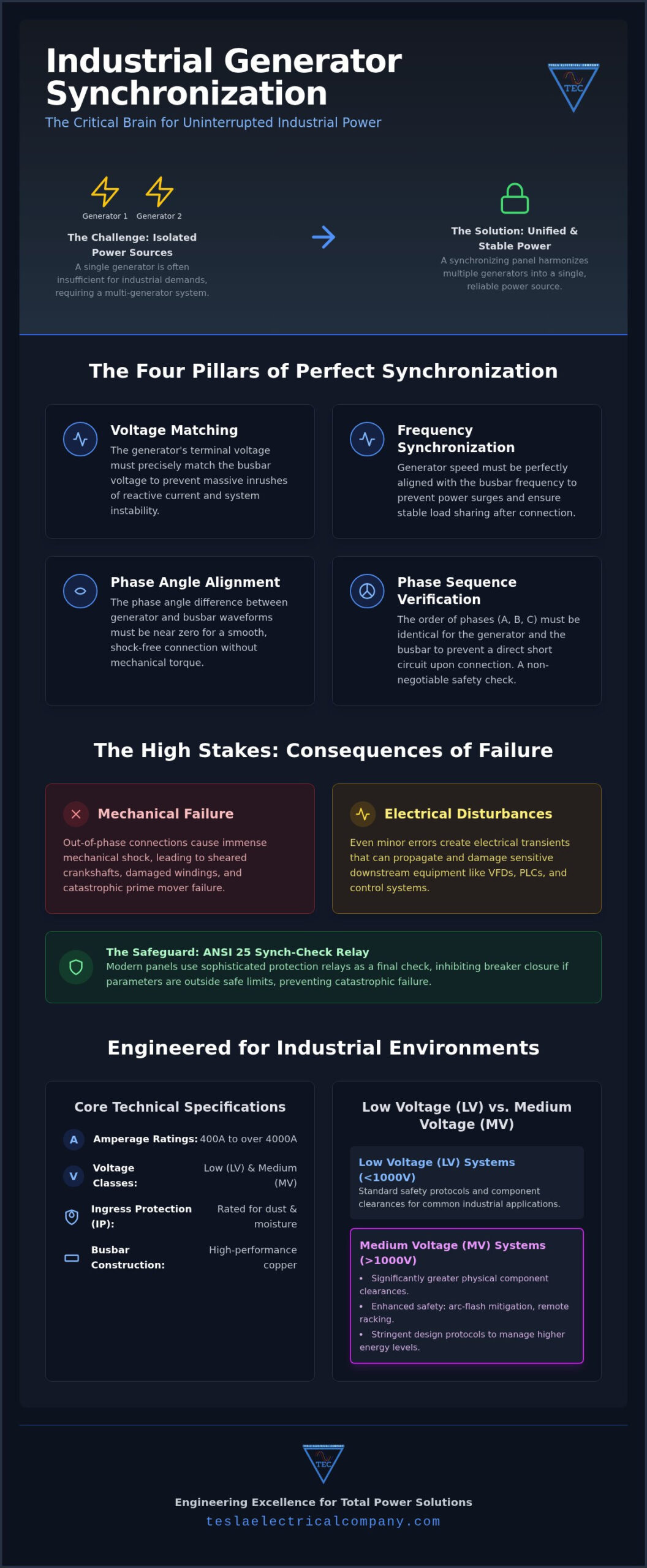
Achieving a seamless parallel connection requires the precise alignment of four critical electrical parameters. Failure to control any one of these can lead to significant equipment damage and system instability.
- Voltage Matching: The terminal voltage of the incoming generator must precisely match the voltage of the busbar. This ensures the potential difference is near zero before the circuit breaker is closed, preventing a massive inrush of reactive current that could destabilize the system.
- Frequency Synchronization: The frequency of the incoming generator, which is directly related to its rotational speed, must align perfectly with the busbar frequency. This alignment is critical for preventing power surges and ensuring stable load sharing once connected.
- Phase Angle Alignment: For high-current industrial applications, the phase angle difference between the incoming generator’s voltage waveform and the busbar’s waveform must be virtually zero. This precision ensures a smooth, shock-free connection without inducing severe mechanical torque on the generator’s shaft.
- Phase Sequence Verification: The order in which the three phases (A, B, C) reach their peak voltage must be identical for the generator and the busbar. This is a non-negotiable safety check, especially for new installations and retrofits, as an incorrect sequence would create a direct short circuit upon connection.
Consequences of Synchronization Failure
Attempting to parallel a generator without meeting the four pillars of synchronization can have immediate and devastating consequences. The immense forces involved in industrial power systems leave no room for error.
- Mechanical Failure: The most severe outcome of an out-of-phase connection is the immense mechanical shock delivered to the generator. This can result in a sheared crankshaft, damaged windings, and catastrophic failure of the prime mover, leading to extensive downtime and costly repairs.
- Electrical Disturbances: Even minor synchronization errors can create significant electrical transients. These disturbances propagate through the facility’s electrical network, potentially damaging sensitive downstream equipment like VFD control panels, PLCs, and other microprocessor-based systems.
- The Role of Protection Relays: Modern synchronizing panels are equipped with sophisticated protection relays (like the ANSI 25 Synch-Check relay) that act as a final safeguard. These devices inhibit the breaker from closing if the parameters are outside of pre-defined limits, mitigating the risk of human error or control system malfunction during “dark start” or automatic sequencing.
Critical Parameters and Technical Specifications
An industrial generator synchronizing control panel is more than just its control logic; its physical construction and electrical components must be engineered to withstand the demanding conditions of industrial environments. From amperage ratings to busbar construction, every specification is chosen to ensure safety, reliability, and longevity.
Standard amperage ratings for these panels typically range from 400A to over 4000A, with voltage classes for both Low Voltage (LV) and Medium Voltage (MV) systems. The mechanical construction is equally critical, with IP ratings (Ingress Protection) specified to protect sensitive internal components from dust, moisture, and chemical exposure common in manufacturing plants or outdoor installations. The enclosure’s durability and structural integrity are paramount for ensuring long-term operational safety. Inside, high-performance copper busbar systems are engineered not just for continuous current but also to handle the immense electromechanical forces generated during a short-circuit fault. Furthermore, modern panels increasingly integrate advanced power quality meters and disturbance recording systems, providing engineers with the data needed to diagnose system anomalies and maintain optimal performance.
LV vs. MV Synchronizing Panels
While the principles of synchronization remain the same, the design and safety protocols for Medium Voltage (MV) systems (typically above 1000V) are significantly more stringent than for Low Voltage (LV) systems.
- Design and Safety: MV switchgear requires greater physical separation (clearances) between energized components to prevent arcing. Safety protocols are enhanced with features like remote racking of breakers, arc-flash mitigation systems, and key interlocks to prevent unsafe operations.
- Circuit Breaker Technology: MV synchronization almost exclusively utilizes vacuum circuit breakers (VCBs) or, in some cases, SF6 breakers. These are chosen for their superior arc-quenching capabilities and durability when interrupting high-energy faults.
- Insulation and Clearances: The insulation levels and air clearance distances within MV panels are mandated by standards like IEEE and IEC to withstand the higher voltage potentials, ensuring the safety of personnel and the reliability of the infrastructure.
Metering and Monitoring Hardware
The ability to accurately see and interpret system parameters is fundamental to synchronization. The hardware used for this task has evolved significantly, moving from basic analog dials to sophisticated digital devices that provide comprehensive system insight.
- Evolution of Measurement: The classic analog synchroscope and voltmeters have been largely replaced by digital multi-function meters. These devices provide precise, real-time data on dozens of parameters on a single screen, simplifying the operator’s task and enabling data logging for analysis.
- Power Monitoring: Effective load management requires constant monitoring of both active power (kW), which relates to the real work being done, and reactive power (kVAR), which is associated with magnetic fields in motors and transformers. Modern panels display both, allowing for precise control and power factor correction.
- Measurement Accuracy: High-precision Current Transformers (CTs) and Potential Transformers (PTs) are essential for stepping down high currents and voltages to safe levels that can be read by meters and relays, ensuring all control decisions are based on accurate, real-world data.
Automation and Control Strategies: Woodward, ComAp, and SCADA
Modern industrial power systems demand a level of sophistication far beyond simple Automatic Mains Failure (AMF) logic. The core of a contemporary synchronizing panel lies in its advanced controller, which manages complex multi-generator load sharing, redundant operations, and seamless integration with facility-wide control systems. Programmable Logic Controllers (PLCs) are often used to execute custom sequences of operation, ensuring that the power system responds intelligently to the facility’s specific needs. This transition to automated, redundant control systems eliminates single points of failure, a critical requirement for mission-critical facilities like data centers and hospitals. Furthermore, integrating the synchronizing panel into a Supervisory Control and Data Acquisition (SCADA) system provides operators with a centralized dashboard for monitoring, control, and historical trend analysis of the entire power infrastructure.
Comparing Industry-Leading Controllers
The choice of generator controller is a critical design decision that dictates the panel’s capabilities. While many options exist, a few brands have become industry standards for their reliability and advanced feature sets.
- Woodward EasyGen Series: Renowned for its robust reliability and powerful load-sharing features, Woodward controllers are a frequent choice for critical power applications where stability and precise load management are paramount.
- ComAp InteliGen: ComAp controllers are known for their exceptional flexibility and are often specified for complex applications such as microgrids, hybrid power systems (e.g., generator and solar), and sites with intricate load shedding requirements.
- Deep Sea Electronics (DSE): DSE offers a range of controllers that are highly regarded for their user-friendly interfaces and straightforward configuration, making them a strong choice for medium-complexity sites that require reliable automation without extensive custom programming.
Load Sharing and Shedding Logic
Once generators are synchronized, the control system must intelligently manage how they share the load. This ensures no single generator is overworked, optimizes fuel consumption, and maintains system stability.
- Isochronous vs. Droop Load Sharing: Isochronous mode maintains a precise, constant frequency, with one generator acting as the leader and others as followers. Droop mode allows frequency to slightly “droop” as load increases, enabling all generators to share the load proportionally without requiring inter-unit communication. The choice depends on whether the system is islanded or connected to a grid.
- Automatic Load Shedding: In the event of a generator failure, the total load may exceed the capacity of the remaining online units. A well-programmed load shedding scheme will automatically disconnect non-essential loads in a prioritized sequence to prevent a total system collapse.
- Intelligent Generator Sequencing: To optimize fuel consumption and equalize engine run hours, advanced controllers can automatically start and stop generators based on the total facility load. This ensures the system runs with the most efficient combination of generators at any given time.
Modernization and Retrofitting Legacy Synchronization Systems
Many industrial facilities operate with synchronization systems that are decades old. While functional, these legacy panels often rely on obsolete electromechanical relays and circuit breakers for which spare parts are scarce. The business case for retrofitting is compelling: it extends the life of the core switchgear asset while dramatically improving the system’s reliability, safety, and functionality. A strategic retrofit allows a facility to integrate modern digital protection, advanced automation, and communication capabilities without the massive capital expenditure and extended downtime associated with a full switchgear replacement. The process involves a systematic, capability-led approach, replacing critical components like protection relays and circuit breakers while minimizing disruption to ongoing operations.
The Retrofit Process: A Methodical Approach
A successful retrofit is not a simple component swap; it is an engineered process that requires meticulous planning and execution to ensure a seamless transition.
- Initial Site Audit: The process begins with a thorough on-site evaluation of the existing system. This includes power quality and disturbance recording to identify underlying issues, verifying schematic drawings, and assessing the mechanical condition of the switchboard.
- Custom Engineering and Design: Based on the audit, engineers design a solution that integrates new components into the existing structure. This often involves manufacturing custom adapter kits for new circuit breakers or creating bespoke wiring harnesses for digital relays to ensure a perfect fit.
- On-Site Installation and Commissioning: The final stage involves the physical installation of the new hardware, followed by rigorous commissioning protocols. This includes point-to-point wiring verification, functional testing of all new controls, and live system testing to ensure the retrofitted panel performs flawlessly under real-world conditions.
Protection Relay Upgrades
Replacing obsolete electromechanical protection relays with modern microprocessor-based equivalents is one of the highest-impact upgrades available in a retrofit project.
- From Analog to Digital: Microprocessor-based relays (from manufacturers like SEL or Basler) offer far greater precision, speed, and reliability than their mechanical predecessors. They are not susceptible to the mechanical wear and calibration drift that plague older devices.
- Enhanced Diagnostics: Modern relays provide invaluable diagnostic capabilities. They record detailed event logs, capture waveform data during a fault, and allow engineers to analyze precisely what happened, significantly reducing troubleshooting time.
- Compliance with Modern Standards: Upgrading ensures the system complies with the latest safety and communication standards, such as IEC 61850. This protocol enables high-speed, peer-to-peer communication between intelligent devices, creating a more responsive and integrated protection scheme for 2026 and beyond.
Engineering Excellence: Designing the Total Solution with Tesla Electrical Company
Choosing an industrial generator synchronizing control panel is a decision that impacts facility-wide stability and operational continuity. At Tesla Electrical Company, we view synchronization not as a hardware purchase, but as an end-to-end engineering discipline. Our approach is founded on human-centric expertise, where our team of seasoned engineers serves as a steady hand for complex, high-stakes industrial projects. We provide comprehensive oversight, managing projects from the initial design and manufacturing stages through to on-site commissioning and final SCADA integration. This commitment to a total solution ensures that every panel we deliver is not just a product, but a fully integrated, reliable, and future-proof component of your critical power infrastructure. We maintain system longevity through dedicated technical support and a comprehensive inventory of spare parts, solidifying our role as a long-term partner in your success.
Custom Engineering for Unique Infrastructure
Every industrial facility has a unique operational profile and power demand. We specialize in tailoring synchronizing panels to meet these specific needs, ensuring optimal performance and reliability for the most demanding applications.
- Application-Specific Design: We engineer custom solutions for a diverse range of sectors, including mission-critical data centers, hospitals requiring life-support-grade power, and heavy industrial plants with large motor loads.
- Integrated Power System Control: Our expertise extends beyond synchronization to include the seamless integration of VFD control panels and capacitor banks, creating a holistic system that optimizes motor control and maintains a healthy power factor.
- Future-Proof Scalability: We design our systems with the future in mind, incorporating modular designs and scalable architecture that allow your power infrastructure to grow alongside your operational needs.
The Tesla Commitment to Reliability
Our reputation is built on the unwavering reliability of the systems we engineer. We understand the immense trust our clients place in us, and our processes are designed to honor that commitment at every stage.
- Rigorous Quality Assurance: Every LV and MV switchboard and control panel undergoes a meticulous testing and quality assurance protocol in our facility before it is shipped, ensuring it meets our exacting standards for performance and safety.
- Long-Term Partnership: We provide long-term technical support and develop customized maintenance strategies to ensure your system operates at peak performance for its entire service life.
- Consult with our senior engineers on your synchronization project and discover how our expertise can bring stability and confidence to your critical power infrastructure.
Frequently Asked Questions (FAQs)
- What is the primary function of a generator synchronizing control panel?
- Its primary function is to safely and automatically parallel two or more generators, matching their voltage, frequency, and phase angle to a common busbar so they can operate as a single, unified power source without causing electrical or mechanical damage.
- Can you synchronize generators of different sizes or brands?
- Yes. A modern synchronizing panel with a capable controller (like Woodward or ComAp) can synchronize and manage load sharing between generators of different sizes, fuel types, and brands, provided they are electrically compatible and properly configured in the control system.
- How does a synchronizing panel improve industrial fuel efficiency?
- By using intelligent generator sequencing, the panel can monitor the total facility load and only run the most efficient combination of generators required to meet that load. This prevents multiple generators from running at low, inefficient load levels, significantly reducing overall fuel consumption.
- What are the risks of manual synchronization in a high-voltage environment?
- Manual synchronization relies entirely on operator skill and carries a high risk of human error. A mistake in judging the synchroscope or closing the breaker at the wrong moment can cause catastrophic equipment failure, arc flash events, and severe safety hazards for personnel.
- Is it better to replace or retrofit an aging synchronization panel?
- If the core switchgear structure is in good condition, retrofitting is often the more cost-effective and less disruptive option. It allows you to gain modern reliability, safety, and communication features by upgrading key components like relays and breakers, without the cost and extended downtime of a full replacement.
- How does SCADA integration benefit generator management?
- SCADA (Supervisory Control and Data Acquisition) integration provides a centralized, facility-wide view of the entire power system. It allows operators to remotely monitor generator status, control operations, view historical trends, and receive alarms, leading to faster response times and more informed decision-making.
- What protection relays are essential for modern industrial synchronizing panels?
- Essential relays include the ANSI 25 (Synch-Check) to prevent out-of-phase closing, ANSI 51 (Overcurrent), ANSI 32 (Reverse Power) to prevent a generator from motoring, and ANSI 81 (Under/Over Frequency). Modern microprocessor-based relays often combine these and many other functions into a single device.
- What is the difference between active and reactive load sharing?
- Active (kW) load sharing refers to how the real power, managed by the engine’s fuel system, is distributed among generators. Reactive (kVAR) load sharing refers to the distribution of reactive power, managed by the generator’s excitation system (AVR). Both must be properly balanced to ensure system stability and prevent circulating currents.
Disclaimer
Some content, images, text, or other materials on this website may have been created or assisted by artificial intelligence (AI).
While we review AI-generated content for accuracy and quality, we do not guarantee that all information is free from errors or omissions.
Content generated using AI is provided for informational purposes only and should not be solely relied upon without independent verification.